
The best time to visit Selong Belanak honestly depends on what kind of trip you’re after. Are you chasing glassy waves at sunrise, or do you just want a quiet stretch of white sand with a cold drink? That distinction matters more than any general travel advice. Selong Belanak, tucked along the southwest coast of Lombok, is one of those beaches that can genuinely surprise you regardless of when you show up, but timing still shapes everything from water clarity to how many people are sharing that sand with you. This guide covers the best time to visit Selong Belanak, honestly, month by month, with real numbers and no vague filler.
I visited for the first time in late June, expecting something nice. What I got was almost empty white sand, perfectly rideable waves in the morning, and a sunset that honestly made me feel a bit emotional. I’ve been back twice since, including once in February during the rainy season. Both trips were good. But they were completely different experiences.
Is There Really a Bad Time to Visit Selong Belanak?
Short answer: not really. The beach is genuinely beautiful year-round. But there are trade-offs depending on the season that are worth knowing before you book flights.
Selong Belanak sits in Lombok’s Kuta area, in the West Nusa Tenggara province of Indonesia. According to Indonesia’s Meteorology, Climatology and Geophysics Agency (BMKG), Lombok follows a monsoon climate with two main seasons: a dry season from approximately May to October and a wet season from November to April. The BMKG’s regional stations consistently record higher rainfall in the Kuta-Selong Belanak corridor between December and February.
But here’s the thing, even the so-called wet season has good windows. You can often get three or four completely clear beach days in a row, even in January. The rain tends to come in short, hard bursts rather than all-day drizzle.
Quick Answer: What Is the Best Time to Visit Selong Belanak?
The best time to visit Selong Belanak is between May and October during Lombok’s dry season. July and August offer the most reliable sunshine, calmest beach conditions, and ideal surf. For fewer crowds and lower prices, aim for May, June, or early October.
The Best Months to Enjoy Selong Belanak at Its Finest
If you’re after the full package, good weather, surfable waves, clear water, and that classic Lombok beach vibe, these are the months to target:
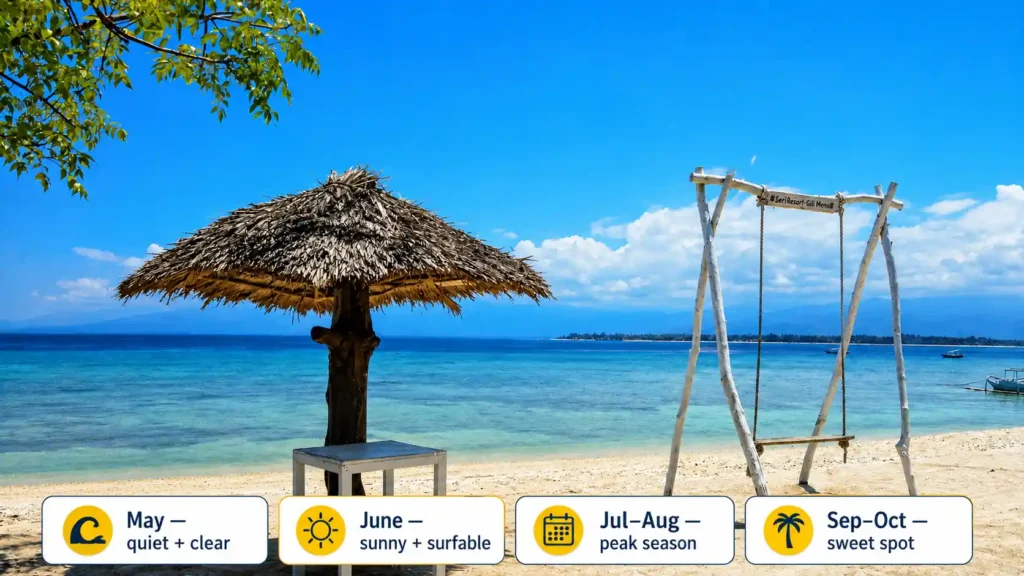
- May: Shoulder season gold. The dry season is kicking in, crowds haven’t peaked, and prices are still reasonable. Water clarity is excellent.
- June: Consistently sunny and dry. Trade winds start picking up, which is great for intermediate surfers.
- July–August: Peak season. Busiest and most expensive, but the conditions are genuinely superb. The beach can get crowded by mid-morning.
- September–October: Arguably the sweet spot. Still dry, trade winds remain, and the tourist crowd thins noticeably after school holidays end in Europe and Australia.
The Lombok Tourism Board officially recognizes July and August as the island’s peak travel months, with visitor numbers roughly 40% higher than shoulder months based on regional tourism data from 2023.
Selong Belanak Month by Month: What to Expect
| Month | Season | Avg Temp (°C) | Rainfall | Crowds | Best For |
| January | Wet | 27–30°C | High | Low | Budget travel |
| February | Wet | 27–30°C | High | Low | Quiet beach days |
| March | Transitional | 28–31°C | Moderate | Low | Deals + sun |
| April | Transitional | 28–32°C | Declining | Moderate | Early dry feel |
| May | Dry | 28–32°C | Low | Moderate | Shoulder sweet spot |
| June | Dry | 27–31°C | Low | Moderate | Surf + sunshine |
| July | Dry | 26–30°C | Very Low | High | Peak conditions |
| August | Dry | 26–30°C | Very Low | Very High | Best overall weather |
| September | Dry | 27–31°C | Low | Moderate | Ideal balance |
| October | Dry | 28–32°C | Low–Mod | Moderate | Late dry season |
| November | Transitional | 28–31°C | Increasing | Low | Budget travel |
| December | Wet | 27–29°C | High | Moderate | Festive season |
What Selong Belanak Feels Like During the Dry Season
The dry season between May and October is when Selong Belanak looks exactly like the photos. The sky gets that deep blue that only happens when the air has dried out. The water turns a shade of turquoise that locals call ‘biru jernih’, clear blue. Early mornings are cool enough to walk the beach comfortably, and the surf comes in consistent, clean sets that intermediate surfers specifically travel to Lombok to ride.
Local surf guide Wayan Sujana, who has worked the Selong Belanak break for over a decade, told me that June through September is when conditions are most predictable. ‘The swells come from the south in a consistent direction, and the wind is offshore in the morning,’ he explained. ‘That’s what makes the wave shape so clean.’
The trade winds also dry things out quickly. Even if there’s a brief shower, the beach is sunny again within an hour. And accommodation-wise, the options open up because more surf camps and beachside warungs are operating at full capacity.
Is Selong Belanak Good for Surfing?
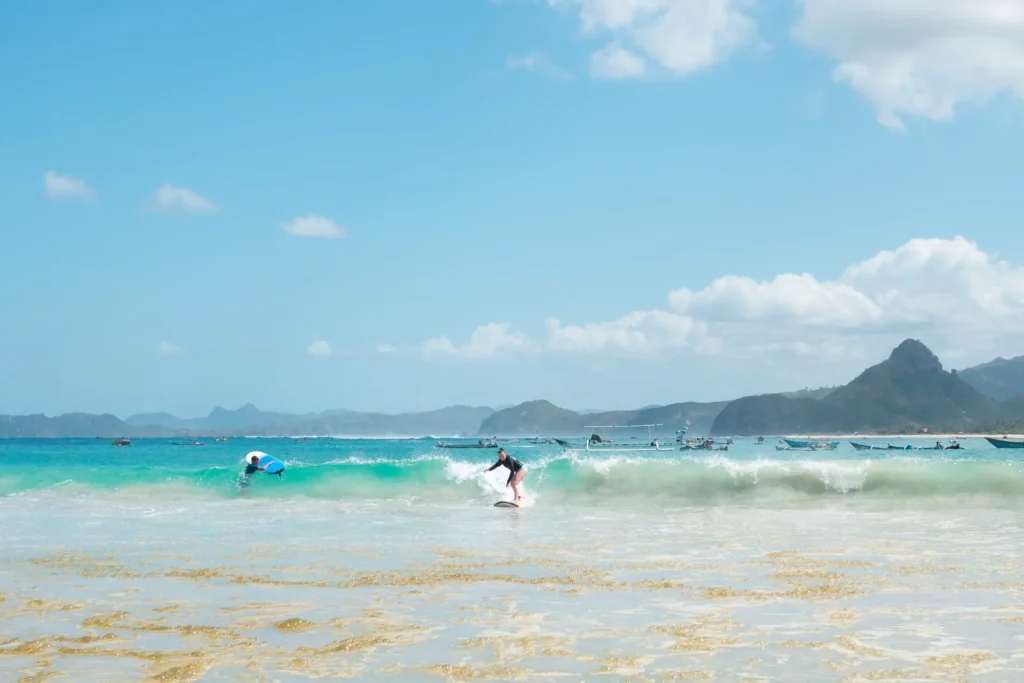
Yes. Selong Belanak is one of the most beginner-to-intermediate-friendly surf breaks in Lombok, with long, rolling waves that are forgiving for learners. The best surf conditions run from June to September when the southern swells are most consistent.
Read more before hitting the waves with our complete Selong Belanak Surfing Guide.
Visiting During the Rainy Season: Better Than You Might Think
Nobody really writes this part honestly, so I will. The wet season, roughly November through March, isn’t a write-off. It’s just different.
The beach is genuinely emptier. On a Thursday in February, I had about a 200-meter stretch almost entirely to myself for most of the morning. The water is warmer, the landscape around Selong Belanak turns green in a visually dramatic way, and the price difference is real. Accommodation that costs 600,000 IDR (around $38 USD) per night in July can drop to 350,000–400,000 IDR in the wet season months.
The main downsides are real, though. Rain can cancel beach days without warning. The surf gets more powerful and less predictable, which is challenging for less experienced swimmers and surfers. Visibility in the water also tends to drop after heavy rain because of runoff stirring up the sand.
The Indonesian Ministry of Tourism’s 2023 regional visitor data shows that Lombok’s southwest coast sees roughly 60% fewer international visitors in January compared to August. That means a proportionally quieter Selong Belanak.
Is It Worth Visiting Selong Belanak in the Rainy Season?
Yes, if you prioritize solitude and budget over guaranteed sunshine. The wet season (November–March) brings heavy rain bursts but also near-empty beaches, lush scenery, lower prices, and warmer water temperatures. Pack a light rain jacket and go with flexible plans.
If You Want Sunny Beach Days, Aim for These Months
For the best chance of all-day sunshine with minimum rain interruptions, July, August, and September are the clear leaders. The BMKG weather station data for West Nusa Tenggara consistently shows fewer than 5 rain days per month across those three months in Lombok’s southwest coastal zone.
September is personally my favorite. The crowds from the European and Australian school holiday peak have gone home, the weather is still brilliant, and the surf is still consistent. Accommodation prices are also starting to soften from their August highs. The beach feels like it’s exhaling after the peak rush.
Average Sunshine Hours and Rain Days at Selong Belanak by Month
| Month | Avg Sunshine Hours/Day | Rain Days/Month | Swim Condition | Surf Condition |
| January | 4–5 hrs | 18–22 days | Moderate | Challenging |
| February | 4–5 hrs | 17–21 days | Moderate | Challenging |
| March | 5–6 hrs | 14–18 days | Good | Moderate |
| April | 6–7 hrs | 10–14 days | Good | Moderate |
| May | 7–8 hrs | 6–9 days | Very Good | Good |
| June | 8–9 hrs | 3–6 days | Excellent | Excellent |
| July | 9–10 hrs | 2–4 days | Excellent | Excellent |
| August | 9–10 hrs | 1–3 days | Excellent | Excellent |
| September | 8–9 hrs | 3–5 days | Excellent | Excellent |
| October | 7–8 hrs | 5–8 days | Very Good | Good |
| November | 5–6 hrs | 10–14 days | Good | Moderate |
| December | 4–5 hrs | 15–20 days | Moderate | Challenging |
When the Waves Are Best for Surfers
Selong Belanak has become one of the more talked-about beginner and intermediate surf spots in Lombok. Unlike the heavy reef breaks further east toward Desert Point, which Surfline and the World Surf League have historically rated as one of Asia’s most challenging left-handers, Selong Belanak offers a much gentler, sandy-bottom wave that’s genuinely forgiving.
The primary swell window runs from May through September when Southern Ocean swells generated below Australia push north and wrap into the bay. Local surf schools, including Selong Belanak Surf Camp, report their busiest student seasons aligning exactly with this window.
For more experienced surfers chasing size, July and August deliver the most consistent overhead swells. For beginners and those learning, May and early June offer smaller but still rideable waves without the intimidating power that mid-season can bring.

When Is the Best Surf Season at Selong Belanak?
The best surf season at Selong Belanak runs from May to September. July and August bring the most powerful and consistent swells. May and June are better for beginners. The wave is a long, rolling right-hander that breaks over sand, making it one of the safest learning breaks in Lombok.
Looking for Fewer Crowds? Here’s When to Go
Peak season at Selong Belanak is roughly mid-July through late August. If you’ve ever had the experience of arriving at a beach you were expecting to be peaceful and finding it packed with day-trippers, you’ll know why this matters.
For the quietest version of Selong Belanak, aim for:
- May (first two weeks especially): pre-peak but already dry
- Early June: schools still in session in Europe and Australia
- October: post-peak but weather still reliable
- November: transitional, sparse crowds, increasingly green
Locals I spoke to near the beach, including a warung owner who has been there since 2015, confirmed that the beach can feel genuinely overwhelming by the third week of July and the first two weeks of August. ‘Some days in August it looks like Kuta beach from the old days,’ she said, laughing, but there was some truth in it.
The Months That Offer the Best Balance of Weather and Prices
The shoulder months, May, June, September, and October, are where the smart money goes. You get conditions close to peak without the price tag or the crowds.
Selong Belanak: Weather, Prices, and Crowd Levels at a Glance
| Period | Weather Quality | Avg Accommodation/Night (IDR) | Beach Crowd Level | Overall Value |
| Jan–Feb | Variable | 300,000–450,000 | Low | Budget focused |
| Mar–Apr | Improving | 350,000–500,000 | Low–Moderate | Good value |
| May–Jun | Excellent | 450,000–650,000 | Moderate | Best balance |
| Jul–Aug | Peak | 700,000–1,200,000+ | High–Very High | Premium experience |
| Sep–Oct | Excellent | 500,000–750,000 | Moderate | Best overall value |
| Nov–Dec | Variable | 350,000–500,000 | Low–Moderate | Budget + quiet |
Accommodation prices above are estimates for mid-range guesthouses and surf camps in the Selong Belanak and Kuta Lombok area, based on 2024–2025 booking platform data. Rates fluctuate with demand, so booking 4–6 weeks ahead during peak season is genuinely recommended.
What the Beach Is Like in Peak Travel Season
Peak season, July through mid-August, brings Selong Belanak its biggest crowds, but it also brings its best conditions. The trade-off is real and worth thinking through before you commit.
During my last peak season visit in late July, the beach was noticeably busier by 10 AM. Surf lessons were running from three or four different schools simultaneously, and the main parking area was full by mid-morning. That said, the beach is long enough that finding personal space was still possible if you walked further along the sand away from the main entry point.
The Indonesian surf and beach tourism authority, under the Lombok Tourism Agency’s regional office in Praya, has published data indicating that the Kuta-Selong Belanak corridor receives approximately 85,000 to 100,000 visitors during the peak July-August window annually. This figure has grown roughly 15% year-on-year since 2019 (pre-pandemic baseline).
Visiting Lombok for the first time? Read more: Lombok Travel Tips I Wish I Knew Before Visiting the Island.
How Crowded Does Selong Belanak Get?
Crowds at Selong Belanak
Selong Belanak sees its highest visitor numbers in July and August. The beach can feel busy by mid-morning during peak season, especially near the main entry point. Walking further along the 1.5 km stretch of sand gives you noticeably more space. Outside July–August, the beach is usually calm and far less crowded.
A Few Things First-Time Visitors Often Don’t Expect
Even people who have done thorough research are sometimes caught off guard by a few things at Selong Belanak. Having visited with people experiencing it for the first time, I’ve noticed these surprises come up consistently:
- The beach is bigger than the photos suggest. It stretches roughly 1.5 kilometers end to end, and the further you walk from the parking area, the more space you have.
- There’s limited shade on the main stretch. Umbrella rentals are available at the main entry point, but if you’re heading further along the beach, bring your own shade solution.
- The road to get there is rough in sections. The main Kuta-Selong Belanak road has improved significantly since 2020, but the final 2–3 km still has some potholes. Scooters handle it better than sedans.
- Water and food options on the beach are limited. There are warungs selling drinks and simple food, but don’t rely on them being fully stocked. Bringing your own water is always a good idea.
- The water is clearest in the morning. Afternoon winds stir up the sand, which reduces visibility for snorkeling or swimming.
What Should I Pack for Selong Belanak?
What to Pack for Selong Belanak
Essentials: sunscreen SPF 50+, at least 2L of water per person, cash in IDR (limited card payment options), reef-safe sunscreen (recommended by local environmental groups), a sarong or beach mat, and a light jacket for wind on cooler dry-season mornings. Surfboards can be rented at the beach.
What to Pack Depending on When You Visit
| Season | Essential Extras | Nice to Have | Leave Behind |
| Dry Season (May–Oct) | SPF 50+, sunhat, lip balm | Wetsuit rash vest, umbrella | Heavy rain jacket |
| Wet Season (Nov–Apr) | Light rain poncho, dry bag | Waterproof phone case, quick-dry towel | White clothes (red mud on trails) |
| Peak Season (Jul–Aug) | Book accommodation early, earplugs | Early alarm (arrive by 7 AM) | Expectations of solitude |
| Shoulder Season | Flexible itinerary | Mosquito repellent at dusk | Rigid schedule |
How Long Should You Stay in Selong Belanak?
Most visitors visit Selong Belanak as a day trip from Kuta Lombok, which is roughly 10 to 15 minutes away. That works well and gives you a full beach day. But staying one or two nights right in the Selong Belanak area changes the experience completely.
Staying overnight means you can hit the beach at 6:30 or 7 AM before any day-trippers arrive. That early morning window, empty sand, soft light, offshore breeze, is genuinely the best version of this beach. Some of the small surf camps and guesthouses directly at or near the beach offer very reasonable rates, especially outside of peak season.
If you’re basing yourself in Kuta Lombok and doing Selong Belanak as a day trip, two full beach days there back-to-back is not too much. The beach doesn’t get old quickly.
Quick Answer: How Long Should I Spend at Selong Belanak?
A minimum of one full day is recommended for Selong Belanak. Arrive by 7–8 AM to enjoy the empty beach and the best morning surf. Staying one night nearby transforms the experience and gives you access to the early morning hours that most day-trippers miss entirely.
My Favorite Time of Year to Visit Selong Belanak
September, without question. The dry season is still fully in effect, the crowd peak from July and August has passed, and there’s something about the light in September, golden, less harsh than mid-summer, that makes everything look stunning. Prices are reasonable, the surf is still good, and the beach feels like it’s been returned to the people who appreciate it quietly.
If September isn’t possible for you, early June runs a close second. The beach is dry, the water is clear, and the shoulder crowd levels mean you can actually find a patch of sand that feels like yours.
Choosing the Right Time for Your Trip to Selong Belanak
There is no universally wrong time to visit Selong Belanak. Every month offers something real. But understanding what each season delivers, and what it doesn’t, is what separates a good trip from a great one. The best time to visit Selong Belanak for most travelers is between May and October, with May, June, September, and October offering the ideal blend of reliable weather, reasonable prices, and manageable crowd levels.
For surfers, July and August are worth the premium. Budget travelers can save significantly by visiting between November and February, when occasional rain showers are balanced by lower prices and fewer crowds. The shoulder months offer the best mix of pleasant weather, reasonable costs, and a relaxed atmosphere.
Plan around what actually matters to you, whether that’s empty sand, good surf, clear water, or a tight budget, and the best time to visit Selong Belanak becomes obvious. The beach is extraordinary enough to reward any timing. But with a bit of thought, it can be genuinely unforgettable.
Frequently Asked Questions
Q1: What is the best month to visit Selong Belanak?
July and August offer peak conditions with the most sunshine and consistent surf. However, May, June, September, and October provide nearly as good weather with fewer crowds and lower accommodation prices.
Q2: Is Selong Belanak worth visiting in the rainy season?
Yes, if you value solitude and lower costs. The wet season (November–March) brings rain showers, but the beach is much emptier, prices are 30–50% lower, and clear mornings still happen frequently. Pack a rain jacket and keep your plans flexible.
Q3: How do I get to Selong Belanak from Bali?
The most common route is a short flight from Bali’s Ngurah Rai International Airport to Lombok International Airport (Zainuddin Abdul Madjid International Airport), then a 45–60 minute drive south to the Kuta-Selong Belanak area. Fast boat services also run between Padangbai (Bali) and Lembar (Lombok), though the journey takes 4–5 hours.
Q4: Is Selong Belanak good for beginner surfers?
Yes. Selong Belanak is consistently recommended by surf schools as one of the best beginner-friendly breaks in Lombok. The wave breaks over sand (not reef), is relatively long and rolling, and is much more forgiving than nearby heavier breaks. Multiple surf schools operate on the beach, particularly during the dry season.
Q5: How crowded is Selong Belanak compared to other Lombok beaches?
Selong Belanak is noticeably busier than it was five years ago, but still significantly quieter than Bali’s main beaches. In peak season, the area near the main entry can feel crowded by late morning. Walking 300–500 meters along the beach in either direction usually provides much more personal space.
Q6: What are the accommodation options near Selong Belanak?
Options range from simple surf camps and family-run guesthouses (starting around 250,000–400,000 IDR per night) to mid-range bungalows and boutique stays. The nearby town of Kuta Lombok, roughly 10–15 minutes away, offers broader choices. Booking in advance is important for July and August.
Q7: Is the water safe for swimming at Selong Belanak?
Generally, yes, during the dry season, particularly in the morning before afternoon winds and swells increase. The bay shape helps keep the water relatively calm in sections. Swimming during the wet season requires more caution due to stronger currents and less predictable surf. There are no permanent lifeguards stationed at the beach.