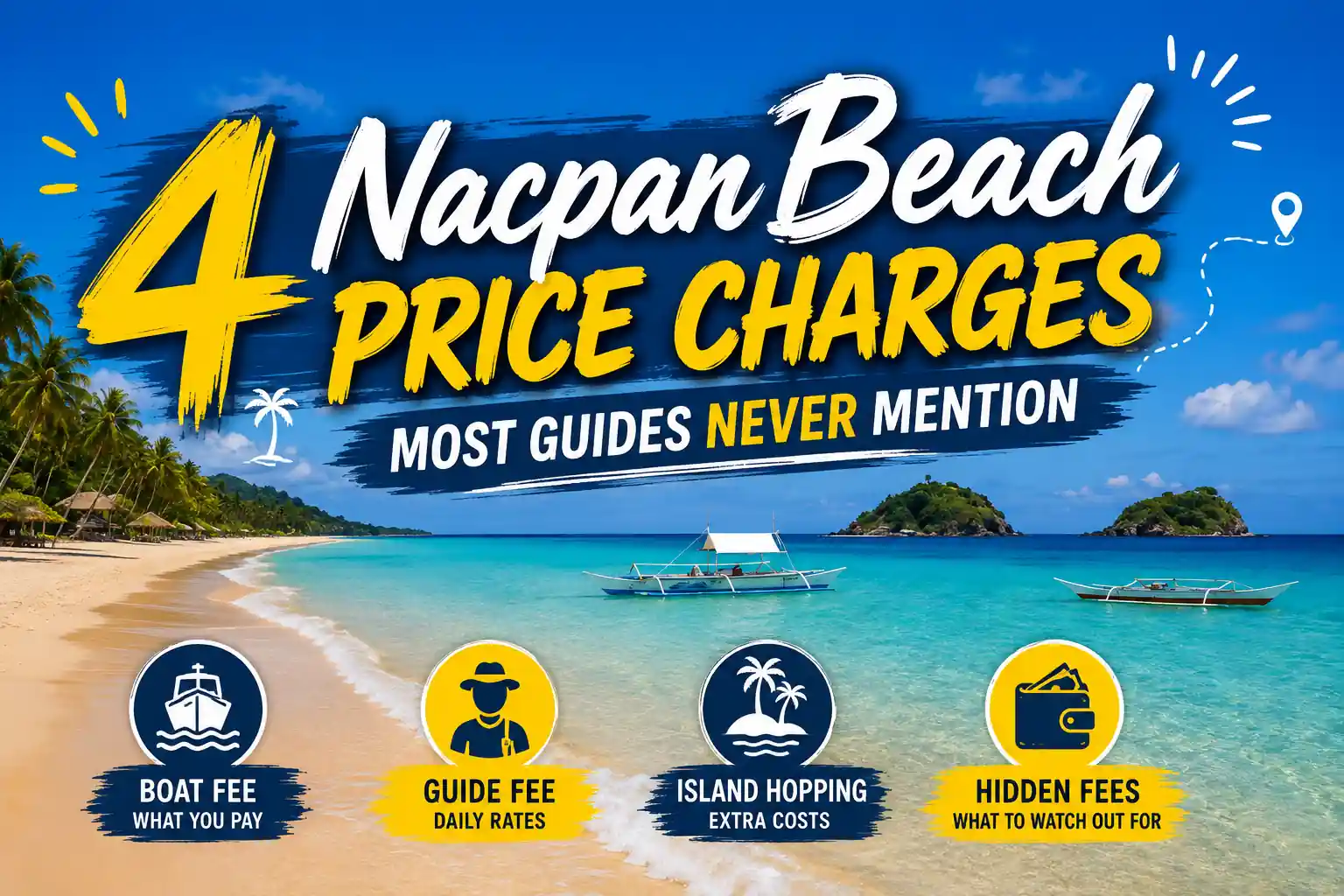

The Nacpan Beach entrance fee and rules are simpler than most tricycle drivers make them out to be. Walking onto the sand itself is free, with no ticket booth or gate at Nacpan Beach. What you actually pay is scooter or van parking, usually around 20 pesos, and the ETDF eco fee of about 200 pesos ($3.50), valid for ten days across El Nido’s covered beaches.
The rules are basic common sense: no littering, no loud music late at night, and no taking shells or coral home. Knowing the real Nacpan Beach entrance fee and rules means you pay only what locals pay, nothing more.
Current Nacpan Beach Entrance Fee for Tourists
Let’s clear up the confusion right away. Multiple 2026 visitor guides confirm that Nacpan Beach has no standalone entrance fee. Unlike some of El Nido’s boat-access lagoons, Nacpan sits on open coastline reachable by road, so there’s no gate, ticket window, or barangay checkpoint charging a per-head fee just to walk onto the sand.
That doesn’t mean the trip is entirely free, though. Every visitor to El Nido, including Nacpan Beach travelers, must pay the Eco-Tourism Development Fee (ETDF). The ETDF is a municipality-wide tourism fee, not a beach entrance fee. It applies whether you’re island-hopping or relaxing at Nacpan Beach.Nacpan Beach itself has no separate entrance fee, according to 2026 visitor guides.
Under Municipal Ordinance No. 01, Series of 2024, the standard ETDF rate sits at ₱400, or roughly $6.90 USD, and it covers ten consecutive days of access to tourism sites across El Nido, not just a single beach visit, so one payment stretches across your whole stay.
Nacpan Beach Entrance Fee and Rules
Nacpan Beach itself is free to enter. The only mandatory charge is El Nido’s ₱400 (about $6.90) Eco-Tourism Development Fee, plus a small parking fee of roughly ₱20–₱50 depending on your vehicle.
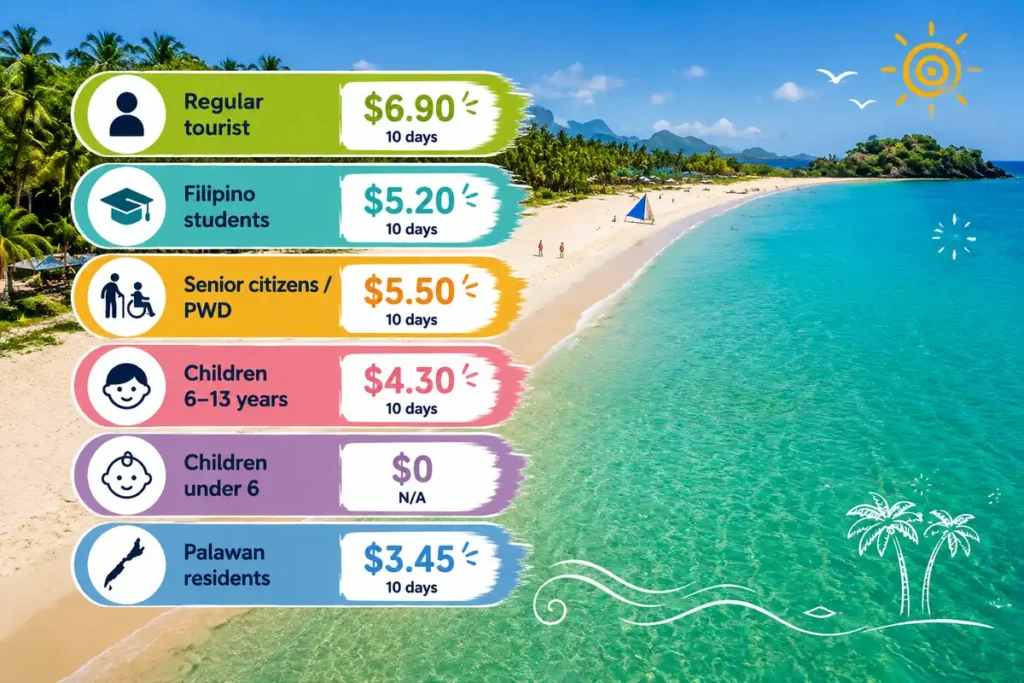
The table below breaks down exactly who pays what under the current ETDF structure, since rates differ depending on age, residency, and visitor category.
| Visitor Category | ETDF Fee (USD approx.) | Valid For |
| Regular tourist | ~$6.90 | 10 days |
| Filipino students | ~$5.20 | 10 days |
| Senior citizens / PWD | ~$5.50 | 10 days |
| Children 6–13 years | ~$4.30 | 10 days |
| Children under 6 | $0 | N/A |
| Palawan residents | ~$3.45 | 10 days |
What Is Included in the Entrance Fee?
The $6.90 ETDF isn’t a toll for Nacpan alone; it’s a ten-day municipality-wide pass, valid even if you visit Bacuit lagoons or Cadlao Island on the same trip. Managed by an ETDF Task Force of government, barangay, and tourism reps, the fee funds beach cleanups, coral protection, mooring buoys, restrooms, and information booths, including the waste bins along Nacpan’s shoreline.
It does not cover food, chair rentals, motorbike parking, or guided tours; those are paid separately. Keep your receipt, as some accommodations may ask for it during longer stays.
Do Children Pay the Nacpan Beach Entrance Fee?
Traveling with kids changes the math slightly, and it’s one of the most common questions parents ask before visiting. As shown in the table above, children under six years old are completely exempt from the ETDF, so families with toddlers pay nothing extra.
Kids between six and thirteen fall into a discounted bracket, paying ₱250, around $4.30, instead of the full adult rate. There is no separate youth pricing tied specifically to a beach-only charge, since Nacpan itself has no ticket booth; the discount applies purely to the municipal ETDF.
Teenagers fourteen and older are typically charged the full adult rate unless they show a valid student ID, in which case the ₱300 student rate may apply. It’s worth carrying ID for children, since staff sometimes ask for proof of age during peak season.
Nacpan Beach Parking Fees
Parking is really the closest thing Nacpan has to an actual entrance charge, and it depends entirely on how you arrive. If you rent a motorbike, the most popular way to reach Nacpan from El Nido town, expect to pay around ₱20 to ₱50 for parking, collected on-site by a local attendant rather than a formal ticket booth.
Cars and vans, including private tour vehicles, typically pay a higher rate, though pricing can shift with the season and crowd levels. Tricycles usually drop passengers off and skip the fee altogether, since they don’t linger.
There’s no posted official price list, so rates feel a little informal, and it’s smart to keep small peso bills on hand. Bargaining isn’t really necessary, since the fees are modest, but confirming the price before you park avoids misunderstandings. Unlike the ETDF, this money goes to the local community managing the beach area rather than to the municipal government.
Here’s a quick look at what different vehicles typically pay to park near Nacpan Beach, based on the latest visitor reports.
| Vehicle Type | Typical Parking Fee |
| Motorbike/scooter | $0.35–$0.90 |
| Tricycle (drop-off only) | $0 |
| Car / SUV | $0.90–$1.75 |
| Van/tour vehicle | $1.75–$2.60 |
Nacpan Beach Opening Hours
Nacpan Beach doesn’t operate on fixed opening or closing hours the way a paid attraction would, since it’s a public shoreline rather than a gated park. That said, there’s a practical rhythm to when you should actually go.
Most visitors arrive between 7 AM and 10 AM, when the water is calm, the light is soft for photos, and the day-tour crowds haven’t rolled in yet. By midday, tour vans and shared shuttles fill the parking area, and the beach feels noticeably busier near the food stalls.
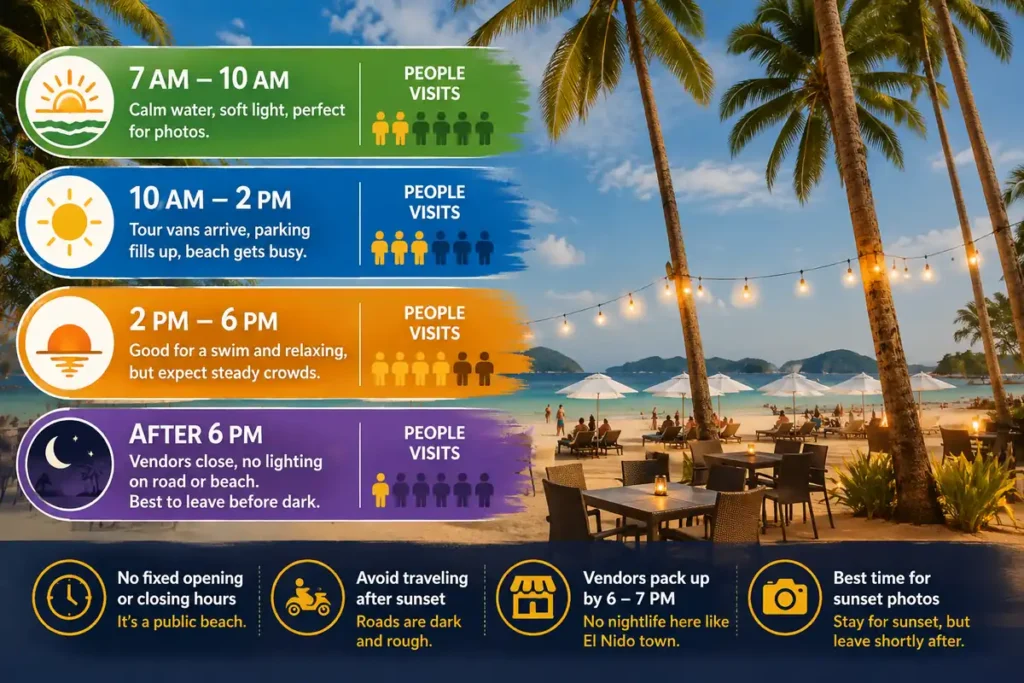
There’s no lighting along the road or the beach itself, so arriving or leaving after sunset is genuinely risky, especially on a motorbike navigating the rougher unpaved stretches. Local vendors close up by early evening, around 6 or 7 PM, since there isn’t much of a nightlife scene here compared to El Nido town. If you’re chasing sunset photos, plan to leave shortly after, rather than lingering on dark, rough roads.
What Time Should You Visit Nacpan Beach?
Nacpan Beach has no official opening or closing time, but the best window is 7 AM–10 AM for calm water and fewer crowds. Plan to leave before sunset, since the road back has no streetlights.
Rules Every Visitor Should Follow at Nacpan Beach
Because Nacpan sits inside a protected coastal zone, a handful of practical rules apply, even though there’s no formal checkpoint enforcing them right at the entrance. Most come down to common sense and respect for a fragile environment rather than strict legal penalties, but ignoring them can still get you fined or asked to leave. The Department of Environment and Natural Resources (DENR) oversees the wider protected area that Nacpan and Calitang fall within, which is part of why these guidelines matter so much here.
Swimming Safety Rules at Nacpan Beach
Nacpan has no lifeguards on duty, which surprises many first-time visitors given how popular the beach has become. Morning swims, roughly between 7 and 11 AM, tend to be safest since the water stays glassy calm before onshore winds pick up.
Currents can get stronger near the headlands at either end of the beach, so it’s best to stay closer to the central stretch if you’re not a confident swimmer. Children should always be supervised directly, not just watched from a beach chair. If conditions look rough, it’s genuinely fine to skip swimming and just enjoy the sand instead.
Beach Cleanliness and Environmental Guidelines
Nacpan stays beautiful because visitors keep it that way. Littering can lead to fines under local barangay rules, and taking sand, shells, or coral is discouraged since it harms the coastal ecosystem. Bring a reusable water bottle to cut down on plastic waste. Local hostels also run beach cleanups, so doing your part, or simply not adding to the mess, helps keep Nacpan looking pristine.
Can You Bring Food and Drinks to Nacpan Beach?
Yes, you’re free to bring your own food and drinks, and many visitors pack a picnic since the beach stretches so far. Local stalls also sell grilled seafood and simple rice meals along the shore. Alcohol is fine in moderate amounts, but keep it low-key since Nacpan attracts a relaxed, family crowd. Skip glass bottles on the sand, and pack out your trash if bins aren’t around.
Drone Rules at Nacpan Beach
Drone photography is popular at Nacpan given its wide, photogenic coastline, and it’s generally allowed for personal, non-commercial use. That said, Philippine airspace regulations under the Civil Aviation Authority of the Philippines (CAAP) require operators to keep flights at a reasonable altitude and avoid flying directly over crowds.
Commercial drone use, such as filming for paid content, may require separate permits from local authorities, so it’s worth checking with the municipal tourism office if that applies to you. Respecting other visitors’ privacy matters too, since not everyone wants to end up in someone else’s aerial footage.
Tips Before Paying the Nacpan Beach Entrance Fee
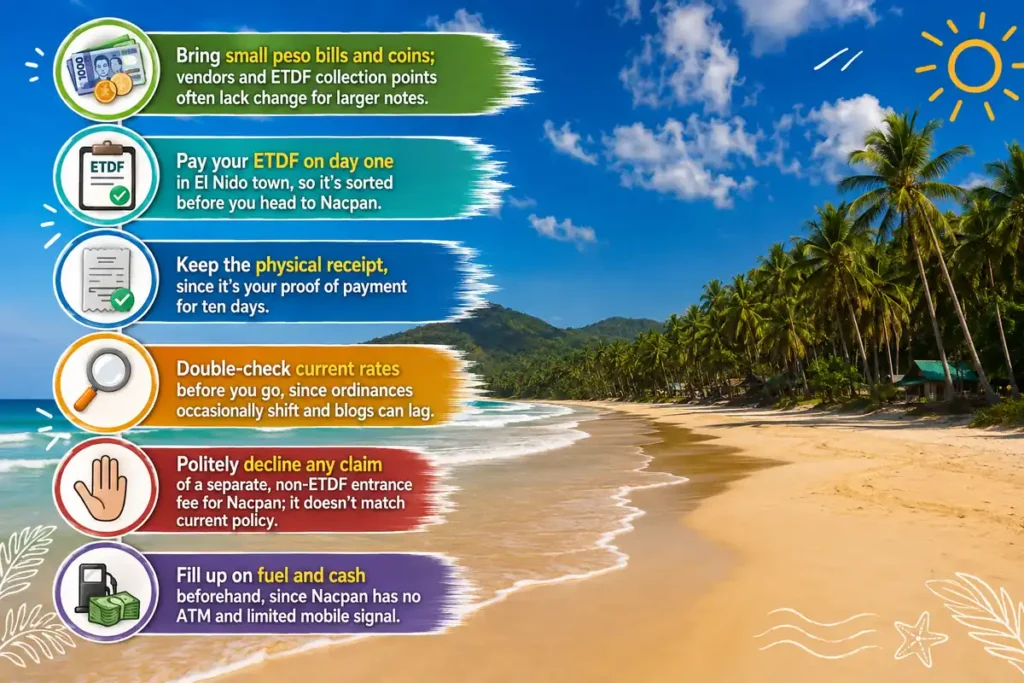
A little preparation makes the trip smoother, especially since Nacpan still runs on a fairly informal, cash-based system. Understanding the Nacpan Beach entrance fee and rules ahead of time really does save money and hassle once you’re standing at the parking lot with a driver waiting.
- Bring small peso bills and coins; vendors and ETDF collection points often lack change for larger notes.
- Pay your ETDF on day one in El Nido town, so it’s sorted before you head to Nacpan.
- Keep the physical receipt, since it’s your proof of payment for ten days.
- Double-check current rates before you go, since ordinances occasionally shift and blogs can lag.
- Politely decline any claim of a separate, non-ETDF entrance fee for Nacpan; it doesn’t match current policy.
- Fill up on fuel and cash beforehand, since Nacpan has no ATM and limited mobile signal.
Is Nacpan Beach Worth Visiting in 2026?
Yes. With no dedicated entrance fee, a modest $6.90 municipal ETDF, and four kilometers of uncrowded coastline, Nacpan Beach offers strong value compared to El Nido’s paid boat tours.
Find Out Why Nacpan Beach Is More Than Just a Pretty Shoreline. Read more in Nacpan Beach in El Nido That Looks Remote but Feels Worth the Ride.
For a realistic snapshot of what a Nacpan Beach day trip actually costs from El Nido town, the table below adds up the typical expenses.
| Expense | Estimated Cost (PHP) | Estimated Cost (USD) |
| El Nido ETDF (per person) | ₱400 | ~$6.90 |
| Motorbike rental (per day) | ₱500–₱600 | ~$8.60–$10.30 |
| Motorbike parking at Nacpan | ₱20–₱50 | ~$0.35–$0.90 |
| Food and drinks (per person) | ₱150–₱300 | ~$2.60–$5.20 |
| Beach chair/umbrella rental | ₱50–₱100 | ~$0.90–$1.75 |
Is the Nacpan Beach Entrance Fee Worth It?
Given that Nacpan itself charges nothing directly, the real question is whether the overall cost of getting there and paying the ETDF is worth it, and for most travelers, the answer leans strongly toward yes. A four-kilometer stretch of genuinely uncrowded white sand, paired with Calitang next door, is rare in a region as popular as El Nido.
The ETDF is modest at roughly $6.90 and covers ten days across multiple sites, not just one beach, which spreads the cost out if you’re exploring the wider area. Compared to boat-access lagoons that require tour packages costing well over $20 per person, Nacpan remains one of the more budget-friendly major attractions, a reputation echoed by resources such as the Philippine Department of Tourism, which lists El Nido’s northern coastline among the province’s key ecotourism destinations. The main added expense is transport, whether a rented scooter or a shared shuttle, and that has more impact on your budget than any official fee.
FAQs About Nacpan Beach Entrance Fee and Rules
Do I have to pay an entrance fee just for Nacpan Beach?
No, Nacpan Beach doesn’t charge a separate entrance fee. You’ll only pay El Nido’s municipal ETDF, currently ₱400 (about $6.90), plus a small parking fee if you arrive by motorbike or car.
How much is the ETDF and how long does it last?
The standard ETDF rate is ₱400 per tourist, valid for ten consecutive days across most tourism sites in El Nido, including Nacpan Beach.
Can I visit Nacpan Beach for free?
You can walk onto the sand without a beach-specific fee, but the ETDF is still required as a municipal charge for tourists visiting El Nido.
Is there parking available at Nacpan Beach?
Yes, informal parking exists near the beach, typically charging ₱20 to ₱50 for motorbikes and slightly more for cars or vans.
Are drones allowed at Nacpan Beach?
Personal drone use is generally allowed, but flyers should follow CAAP altitude and safety guidelines, and commercial use may need permits.
What’s the best time to visit Nacpan Beach?
Early morning, between 7 AM and 10 AM, offers the calmest water, best light, and fewest crowds before day-tour groups arrive.