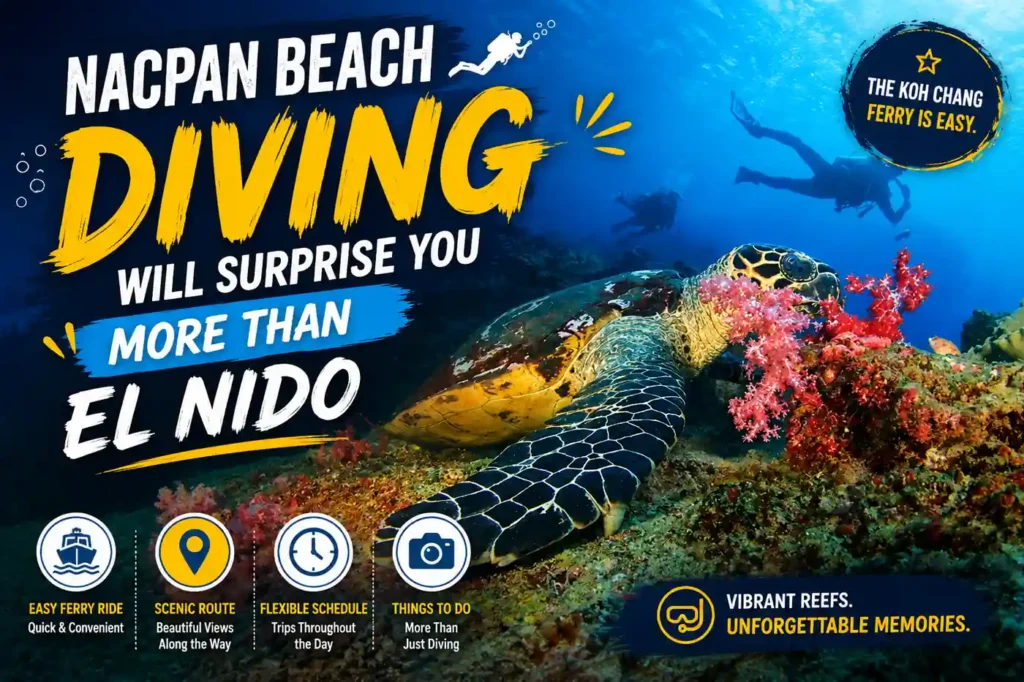
Nacpan Beach diving is not something you do straight off the sand; there is no reef right at the shore, so most operators pick you up and take you by boat or van to real dive sites nearby. This means Nacpan Beach diving actually happens near Bacuit Bay and other spots close to El Nido town, where the coral and marine life are much better. If you stay at Nacpan Beach, expect a short 30 to 45-minute transfer to the water where the diving takes place.
Prices start around $45 for a single tank dive, and most shops include gear, a guide, and transport in that price. So while Nacpan itself is perfect for sunsets, swimming, and relaxing on the sand, the actual diving experience takes place a little further away, in the richer waters around El Nido.
Is Nacpan Beach Good for Diving?
Honestly, no, not directly off the sand. Nacpan’s seabed is mostly flat and sandy, without the coral walls or drop-offs that make for an exciting dive. That said, the beach still works well as a base if you want to combine relaxing days with proper diving trips nearby. Most dive centers are based in El Nido town, roughly 45 minutes south, and they run boat trips into Bacuit Bay and beyond.
So while you won’t strap on a tank right at Nacpan, you can absolutely use it as your quiet home base between dives. Many travelers prefer this setup, since it means fewer crowds and a peaceful stretch of sand to return to. In short, Nacpan gives you the scenery, while nearby operators give you the underwater action.
Discover Whether Nacpan Beach Is Worth Diving. Read more in Nacpan Beach in El Nido That Looks Remote but Feels Worth the Ride.
Diving Spots Near Nacpan Beach
Real diving near Nacpan happens through well-known sites scattered across Bacuit Bay and further north toward Sibaltan. Most operators pick you up from El Nido town rather than Nacpan itself, so plan transport accordingly. Popular spots include Twin Rocks, Dilumacad Island (also called Helicopter Island), and the reefs off Nat Nat Beach on Cadlao Island.
Further out, Sibaltan is known for manta ray sightings, though the ride there takes closer to an hour. Each site has its own personality, ranging from shallow coral gardens for beginners to deeper walls for experienced divers. Below is a quick look at the sites divers commonly visit while staying near Nacpan.
| Dive Site | Travel Time from Nacpan | Depth Range | Known For |
| Twin Rocks, Bacuit Bay | ~60–70 min | 5–18 m | Coral gardens, reef fish |
| Dilumacad (Helicopter) Island | ~60–70 min | 5–25 m | Swim-throughs, macro life |
| Nat Nat Beach, Cadlao Island | ~55–65 min | 5–20 m | Nudibranchs, turtles |
| Sibaltan Manta Point | ~60–90 min | 10–25 m | Manta ray encounters (seasonal) |
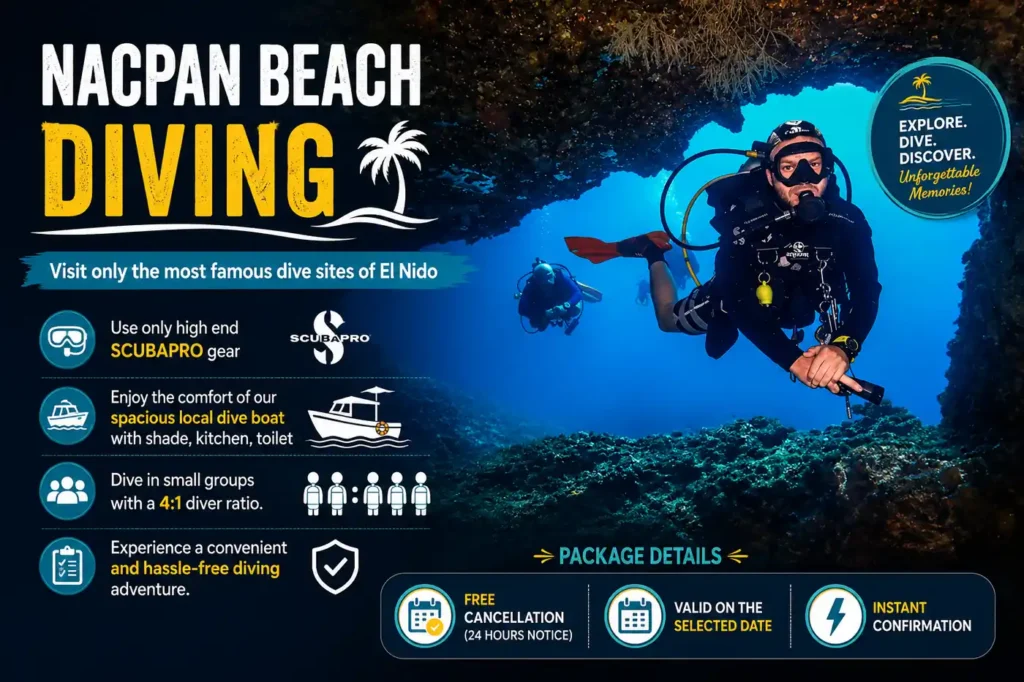
If diving is on your El Nido list, this one looks like a great way to spend the day. Small groups, quality Scubapro gear, and famous dive sites make it easy to enjoy.
What Can You See While Diving at Nacpan Beach?
Real diving happens away from Nacpan’s shore, so what you’ll see depends on the site your boat heads to that day. Expect green sea turtles, clownfish, and schools of barracuda on most trips, plus nudibranchs and seahorses if you’re into macro life. Near Sibaltan, manta rays sometimes glide through during peak season, and a few deeper sites turn up reef sharks or stonefish for the more experienced crowd.
Above the water, Palawan’s limestone cliffs frame the whole scene. That mix of small critters and bigger encounters is exactly why divers keep coming back.
Best Time for Nacpan Beach Diving
Timing makes a real difference for Nacpan Beach diving. Dry season runs November to May, with calmer seas and clearer water. December to February is peak season, so boats fill up fast, and prices climb. March to May often has the best visibility, and it’s a bit cheaper than the holiday rush.
June to October is rainy season, and rough seas cancel a lot of trips. If diving is the main goal, skip July and August, since monsoon winds often shut down sites in southern El Nido. Here’s a quick season-by-season look. The table below gives a quick, season-by-season snapshot.
| Season | Months | Sea Conditions | Best For |
| Dry / Peak | December–February | Calm, clear | Best overall conditions, busiest & priciest |
| Dry / Shoulder | March–May | Calm, excellent visibility | Best value plus visibility combo |
| Transition | November, early June | Mixed | Fewer crowds, generally decent |
| Rainy / Monsoon | June–October | Rough, storms possible | Avoid if diving is the priority (esp. Jul–Aug) |
Nacpan Beach Diving Conditions
Diving conditions around El Nido change with the season and the site. In dry months, you can usually see 10 to 20 meters underwater, but this drops when the rains come. The water stays warm all year, around 27°C to 30°C, so a thin 3mm wetsuit is enough for most people. Currents stay gentle in sheltered bay spots but get much stronger near open points like Sibaltan.
The sea near Nacpan itself is normally calm, though the wider bay can turn choppy if the wind picks up. That’s why dive shops check the water each morning before deciding where to go. Don’t guess the conditions yourself, just ask your operator on the day, since things can shift fast out there.
Nacpan Beach Diving for Beginners
Never dived before? El Nido still has you covered, even if Nacpan itself isn’t the dive spot. Most centers run a Discover Scuba session, no certification needed, just you and an instructor. You’ll start in shallow parts of Bacuit Bay, around 5 to 12 meters deep, which feels a lot less scary than jumping straight into deep water.
Want something official? The PADI Open Water course takes about three to four days in El Nido. Groups stay small, usually two to four people per instructor, so you’re not just a number. Dry season conditions in the bay are calm too, which makes learning easier. Bottom line, basing yourself at Nacpan and driving in for lessons works just fine.
Is Nacpan Beach Diving Good for Beginners?
Yes, while Nacpan Beach itself has no dive sites, beginner-friendly reefs sit within an hour’s drive in Bacuit Bay. Shallow depths, warm water, and small instructor-to-student ratios make it a solid place for a first scuba experience or a full certification.
Nacpan Beach Diving Cost
Diving from Nacpan Beach means budgeting for El Nido too, since that’s where the boats leave from. A single fun dive with gear costs $45 to $58 USD. Want a full day out? Two dives with lunch will run you $82 to $100 USD. New to diving? A Discover Scuba session costs around $65 to $80 USD. Going for certification costs more, with PADI Open Water priced between $327 and $454 USD depending on the shop.
Everyone also pays a small $3.50 USD (₱200) environmental fee, confirmed for 2026 by the El Nido Municipal Tourism Office. It adds up over a few dive days, but it’s worth it for what you get in return.
Here’s a simple breakdown of what to budget for, based on verified 2026 operator pricing.
| Activity | Price (USD) |
| Single fun dive (gear included) | $45–$58 |
| Full-day, 2-dive trip | $82–$100 |
| Discover Scuba Diving (intro) | $65–$80 |
| PADI Open Water certification | $327–$454 |
| El Nido environmental fee (one-time) | $3.50 |
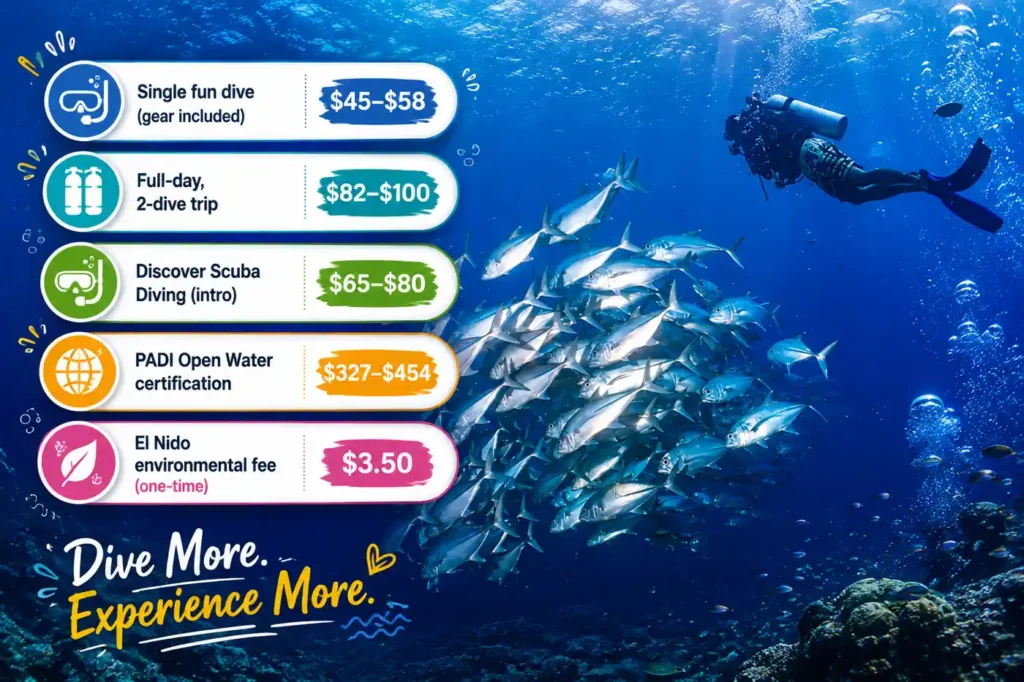
How Much Does Diving Near Nacpan Beach Cost?
A single fun dive near Nacpan Beach costs roughly $45 to $58 USD with gear included, while full PADI Open Water certification runs $327 to $454 USD. Add the mandatory $3.50 USD environmental fee required of every visitor to El Nido’s protected dive sites.
How to Book a Diving Trip at Nacpan Beach
Booking is easy, but keep in mind you’re booking through El Nido town, not Nacpan itself. Most shops take online reservations with a small deposit, the rest paid on arrival. Tabanka Divers, El Dive, and Palawan Divers are solid picks, and they’ll usually help arrange pickup if you’re staying near Nacpan. Just confirm your ride early, since town is about 45 minutes away. Book two to three days ahead, though December to February fills up fast. Bring your certification card and dive logs if you have them, and always check what’s included, since gear, lunch, and transfers vary by operator.
- Reserve online with a deposit, pay the balance on arrival
- Ask about pickup or transfer options from the Nacpan area
- Bring your certification card and recent dive log, if applicable
- Confirm whether gear, lunch, and the environmental fee are included
Nacpan Beach Diving vs Snorkeling
Nacpan’s shallow water is great for snorkeling. Just grab a mask and fins and wade in; no gear rental or boat needed. Diving takes more effort. You’ll need to travel to real reef sites near El Nido or Sibaltan, plus get certified if you want more than a discovery dive.
Snorkeling is nearly free if you bring your own gear, while diving means paying for equipment, boat fees, and an instructor. Want easy, low-effort fish watching? Snorkeling wins. Want deeper reefs and bigger marine life? A Nacpan Beach diving trip is worth it. Many travelers just do both.
| Aspect | Snorkeling at Nacpan | Diving Near Nacpan |
| Location | Right off the beach | Boat trip to Bacuit Bay / Sibaltan |
| Cost | Free to low (gear rental only) | $45–$454 USD depending on activity |
| Skill needed | None | Certification or guided intro dive |
| Marine life | Shallow reef fish | Turtles, mantas, macro life, deeper reef |
| Best for | Casual, relaxed visitors | Adventure seekers, certified divers |
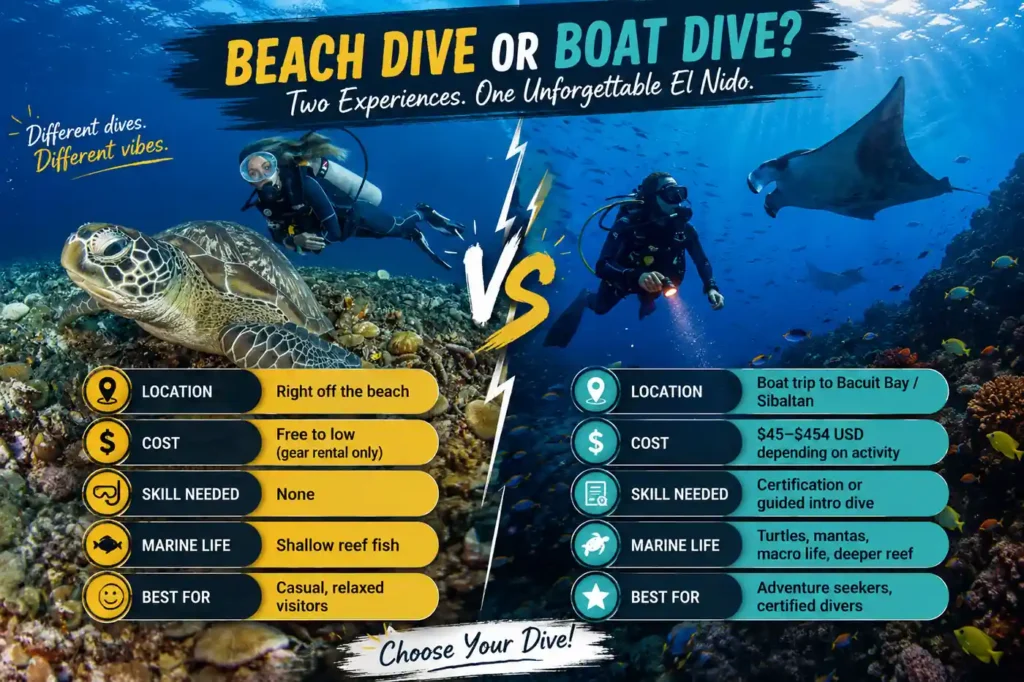
Nacpan Beach Diving vs Snorkeling, Which Should You Choose?
Choose snorkeling if you want a free, easy activity right off Nacpan’s sand with minimal planning. Choose diving if you want deeper reefs, bigger marine life such as manta rays and turtles, and don’t mind the extra boat ride and cost involved.
Nacpan Beach Diving Safety Tips
Pick a dive shop that’s actually certified, PADI, SSI, or NAUI, and don’t be shy about asking to see the instructor’s card. Tell your guide about any health issues, ear trouble, heart conditions, anything, before you get in the water. A good operator always walks you through hand signals and emergency steps first. Get travel insurance that covers diving, since most regular plans won’t. Keep your hands off the coral and the marine life; it protects them and keeps you safe from things like stonefish. And if you’re tired, sick, or had a drink the night before, just skip the dive. It can wait.
- Choose PADI, SSI, or NAUI-affiliated operators only
- Disclose medical conditions honestly before booking
- Confirm safety briefings and emergency procedures are provided
- Get scuba-specific travel insurance before your trip
- Never dive while unwell, exhausted, or after drinking alcohol
Frequently Asked Questions About Nacpan Beach Diving
Is there scuba diving directly at Nacpan Beach?
No, Nacpan Beach has a sandy seabed with no dive sites. Diving happens through operators based in El Nido town, about 45 minutes away.
How much does a diving trip near Nacpan Beach cost in 2026?
A single fun dive costs around $45 to $58 USD, while a full PADI Open Water certification runs $327 to $454 USD, plus a mandatory $3.50 USD fee.
What is the best time of year for diving near Nacpan Beach?
March through May offers the best mix of calm seas and clear visibility, while June through October brings rough conditions that often cancel dive trips.
Can beginners try diving near Nacpan Beach?
Yes, Discover Scuba Diving sessions suit complete beginners, using shallow sites between 5 and 12 meters with a private instructor.
Is snorkeling better than diving at Nacpan Beach?
It depends on your goals; snorkeling off Nacpan’s shore is free and easy, while diving trips offer deeper reefs and bigger marine life like manta rays.
Do I need a certification to dive near El Nido and Nacpan Beach?
You need PADI, SSI, or an equivalent for independent fun dives, but no certification is required for a guided Discover Scuba Diving experience.