
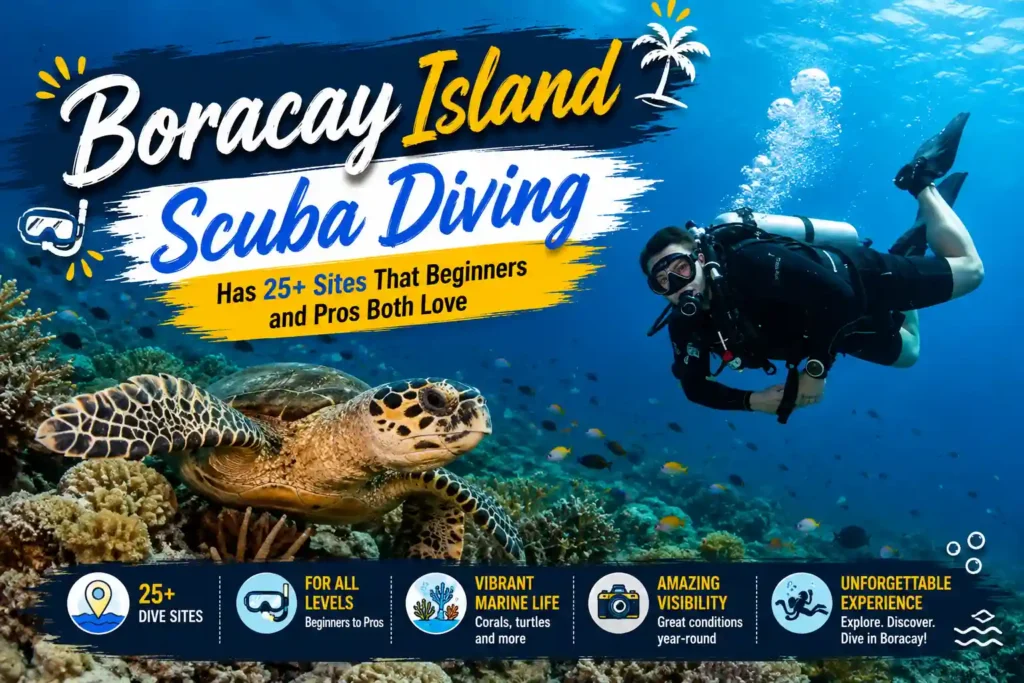
Boracay Island scuba diving takes place in the Sibuyan Sea, where water stays around 28°C all year, and visibility can reach 20 meters from October to May. The island has more than 25 dive sites, ranging from shallow coral gardens near the shore to deeper spots like Yapak, where reef sharks, hawksbill turtles, and sometimes manta rays appear. Beginners can start with a simple introductory dive in calm, sheltered waters, while experienced divers can explore wrecks and stronger drift currents further out.
Most dive shops are based near Caticlan and White Beach, and they offer everything from single dives to full PADI certification courses. Boracay Island scuba diving suits both first-time divers and certified ones, since the mix of easy entry points and challenging deeper sites works for almost every skill level.
Scuba Diving in Boracay: What Makes It Special
Boracay stands out among Philippine dive destinations because nearly every site sits within a short boat ride from shore. Most dive centers reach their reef in 10 to 20 minutes, leaving more time underwater and less time on the boat. Warm water year-round removes the need for thick wetsuits, and gentle currents at shallow sites make skill-building relaxing rather than stressful.
The surrounding waters fall under protections enforced by the DENR (Department of Environment and Natural Resources), so coral cover at sites like Crocodile Island has recovered steadily since the 2018 closure. Divers get real variety in one trip: coral gardens, a wreck, drift currents, and open-water pelagics all within 30 minutes of White Beach. Few destinations built around sand and sunsets offer that much underwater range.
Is Boracay Island Scuba Diving Good for Beginners?
Yes, Boracay scuba diving suits beginners well. Calm currents at sites like Angol Point and Tulubhan Reef, water averaging 28°C, and PADI-certified instructors running guided Discover Scuba Diving sessions mean no prior experience is required to get in the water.
Discover What to Expect From Scuba Diving in Boracay. Read more in 9 Reasons Boracay Island Is Famous but Not for Everyone.
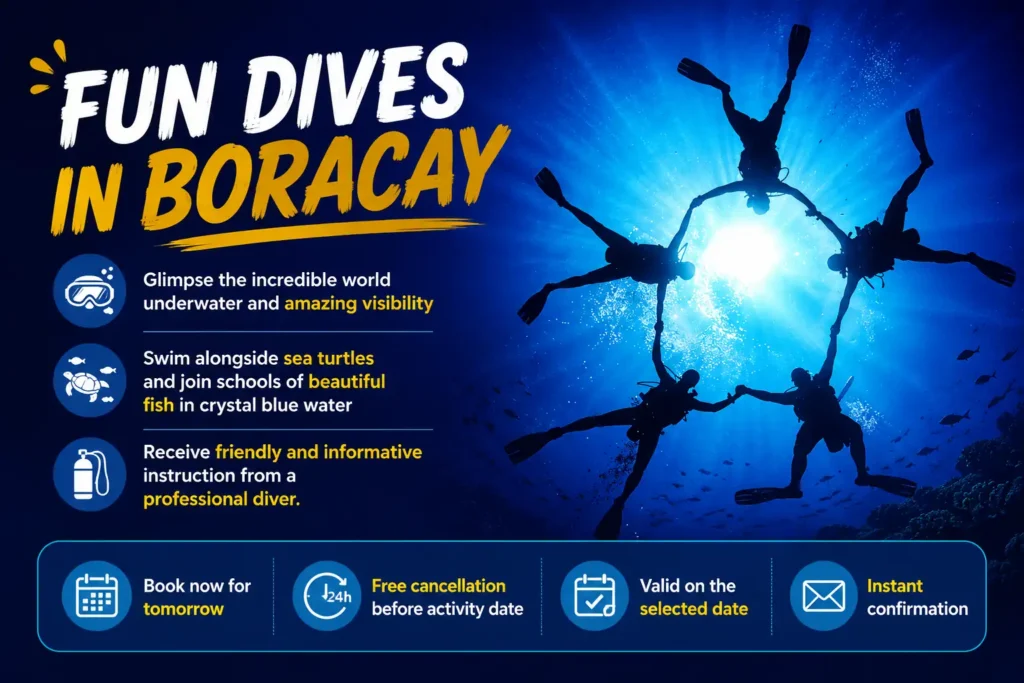
For a little adventure beyond the beach, give this dive a try. You’ll get out on the water, explore a local dive site, and spend a couple of hours discovering Boracay below the surface.
Best Scuba Diving Sites in Boracay
Boracay holds more than 25 recognized dive sites, spread across sheltered western bays and exposed eastern channels. Angol Point ranks as the easiest entry point for new divers, with a gentle slope and reef fish close to the surface. Crocodile Island earns its name as the top biodiversity site, with sloping reefs, gorgonian fans, and frequent hawksbill turtle sightings. Yapak, by contrast, demands real experience: strong currents and depths past 30 meters bring pelagic fish, reef sharks, and occasional manta rays.
The Camia II wreck lets certified divers explore a sunken vessel populated by scorpionfish, batfish, and bluefin trevally. Punta Bunga and Tulubhan Reef round out the beginner-friendly options, both reachable within 20 minutes by boat.
Here’s a quick snapshot of depth, difficulty, and highlights to help match a site to your certification level.
| Dive Site | Depth Range | Difficulty | Highlights |
| Angol Point | 5–12m | Beginner | Easy entry, reef fish, calm current |
| Tulubhan Reef | 5–20m | Beginner | Shallow, quiet, good for training |
| Punta Bunga | 8–18m | Beginner | Calm water, macro photography |
| Coral Garden | 10–15m | Beginner–Intermediate | Soft coral, popular training dive |
| Crocodile Island | 10–20m | Intermediate | Best biodiversity, hawksbill turtles |
| Camia II Wreck | 18–30m | Advanced | Wreck dive, scorpionfish, batfish |
| Yapak | 25–40m | Advanced | Strong current, sharks, manta rays |
| Channel Drift | Varies | Advanced | Rare drift diving in Southeast Asia |
Boracay Scuba Diving for Beginners
First-time divers need no prior experience to try Boracay scuba diving; a Discover Scuba Diving session covers equipment setup and hand signals before anyone touches open water. Basic swimming ability matters more than fitness level, since instructors handle buoyancy and depth control on the first dive. Most operators set the minimum age at 10 years old for the PADI Open Water course, following global PADI standards.
Shallow beginner sites like Angol Point and Tulubhan Reef stay under 12 meters, keeping the learning curve gentle. Every beginner dive includes a certified guide within arm’s reach, so trouble gets handled immediately. Confined water practice in a pool or calm bay always comes before the first open-water descent. Nerves are normal on day one; nearly every center in Boracay expects and plans for first-timers.
PADI Scuba Diving Courses in Boracay
PADI Open Water certification anchors most Boracay scuba courses, taking 3 to 4 days and combining theory, confined water skills, and four open-water dives. Divers wanting more range often add Advanced Open Water next, covering deep diving, navigation, and a specialty like wreck or photography. Rescue Diver training goes further, teaching emergency response skills many experienced divers consider essential.
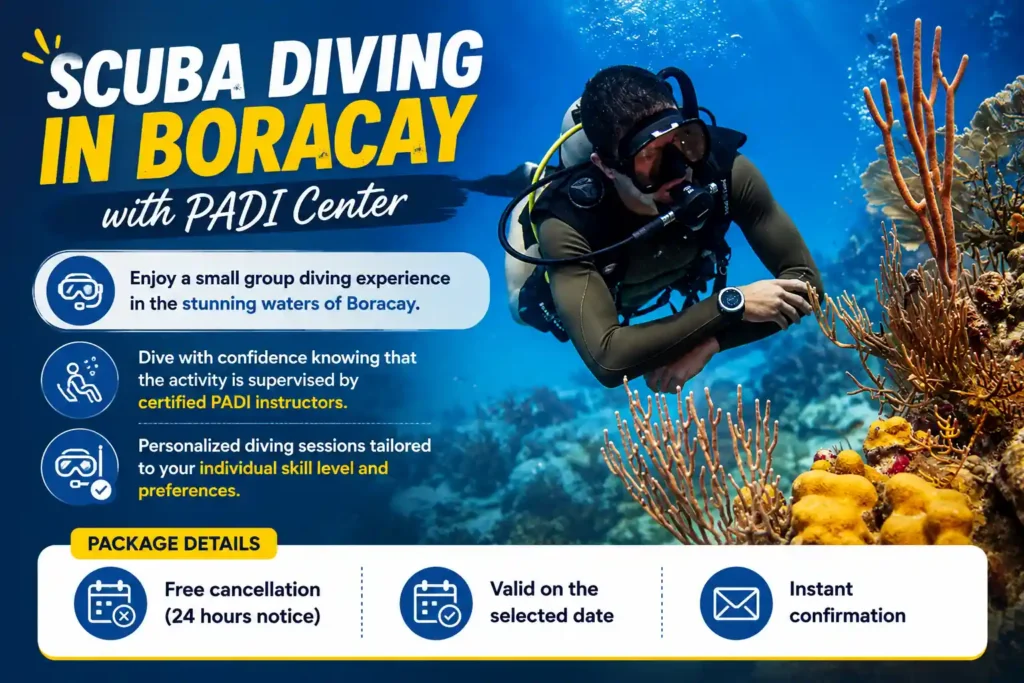
Make your morning in Boracay a little more adventurous. This 8AM dive takes you into clear tropical waters where you can get up close with vibrant marine life.
Several five-star PADI Instructor Development Centers near White Beach also run Divemaster and Instructor courses for those chasing a diving career, teaching in English, Korean, and Chinese for Boracay’s international visitors. Every course ends with a globally recognized certification card. Choose a course level that matches your actual dive goals, since jumping straight to Advanced without solid Open Water skills rarely pays off.
What Can You See While Scuba Diving in Boracay?
Boracay’s reefs host everything from small reef fish to occasional pelagic visitors in deeper channels. Hawksbill turtles are commonly seen grazing calmly around Crocodile Island and Laguna de Boracay. Soft corals, sea fans, and gorgonians dominate the 10 to 20 meter range, while Punta Bunga and Coral Garden draw macro photographers hunting nudibranchs and small crustaceans. Deeper sites like Yapak occasionally reveal reef sharks and manta rays, and the Camia II wreck attracts scorpionfish, batfish, and schools of bluefin trevally. Every dive site here offers something different.
Best Time for Scuba Diving in Boracay
October through May marks the best window for scuba diving in Boracay, when the dry season keeps seas calm on the western side. Northeast monsoon winds, locally called Amihan, dominate this period and push rougher water toward the eastern coast instead. From June through September, conditions flip: the southwest Habagat affects the west coast more, so operators shift trips east.
December through February brings the coolest water and, counterintuitively, the murkiest visibility of the year. Peak diving season overlaps with peak tourist season, so December through April books up fastest. Shoulder months like May and October often combine decent visibility with thinner crowds.
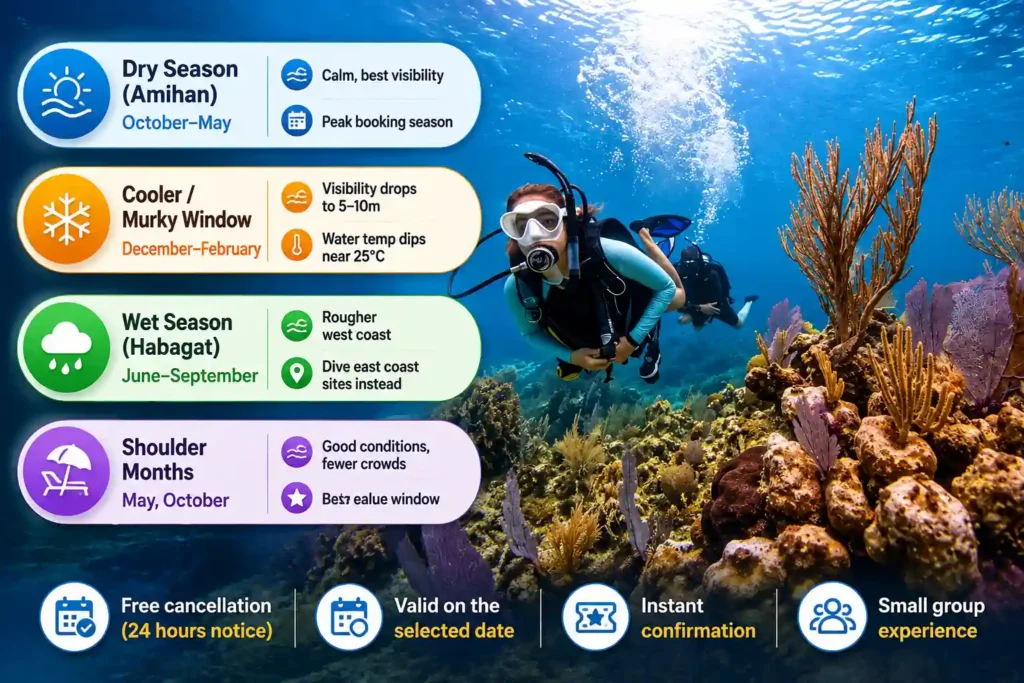
The table below lays out Boracay’s diving conditions season by season.
| Season | Months | West Coast Conditions | Notes |
| Dry Season (Amihan) | October–May | Calm, best visibility | Peak booking season |
| Cooler / Murky Window | December–February | Visibility drops to 5–10m | Water temp dips near 25°C |
| Wet Season (Habagat) | June–September | Rougher west coast | Dive east coast sites instead |
| Shoulder Months | May, October | Good conditions, fewer crowds | Best value window |
Boracay Diving Conditions and Underwater Visibility
Water temperature in Boracay averages around 28°C year-round, dipping near 25°C in cooler months and climbing past 30°C in summer. Visibility swings by season, generally sitting between 15 and 20 meters during the dry months from October to May. December through February brings the weakest visibility, often dropping to 5 to 10 meters as plankton and runoff cloud the water.
Currents at most training sites stay gentle, which is why instructors favor Boracay for early certification dives. Stronger currents appear in the straits between islands, drawing divers who want a livelier drift. A 3mm wetsuit covers most divers comfortably year-round, though some opt for a shorty in peak summer heat. Checking recent visibility with a local dive center before booking multiple days is worth the call.
What Is the Underwater Visibility Like in Boracay?
Underwater visibility in Boracay typically ranges from 15 to 20 meters during the dry season between October and May, dropping to 5 to 10 meters from December through February when plankton and runoff cloud the water.
How Much Does Scuba Diving Cost in Boracay?
Discover Scuba Diving sessions in Boracay typically run from $99 to $120 USD, covering equipment, an instructor, and one guided reef dive. Certified divers looking for a single fun dive pay less, with prices starting around $39 USD at several local operators. A full PADI Open Water course, spanning 3 to 4 days, generally starts at $599 USD and includes materials, tanks, and the certification card.
Prices climb during peak season from December through April, when demand at five-star centers runs highest. Multi-dive packages usually lower the per-dive cost, so ask about bundled rates before booking single trips. Every visitor also pays a one-time environmental fee of roughly $5 USD, plus a terminal fee near $2.50 USD each way through the jetty port. None of these figures include gratuities for boat crew or instructors.
This table lines up typical Boracay scuba diving prices in US dollars.
| Activity | Approx. Price (USD) | What’s Included |
| Discover Scuba Diving | $99–$120 | Instructor, gear, 1 guided reef dive |
| Single Fun Dive (certified) | From $39 | Tank, weights, boat transfer |
| PADI Open Water Course (3–4 days) | From $599 | Theory, gear, 4 dives, certification card |
| Boracay Environmental Fee (one-time) | ~$5 | Island entry, conservation fund |
What Is Included in a Boracay Scuba Diving Package?
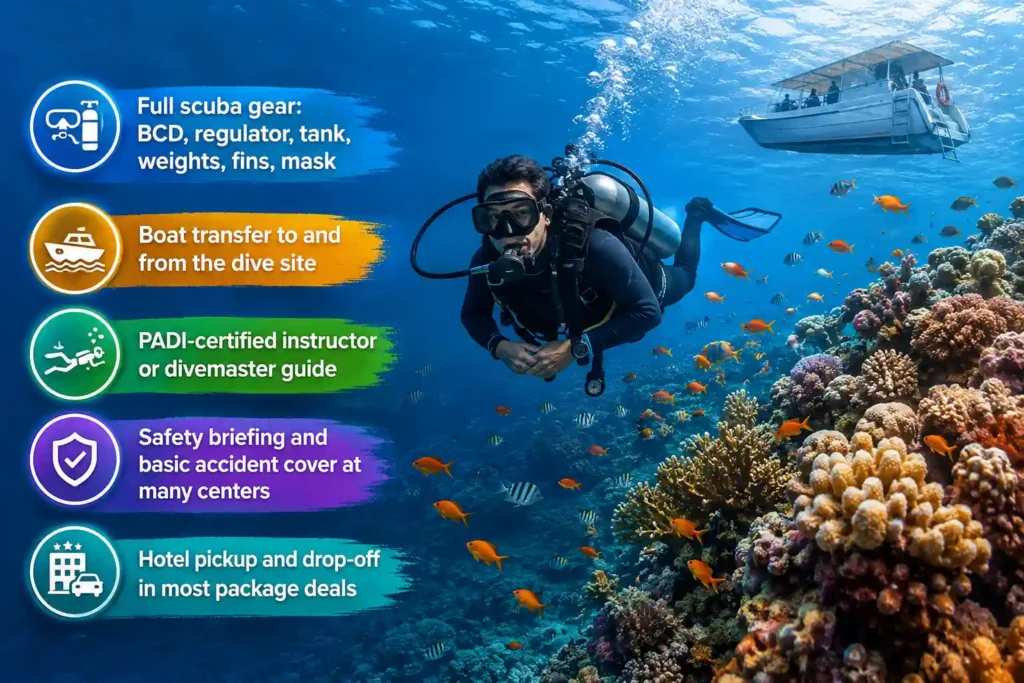
Standard Boracay scuba diving packages bundle gear rental, boat transfer, and a certified guide into one upfront price. Most operators also include hotel pickup and drop-off, saving the hassle of separate transport each morning. Safety briefings happen before every dive, covering hand signals, entry and exit procedures, and what to do if separated. A logbook stamp or digital dive log usually comes standard for certified divers tracking their count. Packages rarely include personal items like reef-safe sunscreen or camera rental, so it helps to check ahead. Typical inclusions look like this:
- Full scuba gear: BCD, regulator, tank, weights, fins, mask
- Boat transfer to and from the dive site
- PADI-certified instructor or divemaster guide
- Safety briefing and basic accident cover at many centers
- Hotel pickup and drop-off in most package deals
Ask specifically about dive insurance coverage before paying, since policies vary between operators and some only cover accidents within Philippine waters.
Boracay Scuba Diving Safety Tips
Choosing a PADI-certified or equivalent-accredited dive center is the single most important safety decision any diver makes in Boracay. Every dive should start with a full equipment check, confirming air supply and buoyancy control, with the buddy system actually in place. Divers should never exceed the depth or conditions covered by their certification level, no matter how calm the water looks.
Dive-specific insurance through providers like Divers Alert Network covers emergency evacuation costs that travel insurance often excludes. Surfacing too quickly after a deep dive raises decompression sickness risk, so follow the dive computer’s ascent rate. Waiting at least 18 hours after diving before flying reduces that risk substantially. A few safety habits go a long way:
- Dive within your certification limits and logged experience
- Confirm the operator carries emergency oxygen on the boat
- Stay with your buddy and agree on hand signals beforehand
- Skip alcohol the night before an early morning dive
- Respect marine sanctuary no-touch rules to protect coral and yourself
How to Choose a Scuba Diving Center in Boracay
Look for PADI five-star or IDC status, and check independent reviews for real feedback on equipment and instructors. Choose operators with small group sizes for closer supervision, and don’t hesitate to ask about equipment maintenance. Confirm the boat has a first aid kit, emergency oxygen, and a working radio. DOT-accredited centers usually meet stricter safety standards. Comparing a few quotes before booking helps you spot corner-cutting prices versus fair ones.
How Many Dive Sites Does Boracay Have?
Boracay has more than 25 recognized dive sites, ranging from shallow, beginner-friendly reefs like Angol Point to advanced drift and wreck sites such as Yapak and the Camia II wreck.
Is Scuba Diving in Boracay Worth It?
Boracay Island scuba diving earns its reputation mainly through convenience: dozens of sites within a short boat ride, warm water year-round, and plenty of beginner-friendly spots. Divers chasing bigger pelagic encounters sometimes prefer destinations like Tubbataha Reef or Malapascua, known for whale sharks and thresher sharks. Boracay doesn’t try to compete on that level; it competes on accessibility and ease.
A traveler who wants a beach holiday with real diving mixed in, rather than a dedicated liveaboard trip, gets exactly that here. Visibility and marine life hold up well against other beginner-focused destinations like Koh Tao or Bali’s calmer bays. The value case gets stronger for anyone completing a full certification, since one trip covers both beach time and a recognized qualification. For most visitors, the answer comes down to matching expectations with the destination.
Boracay Scuba Diving FAQs
Is scuba diving in Boracay good for beginners?
Yes. Boracay is one of the more beginner-friendly diving destinations in the Philippines, with calm sites like Angol Point, warm water, and PADI-certified instructors running Discover Scuba Diving sessions requiring no experience.
How much does scuba diving cost in Boracay?
Prices generally range from $39 USD for a single fun dive to $99–$120 USD for a Discover Scuba Diving session, while a full PADI Open Water course starts around $599 USD.
What is the best time to dive in Boracay?
October to May offers the calmest water and best visibility on Boracay’s western sites, while June through September shifts diving toward the eastern coast due to monsoon winds.
Do I need certification to dive in Boracay?
No prior certification is required for a Discover Scuba Diving session, though certified divers get access to deeper sites like Yapak and the Camia II wreck.
What marine life can divers expect to see in Boracay?
Expect hawksbill turtles, soft corals, gorgonian sea fans, reef fish, and occasional reef sharks or manta rays at deeper sites such as Yapak.
Is Boracay diving suitable for children?
PADI sets the minimum age for Open Water certification at 10, and many Boracay dive centers offer supervised introductory sessions within that guideline.
Do I need travel or dive insurance for scuba diving in Boracay?
Dive-specific insurance through providers like Divers Alert Network is strongly recommended, since it covers emergency evacuation costs that standard travel insurance often excludes.
2 Responses