

The best time to visit Boracay is between late November and April, when the Amihan wind blows steady and dry from the northeast. This wind pattern keeps the sea calm, the sky clear, and rainfall low across the island. Daytime temperatures stay comfortable, usually between 26°C and 31°C, so beach days rarely get ruined by sudden storms.
Water visibility also improves during these months, which makes snorkeling and island hopping far more rewarding. If your main goal is calm water, sunny skies, and reliable outdoor plans, the best time to visit Boracay falls squarely within these six months, with January to March offering the most consistent conditions of all.
When Is the Best Time to Visit Boracay?
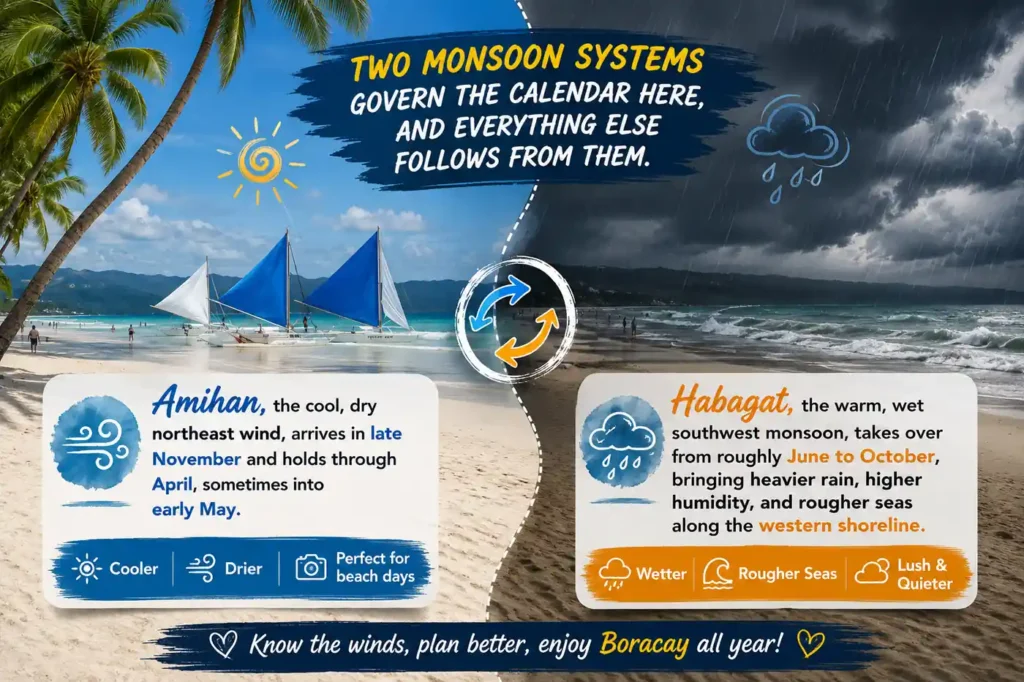
Two monsoon systems govern the calendar here, and everything else follows from them. Amihan, the cool, dry northeast wind, arrives in late November and holds through April, sometimes into early May. Sunshine dominates, humidity drops, and White Beach stays glassy calm since the island’s shape shelters its west coast from the wind. Habagat, the warm, wet southwest monsoon, takes over from roughly June to October, bringing heavier rain, higher humidity, and rougher seas along the western shoreline.
Peak demand clusters around Christmas, New Year, and Holy Week, when flights and beachfront rooms sell out weeks ahead. Shoulder months, especially November and May, offer a smart compromise: mostly cooperative weather with thinner crowds and softer prices. For a first trip built around swimming, sailing, and dependable sun, December through April remains the safest bet.
Find Out What Makes Boracay Island So Special. Read more in 9 Reasons Boracay Island Is Famous but Not for Everyone.
What Time of Year Works Best for a Boracay Trip?
November through April delivers Boracay’s most reliable conditions: sunny skies, calm turquoise water on White Beach, and daily highs around 31–34°C. Sea conditions turn choppier, and rain becomes frequent from June onward, peaking through August and September. Rare among Philippine islands, Boracay actually gets slightly warmer as its dry season progresses, with April and May running hotter than December and January.
Boracay Weather Throughout the Year
Temperature barely shifts across twelve months on this island, hovering between 27°C and 34°C year-round, so heat rarely dictates the decision. Rainfall tells a completely different story, climbing from a mere 25mm in February to a soaked 180mm in August, according to seasonal averages compiled by regional weather trackers. Sunshine hours track the same pattern, dropping from around nine hours a day in March to just five during the wettest stretch of summer.
Government forecasters at PAGASA, the Philippine Atmospheric, Geophysical and Astronomical Services Administration, track these monsoon shifts closely and issue seasonal outlooks that most local operators and hotels follow when setting rates. Four distinct stretches emerge once the data is grouped, each with its own mood on the beach. Below is a season-by-season breakdown worth bookmarking before choosing travel dates.
Here’s the year condensed into four practical windows; save this table before choosing your dates.
| Period | Avg. Temperature | Rainfall | Sea Conditions | Best For |
| December–February | 27–31°C (81–88°F) | Low (25–45mm/mo) | Calm on White Beach, windy at Bulabog | Sun-seekers, kitesurfers |
| March–May | 29–34°C (84–93°F) | Low-moderate (25–55mm/mo) | Warmest, calm seas, occasional algae | Swimming, hottest-weather lovers |
| June–September | 29–33°C (84–91°F) | Heavy (115–180mm/mo) | Rough, typhoon risk peaks Aug–Sep | Budget trips, flexible travelers |
| October–November | 29–32°C (84–90°F) | Moderate, easing (70–120mm/mo) | Improving, occasional swell | Shoulder-season value |
December to February
Peak Amihan season sits right here, and it shows. Daytime highs settle around 28–31°C, evenings cool into the low 20s, and rainfall barely registers outside a handful of light showers. Northeast trade winds turn Bulabog Beach into one of Southeast Asia’s top kitesurfing spots, drawing riders from across the region every January. Crowds peak hardest around Christmas week and New Year’s Eve, when White Beach fills for one of the region’s biggest beach parties, so book accommodation months ahead if these dates are non-negotiable.

March to May
Heat climbs steadily through this stretch, with May regularly posting the year’s hottest daytime readings near 34°C. Skies stay mostly clear, and sea conditions remain some of the calmest on record, ideal for swimming, island-hopping, and snorkeling trips around nearby reef spots. Holy Week, which usually falls in late March or April, brings a domestic travel surge on top of the regular foreign tourist volume. Green algae, locally called lumot, sometimes drifts onto parts of White Beach during warm, calm spells in April and May, though staff generally clear it from the main swimming zones each morning.
June to September
Habagat monsoon dominates this stretch, and rainfall triples compared to the dry months. Afternoon downpours become the norm, often arriving fast and clearing within an hour, while mornings frequently stay bright enough for a beach walk before the clouds build. Typhoon risk climbs sharply through August and September, occasionally forcing ferry suspensions between Caticlan and the island for a day or two at a time. The trade-off for wetter weather comes in the form of the year’s steepest discounts, with hotel rates often falling 30 to 50 percent below December rates.
October to November
Rain begins tapering as Habagat loses strength, though scattered showers and residual swell can still surprise visitors early in October. Amihan winds return by mid-to-late November, gradually calming the western coastline and restoring the classic flat, turquoise look to White Beach. Crowds stay thin throughout this window, since most travelers assume the rainy season hasn’t fully ended, which works in favor of anyone chasing lower prices without gambling on peak-season sunshine. November specifically earns a reputation among repeat visitors as the calendar’s best-kept secret, striking a balance between improving weather and still-quiet beaches.
Best Time to Visit Boracay Weather at a Glance
Cross-referencing rainfall, temperature, and wind, the cleanest answer points to December through April as Boracay’s most weather-reliable stretch, with March through May running hottest and November offering the best value-to-weather ratio. Sea conditions flip almost entirely on the monsoon switch, calm and glassy under Amihan, choppy and unpredictable under Habagat. Anyone chasing a guaranteed sunny beach week should lock in dates inside that five-month dry-season window rather than gambling on shoulder months.
Best Time to Visit Boracay for Fewer Crowds
Crowd size on this island swings as dramatically as the weather, and both often peak together. Christmas week, New Year, and Holy Week pack White Beach shoulder to shoulder, with the Department of Tourism’s carrying-capacity cap near 19,215 visitors at any time and roughly 6,405 daily arrivals through Caticlan port.
These numbers matter because restaurants, sandbar boat trips, and beachfront massages fill up fast once density climbs that high. Quieter windows exist without losing much sunshine, especially early December before the holiday rush and January’s first two weeks. September and early October offer the calendar’s quietest stretch, since rain keeps casual tourists away while local businesses stay open. For travelers who value elbow room over guaranteed sun, that trade-off pays off.
Practical ways to dodge the worst crowds:
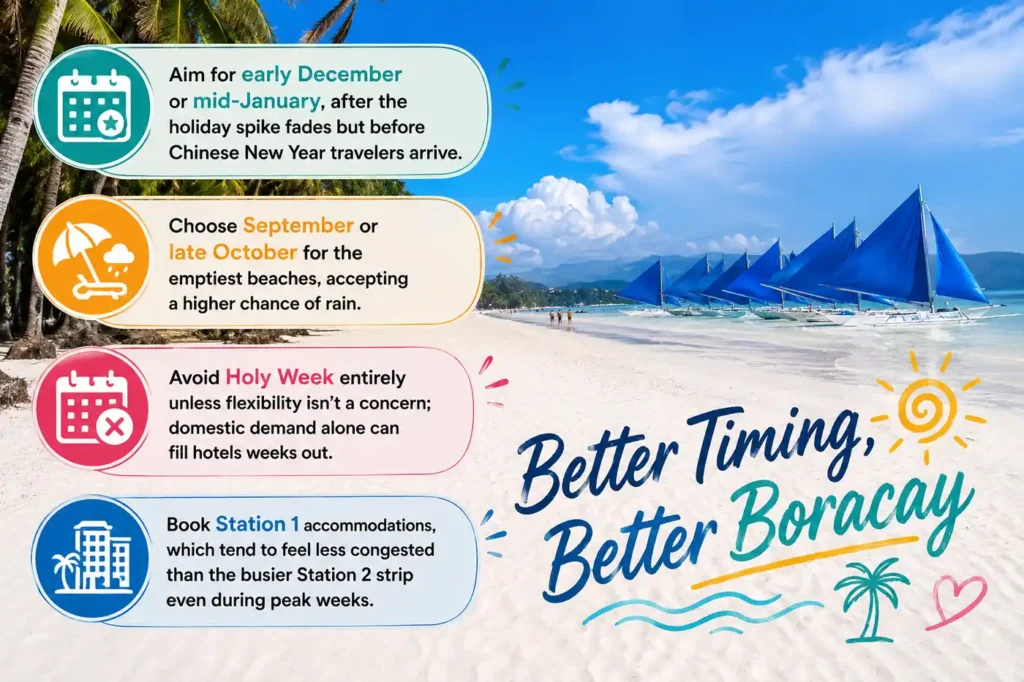
- Aim for early December or mid-January, after the holiday spike fades but before Chinese New Year travelers arrive.
- Choose September or late October for the emptiest beaches, accepting a higher chance of rain.
- Avoid Holy Week entirely unless flexibility isn’t a concern; domestic demand alone can fill hotels weeks out.
- Book Station 1 accommodations, which tend to feel less congested than the busier Station 2 strip even during peak weeks.
This table breaks down expected crowd density by season, useful for anyone planning around quieter beaches.
| Season | Months | Crowd Level | Notes |
| Peak Holiday | Dec 20–Jan 5, Holy Week | Extremely High | Book 2–3+ months ahead |
| General Dry Season | Jan (post-holidays)–Apr | High | Best beach weather draws steady crowds |
| Shoulder | May, November | Moderate | Good balance of weather and space |
| Rainy / Low | June–October | Low | Quietest, especially Sep–early Oct |
Best Time to Visit Boracay on a Budget
Money moves opposite to good weather, almost predictably. Hotel rates run 50 to 100 percent higher from December through February versus September, per booking-platform trend reports. Flights follow suit, spiking around Christmas, New Year, and Holy Week.
Entry fees stay fixed: every visitor pays a mandatory ₱300 (about $4.90 USD) environmental fee plus a ₱150 (about $2.45 USD) terminal fee each way at Caticlan Jetty Port, payable in cash or via the Boracay iPass portal. Bargaining power rises in low season, as operators compete for fewer guests. Shifting dates from February to September can cut total trip costs nearly in half.
Ways to stretch a Boracay budget further:
- Book beachfront rooms in September or November, when rates commonly drop 30–50% below peak pricing.
- Split island-hopping and snorkeling tours with other travelers through group bookings instead of private charters.
- Skip beachfront dining for Station 2’s inland eateries, where meal prices run noticeably lower.
- Register port fees in advance through the official iPass portal to skip queues and avoid scam agents near the jetty.
Costs shift enough by season to change a whole trip budget; this comparison makes the gap easy to see.
| Season | Avg. Double Room / Night | Flights | Overall Trip Cost |
| Peak (Dec–Feb) | $150–$300+ | Highest fares | Premium |
| Dry Shoulder (Mar–May) | $80–$180 | Moderate-high | Above average |
| Low Season (Jun–Sep) | $40–$90 | Lowest fares | Most affordable |
| Shoulder (Oct–Nov) | $60–$110 | Moderate | Good value |

What Is the Rainy Season in Boracay?
Habagat monsoon defines Boracay’s rainy season, running from June through October, with the heaviest rain in July, August, and September. Southwest winds push moisture-loaded air across the island, triggering afternoon thunderstorms that can dump over 150mm of rain in a month. Mornings often stay dry and sunny, since storms tend to build later in the day.
Typhoon season overlaps this window, running June officially through November, with peak activity in August and September. Ferry services between Caticlan and the island sometimes suspend during severe weather, stranding travelers for a day or more. Still, complete washouts are rare; most rainy-season days still bring several hours of usable sunshine.
Is Boracay Worth Visiting During the Rainy Season?
Genuine value exists in a rainy-season trip, provided expectations get adjusted going in. Hotel savings can offset a fair number of interrupted beach days, and the island feels calmer, with shorter queues and more availability for spontaneous boat trips. Dramatic skies are a real perk too, since storm clouds over the water produce some of Boracay’s most photographed sunsets.
Water sports still run most days, though operators may cancel sailing or parasailing when swells pick up. Flexibility matters most during these months; travelers locked into a rigid itinerary risk losing a day or two to weather. For anyone chasing a quiet, budget-friendly escape rather than a guaranteed tan, the trade-offs generally work out in their favor.
When Is the Best Time to Avoid Strong Winds and Rough Seas?
Bulabog Beach’s east coast sees the strongest winds during peak Amihan months, December through February, with northeast trade winds regularly exceeding 15–20 knots, great for kitesurfers but rough for casual swimmers. White Beach faces the reverse problem during Habagat, June through September, when onshore southwest winds create choppy, sometimes unswimmable conditions. The calmest seas island-wide show up in March, April, and early May, just before the pattern flips again.
Decision Time: Weighing Weather, Crowds, and Cost
Weather, crowds, and cost rarely align on the same calendar page, which makes this decision personal rather than one-size-fits-all. Sun-chasers and swimmers should book December through April, accepting higher prices for near-guaranteed good weather. Budget travelers craving a quieter island should look at September through November, when rates drop and beaches empty out.
Amihan’s calm coast makes White Beach shine brightest from December to May, while Habagat flips the advantage toward Bulabog’s kite spots earlier in the year. No month here is truly a bad choice, since even rainy-season storms tend to clear fast and leave dramatic skies behind. Matching your priorities- sunshine, savings, or solitude- against the month-by-month breakdown above makes the final decision easier.
FAQs About the Best Time to Visit Boracay
What month is best for visiting Boracay?
March tends to edge out other months for most travelers, combining reliably sunny weather, calm seas, and slightly thinner crowds than the December-January holiday rush. April and early May run a close second, though heat climbs noticeably by then.
What is the rainy season in Boracay?
The rainy season runs from roughly June through October, driven by the Habagat southwest monsoon, with July, August, and September delivering the heaviest and most frequent downpours.
What are the hottest months in Boracay?
April and May consistently post the year’s highest daytime temperatures, often climbing to 33–34°C, right at the tail end of the dry season before the monsoon shift.
When is Boracay least crowded?
September and early October see the fewest visitors island-wide, since rain and typhoon risk discourage casual travelers even though most businesses stay fully operational.
What is the cheapest month to visit Boracay?
September typically offers the lowest hotel rates and flight prices of the year, with savings of 30–50% common compared with peak December and February pricing.




One Response