
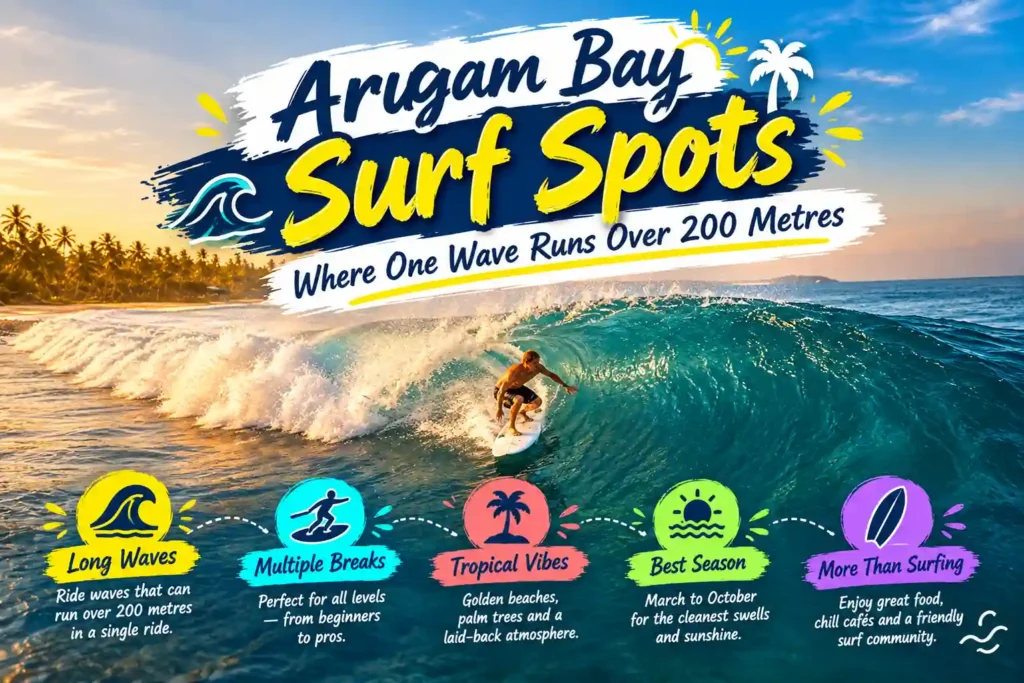
Arugam Bay surf spots are spread along the coast from Pottuvil to Okanda, each one a short tuk-tuk ride apart. Main Point sits right in the centre of Arugam Bay town, next to the lagoon mouth, and is the easiest spot to reach on foot from most guesthouses. Whiskey Point and Baby Point lie just north of Main Point, close to Pottuvil, and are the go-to spots for beginners.
Peanut Farm is 15 minutes south by tuk-tuk, while Elephant Rock lies farther south near Okanda National Park. Panama Point, the farthest and least crowded surf spot, is 30–40 minutes south and ideal for advanced surfers.
Arugam Bay Surf Spots
Arugam Bay sits on Sri Lanka’s southeast coast, roughly 320 km east of Colombo, according to the Sri Lanka Tourism Development Authority. The drive takes five to seven hours via Ella or Monaragala, with scenic views making the journey part of the adventure.
The coastline runs in a fairly continuous stretch of right-hand point and beach breaks, with Arugam Bay town in the middle and Pottuvil village a short ride to the north. Every named wave sits within roughly 20 to 30 minutes of the town centre by tuk-tuk, which is why surfers can realistically try a different break every day without changing accommodation.
These breaks share rocky sands, southwest swells, and right-hand waves. Wave power, crowds, and skill demands vary by surf spot, as the next sections explain.
What Is the Best Surf Spot in Arugam Bay?
Main Point is Arugam Bay’s top surf spot, with a long right-hand break stretching hundreds of metres on a strong swell. Whiskey Point and Pottuvil Point have similar waves with fewer crowds, while Elephant Rock and Peanut Farm suit improving surfers.
Main Point Arugam Bay
Main Point is a top Asian right-hander, offering rides over 200 metres on a solid swell. Confident intermediate surfers and above tend to get the most out of this wave.The takeoff is powerful, and the lineup gets crowded with experienced surfers in July and August. Newer surfers often watch from the channel before paddling in.
Access is simple. Main Point sits a short walk from most guesthouses in town, and the wave is visible from several beachfront cafes, making it easy to check conditions before grabbing a board.

Peanut Farm Arugam Bay
Peanut Farm, a short tuk-tuk ride south of Arugam Bay, offers a friendlier right-hand point break. The sandy bottom makes it popular for beginner and improver surf lessons.
Outside sections pick up more power on bigger swells, giving intermediate surfers a step up without the crowd density of Main Point. Clear water on calmer days also makes this stretch popular for a swim between sessions.
One seasonal note worth remembering: the nearby lagoon can flood during the wet months between November and March, and local guides sometimes advise extra caution around the break during that period.
Whiskey Point Arugam Bay
Whiskey Point lies north of Pottuvil village, roughly 10 to 25 minutes from Arugam Bay town by tuk-tuk. The wave breaks over sand rather than reef, producing a mellow-to-moderate right-hander that suits improving surfers who are already catching unbroken, green waves elsewhere.
Crowds here run noticeably lighter than Main Point, even during the July and August peak, since the extra travel time puts off casual visitors. A few surf-focused stays sit right on this stretch, letting guests check conditions without leaving the property.
Some surf guides note the wave has become less consistent since 2019 compared to its earlier reputation, so checking a live surf report before committing to the trip out is worth the extra few minutes.
Pottuvil Point Arugam Bay
Pottuvil Point sits just past Whiskey Point and delivers one of the longest, slowest right-handers on this stretch of coast. The wave works best on a decent-sized swell and rewards patience over speed, making it a favourite among longboarders and surfers who prefer a workable wall to a short, punchy section.
Crowds thin out considerably here compared to the town-centre breaks, partly because of the extra travel time and partly because the wave needs specific swell conditions to fire properly. A hollow right-hand reef section near the point adds variety for surfers chasing something faster on the right day.
Checking the swell forecast before heading out saves a wasted trip, since Pottuvil Point can sit flat while other spots nearby are still working.
Elephant Rock Arugam Bay
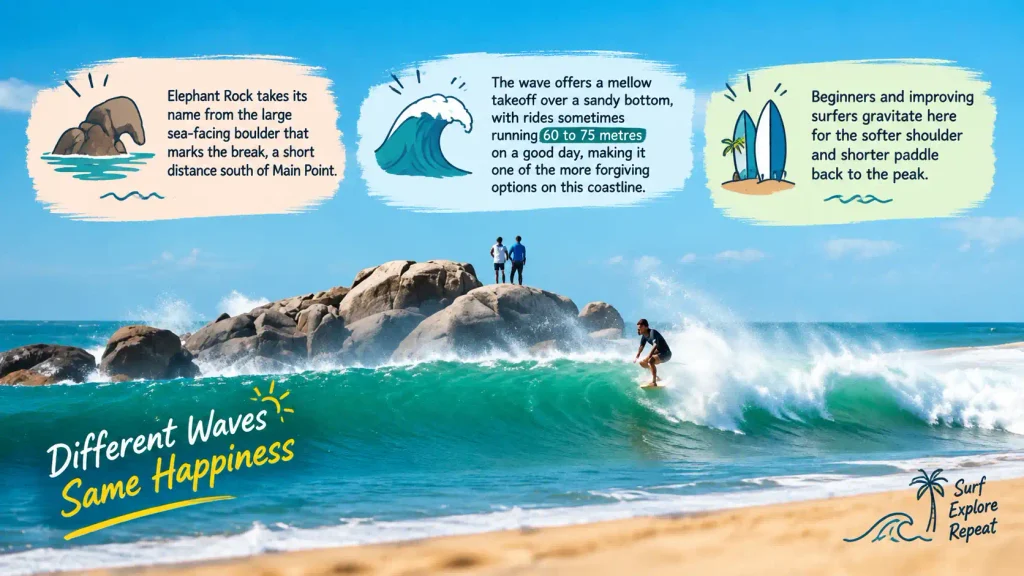
Elephant Rock takes its name from the large sea-facing boulder that marks the break, a short distance south of Main Point. The wave offers a mellow takeoff over a sandy bottom, with rides sometimes running 60 to 75 metres on a good day, making it one of the more forgiving options on this coastline.
Beginners and improving surfers gravitate here for the softer shoulder and shorter paddle back to the peak. The rock itself doubles as a lookout point, and climbing it after a session for sunset views has become a small tradition among regulars.
Wild elephants occasionally cross the access road near the surrounding scrubland at dawn and dusk, which is worth keeping in mind when planning an early session.
Best Surf Spots in Arugam Bay
Choosing between six or seven named breaks gets easier with a side-by-side comparison of wave type, difficulty, and typical crowd levels. The table below lines up the main breaks along this coast so a decision takes minutes instead of an entire morning.
| Surf Spot | Wave Type | Skill Level | Typical Crowd |
| Main Point | Long right-hand point break | Intermediate–Advanced | Heavy, especially Jul–Aug |
| Peanut Farm | Sandy inside, punchier outside | Beginner–Intermediate | Moderate |
| Whiskey Point | Mellow-moderate right over sand | Improver–Intermediate | Light–Moderate |
| Pottuvil Point | Long, slow right; occasional reef section | Intermediate | Light |
| Elephant Rock | Soft right over sand | Beginner–Improver | Moderate |
None of these waves work well on a dead low tide, so checking tide charts alongside the swell forecast makes a bigger difference to a session than picking the “right” spot alone.
Arugam Bay Surf Spots for Beginners
Baby Point, the inside section of Peanut Farm, and the soft inside shoulder of Elephant Rock count among the most forgiving Arugam Bay surf spots for beginners, all breaking over sand with a slow-building wave.
Baby Point sits inside the main bay itself, reachable on foot, and rarely exceeds waist height even when the outer reef is firing. Mid-to-high tide generally works best across these spots, since a dead low tide leaves the water too shallow and causes waves to close out quickly rather than peel.
- Baby Point — walk-in access, knee-to-waist waves
- Peanut Farm (inside) — sandy bottom, gentle takeoff
- Elephant Rock (inside) — soft shoulder, short paddle back
Arugam Bay Surf Season
Arugam Bay’s surf season runs on the southwest monsoon, which pushes swell onto the east coast while keeping the south coast rough and rainy. According to the Department of Meteorology, Sri Lanka, the southwest monsoon typically runs from May through September, which lines up closely with the local surf calendar.
Consistent swell generally arrives from late April and holds through October, with July and August marking peak size and peak crowds. Shoulder months such as May, June, and September often bring similar wave quality with noticeably fewer people in the water.
The village largely quiets down between November and April, when the northeast monsoon takes over, and a number of guesthouses, restaurants, and surf schools reduce their hours or close for the off-season.
A quick season breakdown makes trip planning far simpler than scrolling through old swell charts.
| Period | Months | Conditions |
| Early Season | April–May | Building swell, fewer crowds |
| Peak Season | June–September | Biggest, most consistent swell; busiest |
| Late Season | October | Inconsistent, transition period |
| Off Season | November–March | Northeast monsoon; many businesses reduce hours |

Best Time to Surf Arugam Bay
Early morning, generally before 9:00 AM, offers the cleanest conditions at most breaks along this coast, before the onshore wind builds through the day. Within the season, June through August delivers the most reliable and powerful swell, while May and September offer a calmer, less crowded alternative with only a slight drop in consistency.
Arugam Bay Surfing
Arugam Bay surfing draws a genuinely international crowd, from first-time travellers booking a single lesson to seasoned surfers chasing a specific swell window every year. Compared to Sri Lanka’s south coast, the town feels smaller and more focused, with surf shops, tuk-tuk drivers, and beachfront cafes all oriented around the daily wave report.
Getting around does not require a rental car. A few simple options cover almost every trip to the water:
- Tuk-tuks fitted with board racks connect every major break to the town centre, usually a 10 to 30 minute ride.
- Main Point and Baby Point sit within walking distance of most guesthouses.
- Scooters with board racks are available from some rental shops, though tuk-tuks remain the more common choice.
Sri Lankan elephants roam the scrubland around Pottuvil and Panama Road, particularly around dawn and dusk, and crossing paths with one on the way to an early session is a real possibility rather than a marketing line.
Arugam Bay Surf Lessons
Arugam Bay surf lessons generally run through small local schools rather than large resort operations, with most instruction built around 90-minute to two-hour sessions. Reputable schools employ instructors certified by the International Surfing Association, the global body that sets coaching and safety standards for surf instruction.
Group lessons typically cost less than private coaching, and board rental is usually bundled into the lesson price rather than charged separately. A standard lesson package tends to include:
- An experienced or ISA-certified local instructor
- A soft-top board and leash for the session
- A rash guard, often included at no extra cost
- Transport to whichever spot suits the day’s conditions
Prices shift between operators and seasons, so confirming the current rate directly with a school before booking remains the safest approach. A rough price range still helps with early budgeting.
| Lesson Type | Typical Duration | Approx. Price (USD) |
| Group lesson | 1.5–2 hours | $25–$40 |
| Private lesson | 1.5–2 hours | Higher than group rate; ask school for current pricing |
| Multi-day surf camp | 5–7 days | $300–$800 |

Arugam Bay Surfboard Rental
Board rental shacks line the beach road throughout town, offering everything from soft-top foam boards for beginners to performance shortboards for advanced surfers. A standard board typically rents for around $5 to $8 USD per day, with premium or high-performance boards costing more.
Weekly and monthly rates usually work out cheaper than paying day by day, which suits anyone staying through most of the season. Most shops ask to hold a passport or driver’s licence as a deposit rather than cash, and renters are generally responsible for repair costs if a board gets damaged.
Checking a board for cracked fibreglass, a solid leash plug, and intact fins before paying is worth the extra minute, since quality varies a lot between shacks.
Safety Tips for Surfing Arugam Bay
A few basic precautions go a long way on this coastline. The points below cover the habits that make the biggest difference in the water:
- Check the tide and swell forecast before entering the water.
- Surf with at least one other person nearby, even at a familiar spot.
- Avoid a session shortly after heavy rain, when runoff can affect water quality near lagoon mouths.
- Wear reef-safe footwear at rockier breaks such as Pottuvil Point and Whiskey Point.
- Respect local surfers’ positioning in the lineup, especially in a crowded peak-season session.
Final Thoughts Before You Paddle Out
Arugam Bay’s coastline works because it offers range: Main Point delivers the power, Peanut Farm and Elephant Rock soften the learning curve, and Whiskey Point and Pottuvil Point reward anyone willing to travel a little further for a quieter lineup. Timing a trip around the season, generally May through September, matters almost as much as picking a spot, and an early start beats fighting the afternoon wind.
Beginners have genuine options here: lessons run through experienced local schools, and board rental stays affordable throughout town. None of it replaces checking current tide charts, swell forecasts, and prices before paddling out. Arugam Bay surf spots reward preparation, and a little planning turns a good trip into a great one.
Frequently Asked Questions About Surfing Arugam Bay
What is the most famous surf spot in Arugam Bay?
Main Point is widely considered the most famous surf spot in Arugam Bay, known for its long right-hand point break and its role in the region’s international surfing reputation.
Which surf spots in Arugam Bay work best for beginners?
Baby Point, the inside section of Peanut Farm, and Elephant Rock’s soft shoulder are generally considered the easiest waves for beginners, thanks to sandy bottoms and slower-breaking waves.
When is the best time to visit Arugam Bay for surfing?
The core surf season runs from around May to September, with June through August offering the biggest and most consistent swell. Early morning sessions typically bring the cleanest conditions.
How much do surf lessons cost in Arugam Bay?
Group lessons with experienced instructors typically range from about $25 to $40 USD per session, though exact pricing varies by school and season, so confirming current rates directly is recommended.
How much does surfboard rental cost in Arugam Bay?
A standard board typically rents for around $5 to $8 USD per day, with premium boards costing more. Weekly rates usually offer better value for longer stays.
Is Arugam Bay good for beginner surfers?
Arugam Bay offers several beginner-friendly waves alongside its more advanced breaks, making it workable for first-time surfers as long as they choose spots like Baby Point or Elephant Rock rather than Main Point.
How far is Arugam Bay from Colombo?
Arugam Bay sits roughly 320 km from Colombo, with the drive typically taking five to seven hours depending on the route.





3 Responses