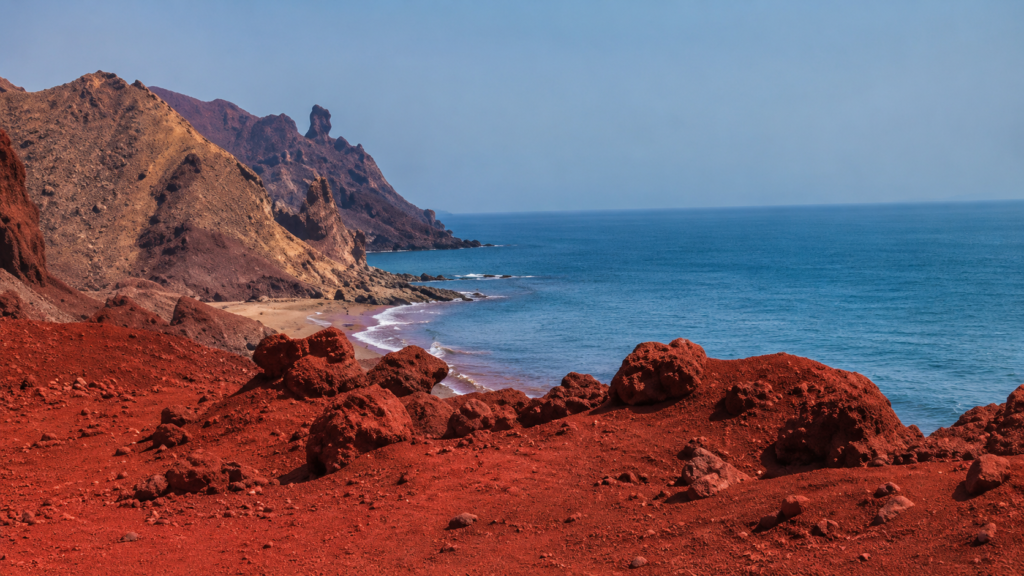
Hormuz Red Beach sits on Hormuz Island, a small piece of land in the Persian Gulf near southern Iran, and it gets its striking color from iron oxide in the local soil. The red sand here is so rich in minerals that it stains your feet, your shoes, and even the water at the shoreline, creating a landscape that looks almost otherworldly. Local artists and cooks actually use this same red soil to make paint and to season food, which shows just how much a part of daily life the color is on this island.
From secret Persian Gulf islands to untouched Caspian shores, these hidden beaches in Iran feel worlds away from the usual tourist trail.
Visitors usually reach Hormuz Red Beach by taking a short ferry ride from the port city of Bandar Abbas, and the whole trip, from mainland Iran to the beach itself, takes only a few hours. Once you arrive, the best time to see the full intensity of the red color is early morning or late afternoon, when the sunlight hits the ground at a lower angle.
Where Is Hormuz Red Beach Located?

Hormuz Island sits in the Strait of Hormuz, roughly 8 kilometers off the southern coast of Iran near the port city of Bandar Abbas in Hormozgan Province. The island itself is tiny, about 42 square kilometers, and the red beach occupies the southern coastline.
Where exactly is Hormuz Red Beach?
Hormuz Red Beach is located on the southern coast of Hormuz Island in the Strait of Hormuz, Hormozgan Province, Iran. The island is about 8 km from Bandar Abbas and accessible by a 30-minute speedboat ride from Shahid Haqqani Port.
How Do You Find Hormuz Red Beach on the Island?
Once you’re on Hormuz, the red beach isn’t hard to find. The island has a single main village, and most visitors either walk, cycle, or hire a tuk-tuk to reach the beach. It’s approximately a 15-minute ride from the ferry dock.
There are no formal addresses or GPS-precise markers, you just follow the coastal path south and the sand gradually shifts from beige to orange to deep red. Locals know it simply as “the red soil area,” and every guesthouse owner on the island can point you in the right direction.
Why Is Hormuz Beach Red? (The Geological Reason)

This is the question everyone asks first. And the answer is genuinely fascinating.
Hormuz Island is volcanic in origin. The soil is packed with iron oxide, the same compound that gives rust its color, along with over 70 other minerals. As the volcanic rock weathers and erodes over millions of years, it breaks down into fine red sediment that accumulates along the shoreline. Geological studies from the University of Tehran and Iran’s Geological Survey Organization have documented the mineral composition extensively. The iron oxide concentration in some areas exceeds 40%, which is remarkably high compared to other red sand formations worldwide.
What makes it even more interesting is that the red soil isn’t just decorative. Locals have used it for centuries as a cooking ingredient. They mix the mineral-rich earth into a spice called “Golak” (also spelled “Gelak”), which is added to fish dishes and traditional sauces. When I spoke with a local fisherman’s wife during my research, she laughed and said, “We eat the beach.”
That’s not something you hear every day.
| Mineral Component | Approximate Presence | Visual Effect |
| Iron oxide (Fe₂O₃) | 40%+ | Deep red-crimson sand |
| Sulfur compounds | Moderate | Yellow streaks in rock |
| Calcium carbonate | Low-moderate | White patches near shore |
| Magnesium silicate | Trace | Green-grey rock veins |
The surrounding Rainbow Valley on the island showcases even more of this geological diversity, yellows, purples, whites, and oranges layered into the rock face like a painting.
Quick Answer: What is the best time to visit Hormuz Red Beach?
The best time to visit Hormuz Red Beach is between November and March, with January being the most comfortable month. Temperatures stay around 20°C–28°C, skies are clear, and humidity is low, perfect conditions for beach exploration and photography.
Best Time to Visit Hormuz Red Beach
Southern Iran gets brutally hot in summer. We’re talking 45°C–50°C between June and August, with humidity levels that make it feel even worse. Nobody enjoys a beach when the sand burns through their shoes.
When Is the Weather Most Comfortable?
The ideal window is November through March. During these months, daytime temperatures hover around 22°C–30°C, which is warm enough for the beach but cool enough for walking and exploring. January and February are the most pleasant, with clear skies and mild breezes.
| Month | Avg. Temperature | Humidity | Suitability |
| November | 26°C | Moderate | Excellent |
| December | 22°C | Low | Excellent |
| January | 20°C | Low | Best month |
| February | 22°C | Low | Excellent |
| March | 26°C | Moderate | Very good |
| April | 32°C | Rising | Acceptable |
| May–September | 38°C–48°C | High | Not recommended |
Ramadan dates shift annually based on the Islamic lunar calendar, so check before booking. During Ramadan, restaurants may be closed during daylight hours, though guesthouses typically still serve meals to guests privately.
How to Reach Hormuz Red Beach
Getting to Hormuz requires a bit of planning, but it’s not complicated once you know the route.
Step-by-Step Travel Route
- Fly to Bandar Abbas. Iran Air, Mahan Air, and Qeshm Air operate daily flights from Tehran, Isfahan, and Shiraz. Flight time from Tehran is about two hours.
- Head to Shahid Haqqani Port. The port is roughly 20 minutes from Bandar Abbas airport by taxi. Expect to pay around 500,000–800,000 Iranian Rials for the ride.
- Take the speedboat. Speedboats to Hormuz Island depart regularly throughout the day. The ride takes about 25–30 minutes and costs approximately 300,000–500,000 Rials per person (roughly $1–2 at current exchange rates).
- Reach the beach. From the Hormuz ferry dock, hire a tuk-tuk or bicycle. Tuk-tuks cost about 200,000 Rials for a round trip to the red beach and back.
There is no bridge or road connection to Hormuz Island. The speedboat from Bandar Abbas is the only practical way for tourists to get there. However, the boats run frequently, especially during tourist season, so you won’t be waiting long.
One important note: Iran’s banking system doesn’t connect to international card networks. Bring cash in US dollars or euros and exchange at licensed exchange offices in Bandar Abbas before heading to the island. ATMs on Hormuz won’t work with foreign cards.
What can you do at Hormuz Red Beach?
Visitors to Hormuz Red Beach can walk the 1.5 km red shoreline, photograph the pink-red water effect at high tide, collect mineral soil samples, taste local Golak-seasoned fish, and explore the surrounding volcanic rock formations and Rainbow Valley.
Things to Do at Hormuz Red Beach

The red beach itself is the main attraction, but there’s more to do here than just stand and stare, though honestly, standing and staring is perfectly valid.
- Walk the red shoreline. The beach stretches for roughly 1.5 kilometers, and the color intensity changes depending on the time of day and tide level. Low tide exposes the richest red tones.
- Watch the red water effect. During high tide, the iron-rich sand dissolves slightly into the water, creating a pinkish-red hue along the surf line. It’s a phenomenon that photographers travel specifically to capture.
- Collect mineral samples. Locals don’t mind visitors picking up small amounts of colored soil as souvenirs. Some even sell pre-packaged mineral sets near the beach.
- Try Golak-seasoned fish. Beach-side vendors and nearby restaurants serve fresh fish seasoned with the island’s red soil spice. It tastes earthy and slightly mineral, unexpected, but good.
There’s a simplicity to the experience that I appreciate. No water sports rental stands. No beach bars and DJ playing music. Just red earth, blue water, and silence. Sometimes that’s exactly what a beach should be.
Photography Spots at Hormuz Red Beach
If you’re a photographer, or even if you just want good phone shots, Hormuz Red Beach delivers. The contrast between the red sand, turquoise water, and blue sky creates a color palette that’s almost too vivid to believe.
Best Angles and Times for Photography
Golden hour (the first hour after sunrise and the last before sunset) is when the red sand absolutely glows. The low-angle sunlight deepens the crimson tones and creates long shadows across the rippled sand. Midday light washes out the color slightly, so avoid shooting between 11 AM and 2 PM if you want maximum saturation.
The best vantage points include the elevated rock formations at the southern edge of the beach, where you can shoot downward across the red coastline with the water in the frame. For close-up textures, get low and shoot the sand patterns where the tide pulls back, the wet sand is darkest red and photographs beautifully.
Drone photography is a gray area. Iran has regulations on drone use, and the Strait of Hormuz is a militarily sensitive zone. According to Iran’s Civil Aviation Organization, unauthorized drone flights can result in confiscation of equipment. If you plan to fly a drone, obtain written permission beforehand through the local governor’s office.
Nearby Attractions on Hormuz Island
The red beach is the headline act, but Hormuz Island has more to offer than just one stretch of sand.
Rainbow Valley
A short walk inland from the beach leads to Rainbow Valley, a series of multicolored rock formations created by the same mineral diversity that produces the red sand. The yellows, greens, purples, and whites layered into the hillside are stunning. It takes about an hour to walk through the valley at a relaxed pace.
Portuguese Castle
Built in the early 1500s during the Portuguese colonial era, this fortress sits on the island’s northern tip. The Iran Cultural Heritage, Handicrafts and Tourism Organization (ICHHTO) has partially restored the structure. It’s a quick visit, maybe 30 minutes, but the views from the ramparts over the strait are excellent.
Salt Goddess Cave
A naturally formed salt cave on the island’s western side. It’s small but striking, with crystalline salt formations lining the walls. Locals consider it a spiritual site.
The Art Village
In recent years, local and international artists have transformed several buildings in Hormuz village with colorful murals and installations. The Hormuz Art Project, supported by Iranian cultural organizations, has turned the village into an open-air gallery. It’s a pleasant walk through narrow lanes covered in street art.
What is the local culture like on Hormuz Island?
Hormuz Island has about 6,000 residents with a culture blending Persian, Baluchi, and historic Portuguese influences. Locals are known for their hospitality, with family-run guesthouses, fresh seafood, and a relaxed pace of life centered around fishing and growing tourism.
Local Culture and Experience in Hormuz
Hormuz Island has a population of roughly 6,000 people, most of whom make their living from fishing and, increasingly, tourism. The culture here blends Persian, Baluchi, and even traces of Portuguese and African heritage, a reflection of centuries of maritime trade through the strait.
The locals are remarkably welcoming. Guesthouse owners often invite guests for tea, and fishermen will happily take you along on early morning trips if you ask politely. The island’s pace of life is slow. There are no traffic lights, very few cars, and the loudest sound you’ll hear most days is the call to prayer echoing across the water.
Accommodation is basic but charming. Most options are small guesthouses or eco-lodges run by families. Prices range from roughly $10–25 per night. Don’t expect luxury, expect warmth, fresh fish, and genuinely memorable hospitality.
Quick Answer: Is it safe to visit Hormuz Island during Iran–US tensions?
Hormuz Island remains safe for civilian visitors. Geopolitical tensions involve naval operations in the open strait, not the island or its beaches. Ferry services run daily, tourist safety records are clean, and local life continues normally. Always check current travel advisories before visiting.
Impact of Iran–US Conflict on Hormuz Red Beach

Let’s address this directly, because it’s the first thing many travelers worry about.
How the Iran–US Tension Affects Tourism
The Strait of Hormuz is one of the most strategically important waterways in the world, and roughly 20% of global oil passes through it daily. Geopolitical tensions between Iran and the United States have occasionally escalated in this region, particularly during the 2019–2020 period when naval confrontations made international headlines.
However, these incidents involve military vessels in the open strait, not the coastline or islands. Hormuz Island itself is a civilian area with no military installations. The Iranian government, through the Hormozgan Province Tourism Bureau, has continued promoting island tourism even during periods of elevated tension.
Safety Conditions During Regional Conflict
During my conversations with guesthouse owners and tour operators on Hormuz, the consistent message was: “The tensions are in the water, not on the island.” Civilian life on Hormuz carries on normally regardless of what’s happening geopolitically in the strait. Schools stay open. Ferries keep running. Tourists keep coming.
That said, it’s responsible to acknowledge the reality. Travel advisories from several Western governments (UK FCDO, US State Department, Australian DFAT) have periodically flagged Hormozgan Province under general Iran advisories. These advisories rarely mention Hormuz Island specifically, but they apply to the broader province.
| Factor | Current Reality |
| Military activity near island | None reported on the island itself |
| Ferry service disruption | Extremely rare, runs daily |
| Tourist safety on the island | No incidents reported involving tourists |
| Travel advisory status | Province-level advisory; island-specific warnings absent |
| Insurance considerations | Some insurers exclude Iran; specialized travel insurance available |
Effect on Travel Routes & Coastal Activity
The main practical impact is on international perception, not on-the-ground safety. Some travelers avoid the entire region based on headlines, which means those who do visit often find the island quieter and more personal than expected. Ferry services from Bandar Abbas have not been disrupted by geopolitical events in recent years. Fishing and maritime tourism continue normally.
The honest advice: check your government’s travel advisory before booking. Register with your embassy if required. But don’t let distant naval politics erase Hormuz from your travel list without actually looking at the facts on the ground.
Travel Tips for Visiting Hormuz Red Beach
A few practical things that will make your trip smoother:
- Bring cash. International cards don’t work in Iran. Carry USD or EUR and exchange in Bandar Abbas.
- Pack sun protection. Even in winter months, the sun is strong. Sunscreen, a hat, and sunglasses are essential.
- Wear comfortable walking shoes. The red sand area has rocky sections and volcanic terrain. Flip-flops aren’t ideal for exploring beyond the main beach.
- Respect the dress code. Iran’s public dress code applies on the beach. Women should wear a headscarf and loose-fitting clothing in public areas.
- Book accommodation early in peak season. Hormuz has limited guesthouse capacity. During Iranian holidays (especially Nowruz in March), the island fills up fast.
- Download offline maps. Google Maps works in Iran, but mobile data can be unreliable on the island. Download the Hormuz area for offline use before arriving.
- Bring a waterproof phone case. The red water effect at high tide is best captured from the surf line, and you will get splashed.
Is Hormuz Red Beach Worth Visiting?
Without question, yes.
This isn’t a beach where you go to lounge on a towel with a cocktail. It’s a beach that makes you feel like you’ve stepped onto another planet. The geological uniqueness alone puts Hormuz Red Beach in a category with very few peers globally, places like Rábida Island in the Galápagos or the Red Beach in Panjin, China. But unlike those, Hormuz remains affordable, accessible, and uncrowded.
The island offers more than just the beach, Rainbow Valley, the Portuguese Castle, street art, local food, and a pace of life that forces you to slow down. For the cost of a single night in a Dubai hotel, you could spend an entire week on Hormuz with meals, accommodation, and transport included.
If you value authenticity over luxury, and wonder over convenience, Hormuz Red Beach is one of the most extraordinary coastal destinations you’ll ever visit.
FAQs About Hormuz Red Beach
Q: Can you swim at Hormuz Red Beach?
A: Yes, you can swim in the waters around Hormuz Island. The red beach area has a gentle slope and calm waters. However, be aware of the dress code, public swimming areas in Iran require modest swimwear for both men and women.
Q: How long should I spend on Hormuz Island?
A: Two to three days is ideal. This gives you enough time to explore the red beach, walk through Rainbow Valley, visit the Portuguese Castle, and enjoy the village at a relaxed pace. A single day trip is possible but feels rushed.
Q: Is Hormuz Red Beach free to visit?
A: Yes. There is no entrance fee for the beach or for most attractions on the island. The only costs are transport (ferry and tuk-tuk) and accommodation.
Q: Can I visit Hormuz Island without a visa?
A: Hormuz is not in a free trade zone, so standard Iran visa requirements apply. However, citizens of many countries can obtain a visa on arrival at major Iranian airports, including Bandar Abbas. Check with Iran’s Ministry of Foreign Affairs for the latest visa policies.
Q: Is there mobile phone reception on Hormuz Island?
A: Yes, Iranian mobile networks (Irancell and Hamrah-e-Aval) cover the island. However, signal strength varies, and internet speeds can be slow. VPN services are commonly used in Iran to access restricted websites and apps.
Q: Are there guided tours of Hormuz Red Beach?
A: Local guides are available on the island and can be arranged through guesthouses. A full-day guided tour of the island, including the red beach and Rainbow Valley, typically costs around $15–25 per person. No advance booking platforms exist, arrangements are made on arrival.