If you’ve been searching for Goyambokka beach photos & views online and wondering whether the place actually looks as beautiful in real life, yes, it really does. Honestly? It’s better. I visited Goyambokka beach near Tangalle in Sri Lanka’s Southern Province in January, during peak dry season, and the sheer visual drama of that shoreline stopped me in my tracks about three minutes after I arrived. The goyambokka beach photos & views you see circulating on travel platforms barely scratch the surface of what this place looks like in person. It’s one of those beaches where you take out your camera and don’t put it down for hours.
According to the Sri Lanka Tourism Development Authority (SLTDA), the Southern Coast, particularly the Tangalle area where Goyambokka sits, recorded over 185,000 international visitor arrivals in 2023 alone, a 34% increase from the previous year. That’s nothing. People are finding out about this place fast. And once you see it, you’ll understand exactly why.
A Quick Look at Goyambokka Beach
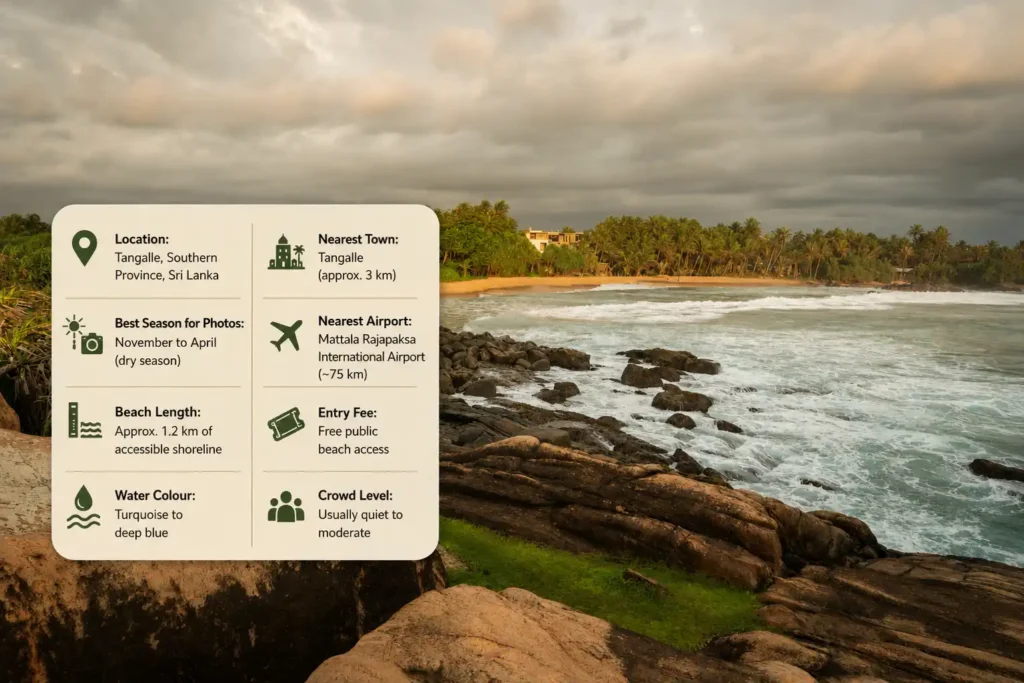
Before we get into the photography gold, here’s a quick overview of the beach itself, the kind of thing you’d want to know before you show up with your camera bag and no plan.
| Feature | Details |
| Location | Tangalle, Southern Province, Sri Lanka |
| Best Season for Photos | November to April (dry season) |
| Beach Length | Approx. 1.2 km of accessible shoreline |
| Water Colour | Turquoise to deep blue, depending on depth |
| Nearest Town | Tangalle (approx. 3 km) |
| Nearest Airport | Mattala Rajapaksa International Airport (~75 km) |
| Entry Fee | Free public beach access |
| Crowd Level | Low to moderate (still under the tourist radar) |
The beach sits in a gently curved bay sheltered by rocky headlands on both sides, which does something genuinely special to the light, especially in the morning and late afternoon. The Sri Lanka Coast Conservation Department classifies this section of shoreline as a protected coastal zone, which means development is restricted and the natural scenery stays intact. That’s good news for photographers.
Get to know this hidden Sri Lankan beach. Read more in Goyambokka Beach Sri Lanka Travel Guide: This Beach Feels Like a Secret for the essentials.
First Impressions: The View That Stops You in Your Tracks
The first thing that hits you is colour. The water at Goyambokka is almost cartoonishly turquoise in the shallows, the kind of blue-green that makes you think your phone camera is adding a filter when it isn’t. Locals who’ve lived near Tangalle for generations say the colour is caused by the combination of white sand base and the shallow reef shelf just offshore. Dr. Nimal Dissanayake of the University of Ruhuna’s Department of Marine Sciences has noted that Sri Lanka’s southern coastline has some of the clearest coastal waters in the Indian Ocean due to its distance from major river sediment flows.
Backed by tall coconut palms leaning slightly over the sand, and framed by rust-coloured rocky outcrops at each end of the bay, the view is genuinely striking. Not just ‘nice beach,’ striking, properly cinematic.
Best Photo Spots Around Goyambokka Beach
Let’s be specific, because ‘the whole beach is photogenic’ isn’t actually useful. Here are the 11 spots that consistently deliver the best frames:
- The northern rock platform at low tide creates natural leading lines into the ocean
- The southern cliff path (5-minute walk from the main beach): elevated views with no tourists
- The line of leaning coconut palms at the mid-beach stretch: classic Sri Lankan beach framing
- The tidal pools near the headland: incredible macro photography potential
- The beach at the golden hour (5:30–6:15 PM): warm light, long shadows, empty sand
- The lagoon entrance at the northern end: calm, reflective water, especially at dawn
- The reef line visible from shore: stunning with a polarising lens filter
- The small fishing boat mooring area: great for lifestyle and documentary shots
- The treeline-to-sea composition from the southern end looking north
- The clifftop viewpoint (see section below): arguably the best wide-angle shot in the area
- The beach at blue hour (just after sunset): deep indigo sky meets the lit shoreline
The Famous Palm-Fringed Shoreline
If there’s one image that defines Goyambokka beach photos & views on every travel platform, it’s the palm-fringed shoreline. The coconut palms here aren’t planted in neat rows like a resort garden; they lean naturally, some almost horizontal over the sand, in the way that only happens when trees grow in open coastal conditions for decades. The Sri Lanka Coconut Research Institute estimates the palm groves along Tangalle’s southern coast are 40–80 years old on average. That age shows in the character of the trees.
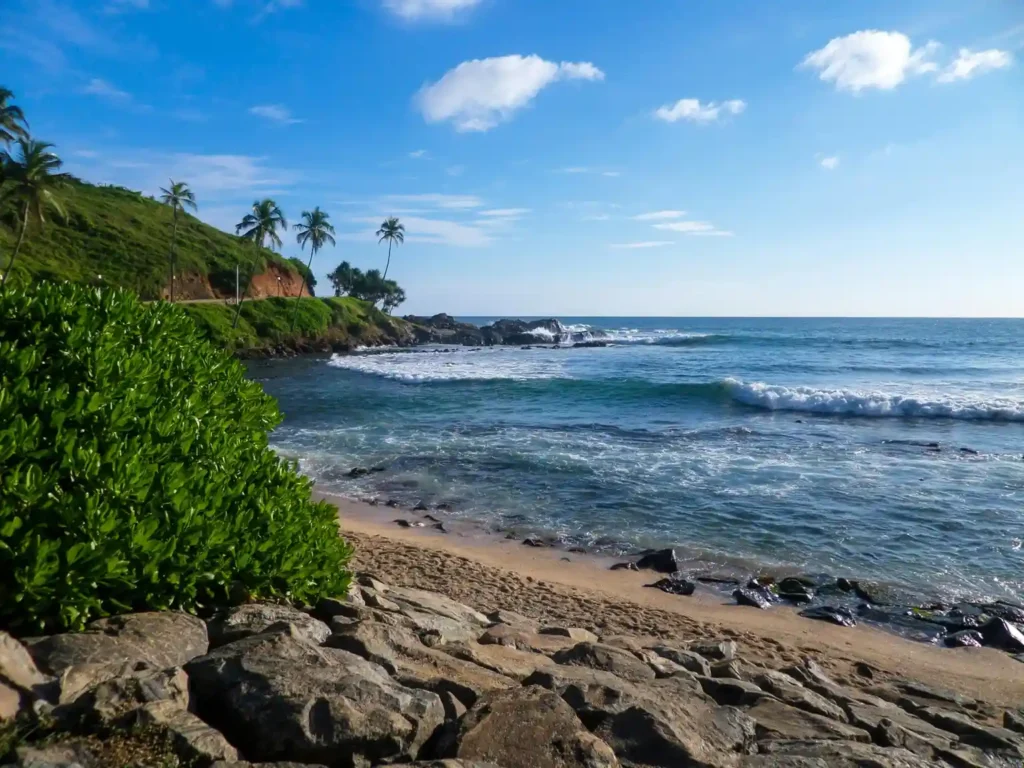
The best framing technique here is to position yourself directly beneath one of the leaning palms and shoot toward the ocean with a wide-angle lens. You get the palm fronds acting as a natural canopy, the white sand running to the water, and the turquoise sea in the background. It’s a strong composition, and it works in any direction of light.
Crystal-Clear Water and Golden Sand Views
One thing that surprises most first-time visitors is how clear the water actually is. On a calm day, which is most days between December and March, you can see the sandy bottom in depths of up to 4 metres from shore. The water clarity here has been informally measured by divers at the Goyambokka area at visibility exceeding 15 metres on calm days, according to dive operators based in Tangalle town.
The sand is a pale, almost white gold. Fine-grained, not coarse. It catches light beautifully at sunrise and turns a warm amber in the late afternoon. Overhead midday sun flattens everything out and kills the texture; avoid shooting the sand itself between 11 AM and 2 PM.
Light Conditions by Time of Day
| Time of Day | Light Quality | Best Subjects | Avoid |
| 5:30 – 7:00 AM | Soft golden-pink, low angle | Sunrise, reflections, silhouettes | Nothing – ideal all round |
| 7:00 – 10:00 AM | Warm, directional | Water colour, palms, wide shots | Harsh shadows forming |
| 10:00 AM – 2:00 PM | Harsh overhead | Underwater clarity (snorkel shots) | Sand texture, portraits |
| 2:00 – 4:30 PM | Warm, side-lit | Coastal rocks, wave action | Can be hazy |
| 4:30 – 6:15 PM | Golden hour – exceptional | Everything. Seriously. | Nothing |
| 6:15 – 7:00 PM | Blue hour | Sky-to-sea compositions, long exposure | Needs tripod |
Sunrise or Sunset: Which Looks Better Here?
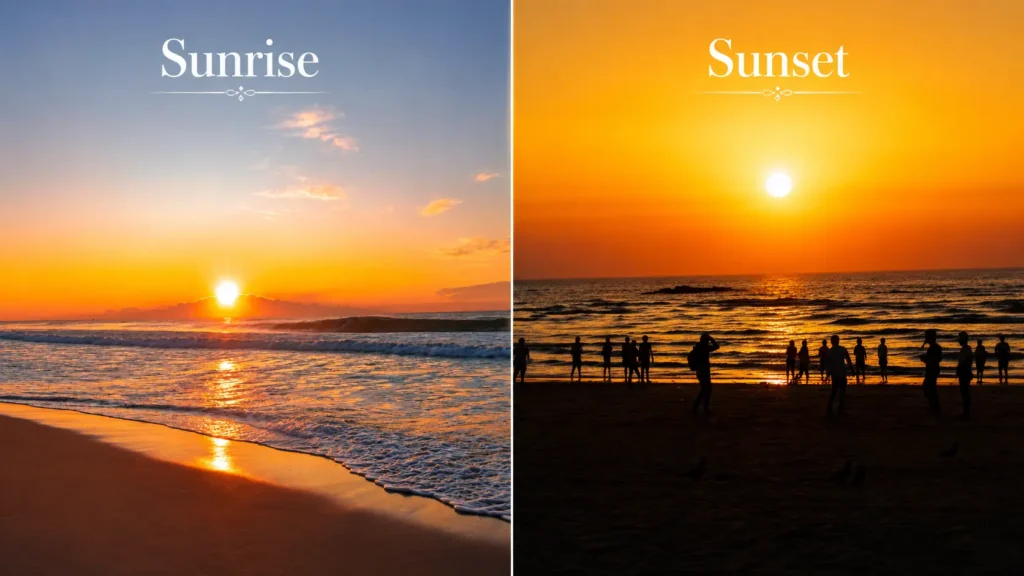
This is the question every photographer asks, and there’s actually a clear answer for Goyambokka: sunset wins. The beach faces roughly south-southwest, so the setting sun drops behind the land to the west and throws incredible lateral light across the bay. Sunrise gives you beautiful soft pink tones reflected in the water, but the sun rises behind you (to the east), so you’re shooting into shadow on the beach itself. Still beautiful, just different.
For sunset, position yourself anywhere along the central beach stretch and face south. The horizon is completely open ocean, no islands, no haze on a clear day, and you get the full sun-on-water effect as it drops. I’ve seen this sunset turn the water completely orange-gold in the last few minutes before the sun disappears. Locals say this happens most reliably between November and February.
What Time Is Sunset at Goyambokka Beach?
Sunset at Goyambokka beach (near Tangalle, Sri Lanka) falls between approximately 6:00 PM and 6:20 PM from November to April. During peak dry season (December–February), golden hour begins around 4:30 PM, and the sky can remain vivid until 6:30 PM or later. The Sri Lanka Meteorological Department provides accurate daily sunset times for the Tangalle district through its official weather portal.
Clifftop Views You Shouldn’t Miss
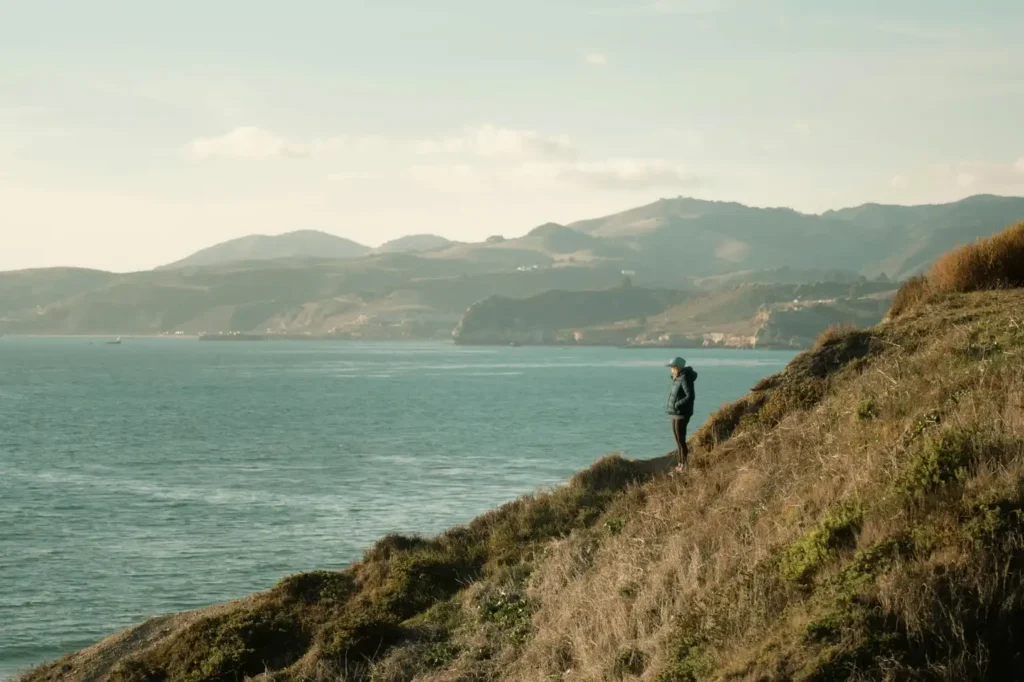
About a five-minute walk south along the coast path from the main beach, there’s a rocky clifftop that most visitors never find because there’s no signage. The view from up there is one of the best wide-angle coastal shots I’ve seen in Sri Lanka. You get the full sweep of Goyambokka Bay below you, the palm-fringed beach curving away to the north, the reef line visible as a slightly darker band in the water, and the open Indian Ocean beyond.
The Tangalle Urban Council and the Ceylon Tourist Board have flagged this section of coast as an area of outstanding natural scenic value in regional planning documents, though official viewpoint infrastructure doesn’t yet exist. Go carefully on the rocks, they’re uneven and can be slippery in the morning dew.
Is There a Clifftop Viewpoint at Goyambokka Beach?
Yes. An unmarked clifftop viewpoint exists approximately 400 metres south of the main Goyambokka beach access point, reached via a coastal walking path. It provides an elevated panoramic view of the bay and is considered one of the best wide-angle photography locations on the Tangalle coastline. There are no official facilities or signage at this location as of 2024.
Beach Photos in Different Seasons
Sri Lanka has two monsoon seasons, and the timing matters enormously for photography. The Southwest Monsoon (May–September) brings heavy rain and rough seas to the south coast, making photography challenging and swimming dangerous. The Northeast Monsoon largely misses the southern coast. Here’s a seasonal breakdown:
| Season | Months | Photography Conditions | Sea State |
| Peak Dry Season | Dec – Feb | Excellent. Clear skies, calm water | Flat calm |
| Shoulder Dry | Nov & Mar–Apr | Very good. Occasional cloud adds drama | Mostly calm |
| Pre-Monsoon | May | Interesting sky drama, unpredictable light | Choppy |
| Southwest Monsoon | Jun – Sep | Challenging. Rain, grey skies | Rough/unsafe |
| Post-Monsoon | Oct – Nov | Improving rapidly, fewer crowds | Settling down |
According to the Sri Lanka Tourism Promotion Bureau’s annual visitor data, November through March accounts for over 68% of all tourist visits to the southern coastal zone. There’s a reason everyone goes at the same time.
Hidden Corners Most Visitors Walk Past
The tidal rock pools at the northern headland are genuinely overlooked. Most people head for the open sand and never notice them. On a low tide morning, these pools are alive with small crabs, colourful sea anemones, and tiny fish, incredible for macro photography and for those lifestyle travel shots where someone is crouching down looking at something interesting.
There’s also a small lagoon-like inlet tucked behind the northern rocks where the water is almost completely still. Reflections of the palms and sky in this inlet are extraordinary in the early morning. I spent 40 minutes here alone, which felt indulgent but produced some of my best shots from the whole trip. A local fisherman named Pradeep, who’s been working this coastline for over 20 years, pointed it out. It’s not on any map.
Hidden Photography Spots at Goyambokka Beach
The best hidden photography spots at Goyambokka beach include: (1) the tidal rock pools at the northern headland accessible at low tide, (2) the small sheltered lagoon inlet behind the northern rocks, (3) the clifftop path south of the main beach with no signage, and (4) the reef line visible from shore with a polarising filter. None of these locations appears on standard tourist maps.
Drone Views of Goyambokka Beach
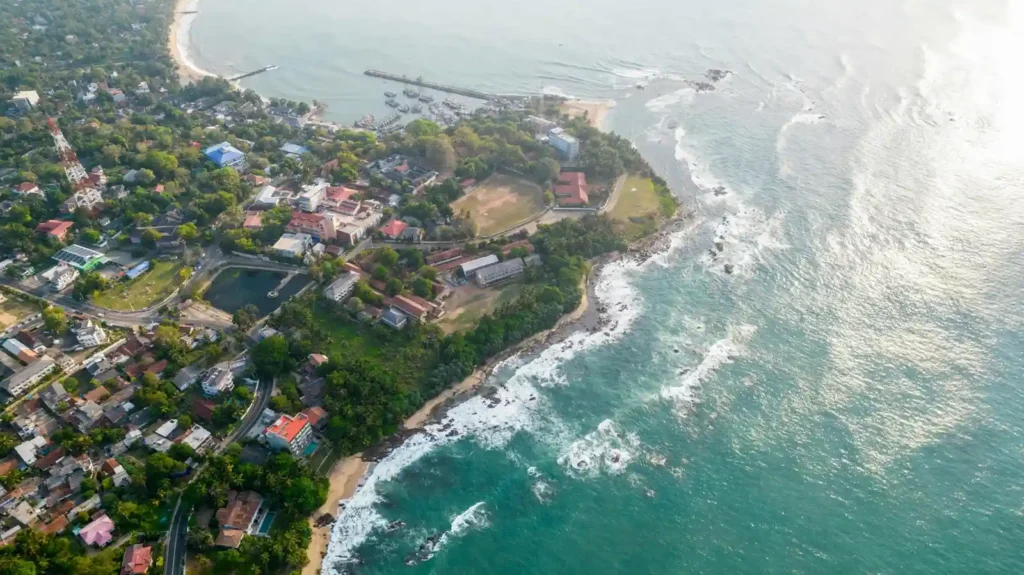
From above, the bay shape becomes even more dramatic, a perfect crescent of white-gold sand with vivid turquoise water inside the reef, deepening to dark blue at the ocean boundary. The palm canopy along the beach edge is clearly visible from altitude, and the rocky headlands on both ends frame the composition naturally.
Important note on regulations: The Civil Aviation Authority of Sri Lanka (CAASL) requires all drone operators to register their drone and obtain flight authorisation before flying in Sri Lanka, including coastal areas. Unregistered drone flights carry fines. Apply through the CAASL portal at least 7 days before your planned flight. This is worth doing; the aerial shots are spectacular.
Can You Fly a Drone at Goyambokka Beach?
Yes, but drone flights at Goyambokka beach require prior authorisation from the Civil Aviation Authority of Sri Lanka (CAASL). All drones must be registered, and flight permits must be obtained through the CAASL official portal before flying. Operating an unregistered drone in Sri Lanka carries financial penalties. There are no permanent no-fly zone restrictions specifically over Goyambokka beach as of 2024, but standard coastal flying regulations apply.
What the Beach Looks Like on a Calm Day vs. a Rough Day
On a calm day (December through February, typically), the water inside the bay is almost mirror-flat in the morning. The colour shifts from pale mint green in the shallows to vivid turquoise further out. The sand looks dry, pale, and clean. The reflections are almost too perfect, the kind of thing that makes photos look edited when they aren’t.
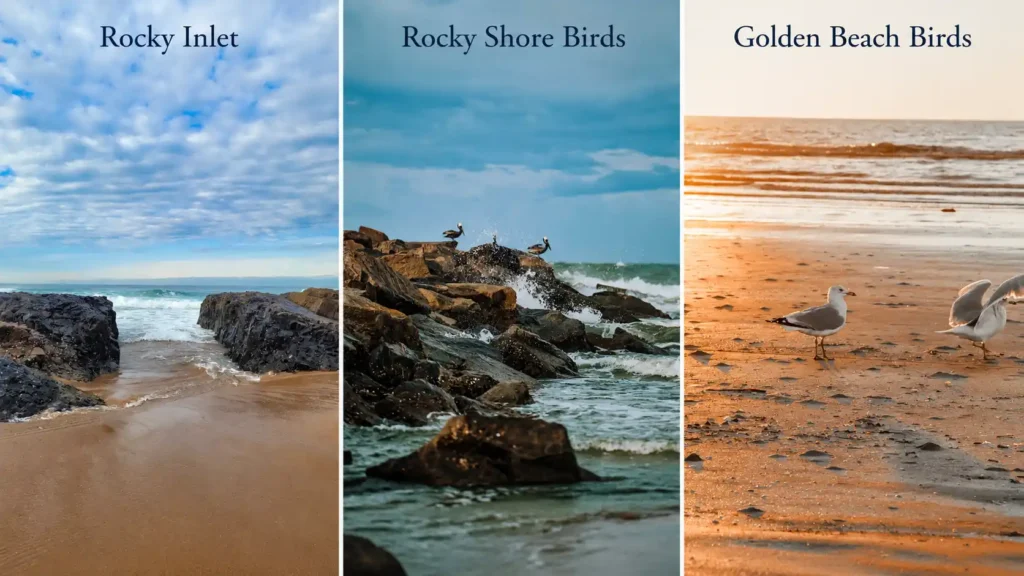
On a rougher day, common in May and October, the character of the beach changes completely. Waves break harder against the northern rocks, sending occasional spray metres into the air. The water turns a deeper, moodier blue-grey. The beach itself empties of swimmers. Honestly? Those conditions produce completely different but equally compelling photos. The wave action against the headland rocks is dramatic. It just requires different settings and a slightly more cautious approach.
Wildlife and Nature Shots Around the Beach
The beach and surrounding area offer more wildlife photography opportunities than most visitors expect. Here’s what you’re likely to encounter:
- Sea turtles: Green and Hawksbill turtles nest on nearby beaches. The Turtle Conservation Project (TCP), a Sri Lankan NGO operating since 1993, monitors nesting activity along this coastline. Sightings from shore are possible during nesting season (October–April)
- Stilt fishermen: Traditional stilt fishermen are occasionally visible at nearby Koggala and Ahangama, though less common at Goyambokka specifically
- Coastal birds: Brahminy Kites, White-bellied Sea Eagles, and several kingfisher species are regularly observed. The Wildlife Conservation Society of Sri Lanka lists this coastal zone as a significant bird observation area
- Reef fish visible from shore: In clear water conditions, schools of small reef fish are visible from the beach in ankle-deep water
- Land monitor lizards: Common throughout the coastal vegetation, often photographable from close range
What Wildlife Can You See at Goyambokka Beach?
Wildlife commonly seen at and near Goyambokka beach includes: sea turtles (Green and Hawksbill species, particularly during October–April nesting season), White-bellied Sea Eagles and Brahminy Kites, land monitor lizards, reef fish visible from shallow water, and various kingfisher species. The Turtle Conservation Project (TCP) has been monitoring the wider Tangalle coastline since 1993 and confirms this area as an active turtle habitat.
Best Time of Day for Taking Photos
Already covered light quality above, but here’s a priority ranking for planning your time:
- Priority 1: Golden hour (4:30–6:15 PM): highest-quality light, warm tones, long shadows
- Priority 2: Blue hour (6:15–7:00 PM): extraordinary sky colours, need tripod
- Priority 3: Sunrise (5:30–7:00 AM): softer light, almost no other visitors
- Priority 4: Mid-morning (7:00–9:30 AM): good water colour, palm shadows on sand
- Avoid: 11 AM–2 PM for landscape/beach shots (overhead light is flat and harsh)
Real Visitor Photos vs. Reality: Does It Match?
Genuinely, yes, more than most places. The photos you see of Goyambokka beach on platforms like Instagram and travel blogs represent the real place accurately, which isn’t something you can say about every beach. There’s no filter-dependent enhancement happening here. The water really is that colour. The palms really do lean that way.
What the photos don’t always show: the beach is not entirely litter-free (typical of Sri Lankan public beaches without resort management), there are occasional small fishing boat motors, and some sections of the sand near the access point can be a bit cluttered. Walk 200 metres in either direction, and you get clean, unobstructed shots. The Sri Lanka Tourism Authority’s 2023 Coastal Cleanliness Assessment rated the Tangalle southern coastal zone as ‘moderate’ in terms of beach cleanliness compared to resort-managed beaches like Mirissa or Unawatuna.
Photography Tips for First-Time Visitors
| Tip | Why It Matters | Gear Suggestion |
| Arrive before sunrise | Empty beach, soft light, calm water reflections | Wide-angle lens, tripod |
| Use a polarising filter. | Cuts water surface glare, reveals the reef colour | CPL filter (77mm+) |
| Shoot from the water level. | Transforms ordinary waves into dramatic foregrounds | Waterproof housing or bag |
| Walk south to the cliff path. | Elevated perspective that most visitors miss completely | Any camera |
| Stay for blue hour | Sky turns deep indigo over open ocean | Tripod essential |
| Visit tidal pools at low tide. | Unique macro and wildlife shots in natural pools | Macro lens or close-up mode |
| Check sea conditions first. | Rough days change the shooting angles needed | Weather app or local advice |
What Camera Settings Work Best at Goyambokka Beach?
For Goyambokka beach photos, recommended settings include: ISO 100–200 for golden hour shots in bright conditions; f/8–f/11 for landscape depth of field; shutter speed 1/500s or faster for waves in motion, or 1/4s–2s for silky water effects with a tripod. For blue hour, use ISO 400–800, f/8, and shutter speeds of 5–30 seconds depending on available light. A polarising filter is highly recommended for all water-facing shots to manage surface glare.
Is Goyambokka Beach Worth Visiting for Photography?
Yes. Goyambokka Beach is considered one of the most photogenic beaches on Sri Lanka’s southern coast. Its combination of a sheltered bay, palm-fringed shoreline, turquoise water, rocky headlands, accessible clifftop viewpoints, and limited tourist development makes it consistently rewarding for both amateur and professional photographers. The Sri Lanka Tourism Development Authority has identified the Tangalle coastal zone, which includes Goyambokka, as a priority area for sustainable tourism growth due to its exceptional natural scenic quality.
Final Thoughts on Goyambokka Beach’s Picture-Perfect Views
The reason Goyambokka beach photos & views keep appearing in ‘hidden gem’ articles is not hype; it’s because the place genuinely delivers. It’s the combination of things that makes it photogenic rather than any single feature: the curved bay, the colour of the water, the character of those leaning palms, the rocky headlands, the elevated clifftop views, and the fact that it’s still relatively quiet compared to the more famous beaches further west.
It won’t stay hidden forever. Visitor numbers are rising. But right now, in 2024–2025, you can still walk the southern cliff path alone at sunset and have the whole panorama to yourself. When that stops being true, the photography gets harder. This is the time to go.
One last thing: the locals are genuinely warm and won’t mind you photographing the beach or the natural surroundings. Just ask before photographing people directly, it’s common courtesy and goes a long way. A few words in Sinhala, or simply a smile and a gesture asking permission, open almost every door.
Frequently Asked Questions
Q: How do I get to Goyambokka Beach from Colombo?
The most common route is by bus or train to Tangalle town (approximately 4–5 hours from Colombo by express), then a tuk-tuk to Goyambokka beach (approximately 10–15 minutes, around 3 km). A hired car or taxi is faster and more comfortable. The Mattala Rajapaksa International Airport near Hambantota is approximately 75 km away for direct arrivals.
Q: Is Goyambokka beach safe for swimming?
Generally, yes, during the dry season (November–April). The bay’s sheltered position reduces strong currents compared to open beaches. However, no official lifeguard service operates here, and conditions change during the Southwest Monsoon (May–September) when swimming can be dangerous. The Sri Lanka Red Cross Society advises checking local conditions before entering the water at any unguarded beach.
Q: Are there hotels or guesthouses near Goyambokka beach?
Yes. Several small boutique guesthouses and eco-lodges operate within 1–2 km of the beach. The SLTDA-registered accommodation list for Tangalle district includes options ranging from budget guesthouses (approximately LKR 3,000–5,000 per night) to mid-range eco-properties (LKR 12,000–25,000). Larger resort options exist in nearby Tangalle town.
Q: Can I see the beach from any elevated viewpoint?
Yes. An informal clifftop viewpoint exists approximately 400 metres south of the main beach access point via a coastal walking path. The view encompasses the full bay, the palm shoreline, and the open ocean. There are no official facilities at this viewpoint. The walk takes approximately 5–7 minutes on uneven rocky terrain.
Q: What is the best month to visit Goyambokka Beach for photography?
January is widely considered the best month for beach photography on Sri Lanka’s south coast, including Goyambokka. The dry season is well established, winds are light, the sea is calm, and skies are consistently clear. December and February are close alternatives. The Sri Lanka Meteorological Department’s climate data for the Tangalle district confirms that January has the highest percentage of clear-sky days annually.