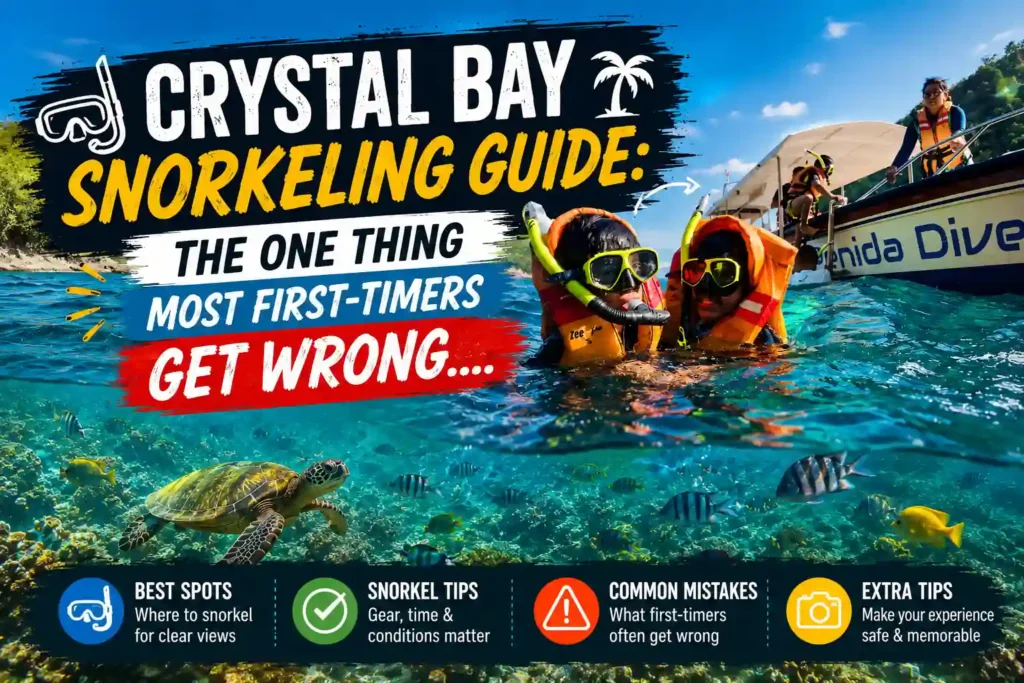
Crystal Bay is one of the best snorkeling spots in Nusa Penida thanks to its clear water, healthy coral reefs, sea turtles, and seasonal manta ray sightings. This guide covers costs, safety, currents, visibility, and the best snorkeling areas.
Crystal Bay sits on the western tip of Nusa Penida island, about 45 minutes by fast boat from Sanur Beach, Bali. The bay itself is calm-ish, with water so clear on good days you can see 15–20 meters down without any effort. It’s one of those spots where first-timers literally stop mid-swim just to stare. And this crystal bay snorkeling guide will make sure you’re ready when that moment hits.
What sets it apart from Padang Bai or Amed? The combination of visibility, biodiversity, and, on the right day, the genuine possibility of swimming alongside an oceanic manta ray. That’s not marketing. That’s just Crystal Bay being Crystal Bay.
Is Crystal Bay good for snorkeling?
Crystal Bay is one of the best snorkeling spots in Nusa Penida because it offers clear water visibility of up to 25 meters, healthy coral reefs, sea turtles, reef fish, and seasonal sightings of manta rays and mola mola. The calm main bay is suitable for beginners, while deeper areas attract experienced snorkelers and divers.
Where Crystal Bay Is and How to Get There
Crystal Bay is on Nusa Penida’s northwest coast, administratively part of Klungkung Regency, Bali. Here’s the deal with getting there:
- From Sanur Beach, Bali: Fast boat takes 35–45 minutes. Boats leave from roughly 7:30 AM onward. Expect to pay IDR 150,000–250,000 (~$9–$16 USD) one way.
- From Nusa Lembongan: Short 20-minute crossing. Easy day trip option.
- On Nusa Penida itself: Rent a scooter or hire a driver. The road to Crystal Bay is scenic but rough in parts; budget 40–60 minutes from Toyapakeh harbor.
One thing nobody warns you about: the final stretch of road to the bay is steep and narrow. If you’re on a scooter and it’s been raining, take it slow. Seen too many scraped knees from rushed descents.
Planning a visit? Learn where Crystal Bay is and the easiest ways to reach it: Read more in How to Get to Crystal Bay Without Wasting Time or Money.
What is the best time to snorkel at Crystal Bay?
The best time to snorkel at Crystal Bay is from May to September when visibility ranges from 15 to 25 meters, and sea conditions are generally calmer. Travelers hoping to see manta rays may have better chances between October and March, although water visibility is usually lower during this period.
Best Time to Go Snorkeling at Crystal Bay
Here’s a quick seasonal breakdown. Save this before you book:
| Season | Months | Visibility | Manta Ray Odds | Crowd Level |
| Peak Dry | May – Sep | 15–25m | Low–Moderate | High |
| Shoulder | Oct – Nov | 10–18m | Moderate–High | Medium |
| Wet Season | Dec – Mar | 5–12m | High | Low |
| Transition | Apr | Variable | Moderate | Medium |
Best overall window: May through September. Water is warmest (27–29°C), visibility peaks, and conditions are most beginner-friendly.
Here’s the twist, though: if seeing manta rays is your main goal, the wet season (December to March) actually gives you better odds. The mantas follow plankton blooms, and there’s more plankton when visibility is lower. So you trade picture-perfect clarity for a real shot at mantas. Worth knowing before you commit to a travel date.
How deep is Crystal Bay for snorkeling?
Crystal Bay’s main snorkeling area ranges from 1 to 8 meters deep, making it suitable for most swimmers. The northern reef reaches depths of around 15 meters, while waters beyond the headlands can exceed 20 to 25 meters and are best suited for advanced snorkelers and divers.
Crystal Bay Water Conditions: What to Expect
Crystal Bay has a split personality. Inside the sheltered part of the bay, calm, warm, relatively current-free. Around the headland toward the open ocean? Completely different story.
Water temperature stays between 24–29°C year-round. The bay itself usually gets 1–4 knots of current, which is manageable. But the channel between Crystal Bay and Nusa Ceningan can hit 4–8 knots during tidal shifts. That’s strong enough to sweep experienced swimmers off course.
Visibility averages 10–20 meters in the dry season. During the wet season, expect 5–12 meters but with occasional plankton patches that look almost otherworldly, bioluminescent at night, murky-green in the day.
Marine Life You Can Actually See Here
This is where Crystal Bay genuinely earns its reputation. The marine biodiversity here is legitimately impressive, even by Indonesian standards.
- Reef fish: Moorish idols, surgeonfish, parrotfish, and huge schools of fusiliers that swirl around you like living tornadoes.
- Turtles: Green sea turtles hang around the coral heads near the main beach, honestly a near-daily sighting.
- Mola mola (ocean sunfish): Crystal Bay is one of the few places on earth where you can see mola mola. They surface between July and October, drawn up from deeper water by the thermocline.
- Oceanic manta rays: More common in the wet season; size can reach 3–5 meters wingspan.
- Reef sharks: Whitetip and blacktip reef sharks patrol the deeper sections. They’re shy. You probably won’t notice them before they notice you.
The first time I saw a mola mola here, I honestly thought it was a piece of debris at first. It’s such a bizarre-looking fish. Then it slowly turned, and I realized I was about 4 meters from something the size of a small car.
Coral Reefs Around Crystal Bay
The reefs here are in genuinely good shape compared to many Bali-area sites. Hard coral coverage on the northern reef slope runs 40–65%, which is solid for this region according to reef health surveys published by the Coral Triangle Initiative (CTI-CFF).
Main coral zones:
- Shallow shelf (1–5m): Staghorn and plate corals. Good for beginners.
- Mid-reef (5–12m): Brain corals, sea fans, soft corals in orange and purple. Most photogenic zone.
- Deep wall (12m+): Dramatic drop-offs with gorgonian fans. Dive territory rather than snorkel.
The corals near the main beach took some bleaching damage in 2016 and 2019 (El Niño events) but have shown meaningful recovery. Avoid standing on anything; even one foot placement can set recovery back years.
Crystal Bay Snorkeling Map: Main Areas to Explore
Use this reference to plan which zone matches your skill level and goals:
| Zone | Location | Depth | Best For | Skill Level |
| Main Bay | In front of the main beach | 1–8m | Turtles, reef fish | Beginner |
| North Reef | Left from the beach (north) | 3–15m | Coral, mantas | Intermediate |
| South Point | Right headland | 5–20m | Mola mola, sharks | Advanced |
| Channel Entry | Between headlands | 8–25m | Pelagics, big stuff | Expert only |
Most organized snorkel tours take you to the North Reef and Main Bay. If you want the south point, you’ll likely need to go with a specialized dive/snorkel guide who knows the current patterns there.
Shore Snorkeling vs Boat Snorkeling, Which Is Better?
Shore snorkeling from the main beach is easy, free (beyond gear), and gives great access to the main bay zone. Turtles, reef fish, and shallow corals are all reachable from shore. Water entry is straightforward over sand and small stones.
Boat snorkeling gets you to the north reef and south point without fighting currents. Most day trips include 2–3 snorkel stops and cost IDR 350,000–600,000 (~$22–$38 USD) per person, including gear.
Honest opinion: if this is your first time at Crystal Bay and you’re not a strong swimmer, start with shore snorkeling to get comfortable, then consider a boat trip for the afternoon. Don’t let anyone pressure you into deeper spots on day one.
Do You Need a Guide or Can You Go Solo?
For the main bay and north reef in calm conditions, no, you don’t strictly need a guide. Plenty of confident snorkelers go independently every day.
But here’s when a guide is genuinely worth it:
- You want to reach the south point or channel area
- You’re visiting during tidal transitions (early morning or late afternoon)
- You’re traveling with kids or first-timers
- You specifically want mola mola or manta encounters, guides know the seasonal patterns
Local guides charge around IDR 150,000–300,000 ($9–$19 USD) for a 2-hour guided snorkel. Some boat operators include guides in the trip cost. Well-regarded local operators include Penida Fever Dive & Snorkel and Mahagiri Crystal Bay Tours, both based steps from the beach.
Snorkeling Gear Checklist for Crystal Bay
- Mask: Silicone skirt, anti-fog treated. Wide-view masks recommended for photography.
- Snorkel: Dry-top preferred if there’s any chop.
- Fins: Full-foot fins for warmer water. Open heel for current-heavy zones.
- Wetsuit or rash guard: A 2–3mm shorty is enough in the dry season. Adds thermal protection and protects from jellyfish.
- Reef-safe sunscreen: Non-negotiable. Chemical sunscreens are damaging the reefs here. Use mineral-based (zinc oxide).
- Underwater camera or GoPro: Red filter lens helps restore color at depth.
- Life jacket or snorkel vest: Rental available on the beach for IDR 20,000–30,000. Recommended for non-swimmers.
Entry Fees, Rentals, and Typical Costs
Budget breakdown for a Crystal Bay snorkeling day, no surprises:
| Item | Cost (IDR) | Cost (USD approx.) |
| Beach entry fee | IDR 10,000–20,000 | ~$0.60–$1.30 |
| Snorkel gear rental | IDR 50,000–75,000 | ~$3–$5 |
| Life jacket rental | IDR 20,000–30,000 | ~$1.25–$2 |
| Boat snorkel trip (shared) | IDR 350,000–600,000 | ~$22–$38 |
| Private guide (2 hrs) | IDR 150,000–300,000 | ~$9–$19 |
| Locker rental | IDR 20,000 | ~$1.25 |
| Warung lunch on the beach | IDR 40,000–80,000 | ~$2.50–$5 |
Total for a solo shore snorkel day: as low as IDR 80,000–120,000 (~$5–$8). Full boat trip day with guide: IDR 500,000–900,000 (~$31–$57). Crystal Bay is genuinely affordable by international standards.
Safety Tips Before Entering the Water
- Always check tide tables. Currents are strongest 1–2 hours either side of low or high tide.
- Never snorkel alone. The buddy system is basic, but people skip it. Don’t.
- Stay inside the bay flags. Yellow buoys mark the safe zone. Past them, currents become unpredictable.
- Know the exit points. Strong current can push you down the beach. Identify where you’ll exit before you enter.
- Don’t touch marine life. Not just about conservation — some corals sting, some fish bite.
- Hydrate. Hot sun + saltwater + physical effort = dehydration faster than you expect.
According to Bali’s SAR (Search and Rescue) Agency (Basarnas), Crystal Bay and the surrounding Nusa Penida waters account for a disproportionate share of water incident calls involving tourists. Currents are the main factor. Respect them.
Understanding Currents at Crystal Bay
How Strong Are the Currents at Crystal Bay?
This is the most important thing to understand. Crystal Bay sits in a current-prone zone where Indian Ocean water funnels through narrow island channels.
Inside the main bay: generally 1–3 knots. Manageable for most swimmers.
North reef edge and beyond: 3–6 knots during tidal movement. Experienced swimmers only.
South point and channel: can exceed 6 knots during spring tides. Not a snorkel zone unless you really know what you’re doing.
Currents here shift direction fast. What was calm at 8 AM can be pulling strongly by 10 AM. The safest window for most people is generally 7:30–10:00 AM and 2:00–4:00 PM during neap tides (smaller tidal range).
Can Beginners Snorkel at Crystal Bay?
Yes, but with boundaries. The main bay area is genuinely beginner-friendly in calm conditions. Shallow, clear, and full of interesting things to see at 2–4 meters depth.
What makes it trickier than average is the current potential. A beginner who drifts past the bay’s protective headland can find themselves in water that’s suddenly moving fast. Stay in the flagged zone, wear a snorkel vest if you’re not a confident swimmer, and you’ll be absolutely fine.
Families with older kids (8+) regularly have great experiences at Crystal Bay. It’s one of those places where the wow factor is high enough to make snorkeling converts out of reluctant non-swimmers.
Best Spots for Seeing Colorful Fish
The coral bommies (large individual coral heads) scattered across the northern end of the main bay are your best bet. They’re swarmed with anthias, damselfish, and parrotfish constantly.
Look for the large plate coral formations at 4–7 meters depth on the north reef, schools of 200+ yellowfin fusiliers are basically permanent residents there. Moorish idols, though, tend to be spotted more in the southern rocky sections near the headland.
Early morning (before 9 AM) is when fish activity is highest. Water is clearer before boat traffic kicks up sediment, and the angle of light filtering through the surface is genuinely beautiful for photography.
Chances of Spotting Manta Rays (and Reality vs Expectations)
Let’s be real here, because a lot of tour operators oversell this.
Manta ray sightings at Crystal Bay are not guaranteed. They’re not even common in the dry season. The mantas prefer the area around Manta Bay (Tanjung Benoa side of Nusa Penida) more consistently. Crystal Bay mantas tend to appear more in transitional months — October, November, and January–March.
Mola mola (ocean sunfish), on the other hand, are more reliably spotted here between July and October. The Mola Mola Research Project at the Institut Pertanian Bogor (IPB University) has tracked significant sunfish aggregations around Nusa Penida’s thermocline during this window.
Bottom line: don’t book Crystal Bay solely for mantas. Book it for the whole package, coral, fish, visibility, turtles, and treat a manta sighting as a bonus.
Crystal Bay for Families and Kids
Good news: Crystal Bay has a proper sandy beach, basic facilities, and shallow entry that works for families. A few practical things:
- Water shoes recommended for kids, the entry has some rocks and urchins in places
- Kids under 10 should wear a snorkel vest regardless of swimming ability
- Shade is limited on the beach; bring a beach umbrella or arrive before 10 AM
- The local warungs (food stalls) serve basic Indonesian food and snacks, Nasi Goreng, Mie Goreng, and cold coconut water
From personal experience: kids are absolutely mesmerized by the turtles here. If you can position a child near one of the coral bommies in about 2–3 meters of water and let a turtle surface nearby, that moment tends to stick for life.
Underwater Photography Tips at Crystal Bay
- Use a red filter: Below 3 meters, water absorbs red wavelengths. A clip-on red filter restores natural colors.
- Shoot in RAW if possible: Allows much more post-processing flexibility for color correction.
- Best light: 10 AM–noon when the sun is high and penetrates the water column directly.
- Get low: Shoot upward toward coral and fish against the surface light for dramatic shots.
- Be patient: Turtles here are surprisingly unafraid. Give them space, and they’ll often swim toward you.
- Waterproof housing: For smartphones, a universal underwater housing ($20–40) significantly improves photo quality vs a bare waterproof phone.
What to Wear and What to Bring
Keep it simple. Over-packing is real.
- Swimwear + rash guard (or thin wetsuit in wet season)
- Reef-safe mineral sunscreen, not negotiable at this protected site
- Dry bag for phone, cash, and anything electronic
- Water bottle, 1.5L minimum in dry season heat
- Small towel or sarong (dries fast, doubles as beach cover)
- Cash in IDR, vendors don’t take cards
- Snacks for the boat if you’re doing a tour
Nearby Beaches and Places Worth Visiting After Snorkeling
Nusa Penida rewards you for staying longer than just the snorkel. Within 30–90 minutes of Crystal Bay:
- Kelingking Beach: The T. rex cliff viewpoint. Instagram famous but legitimately stunning. 30 min by scooter.
- Atuh Beach: Quieter, with dramatic limestone formations. 45–60 min east.
- Broken Beach & Angel’s Billabong: Natural arch and tidal pool combo. 20 min from Crystal Bay.
- Toyapakeh mangroves: Short kayak tours available from Toyapakeh village harbor.
Food, Cafes, and Facilities Around Crystal Bay
Quick facilities guide so you know what to expect before you arrive:
| Facility | Available? | Notes |
| Restrooms | Yes | Basic, IDR 5,000 fee |
| Outdoor showers | Yes | Freshwater rinse post-swim |
| Food warungs | Yes (4–5 stalls) | Simple Indonesian food, IDR 25,000–60,000 |
| Gear rental | Yes | Multiple vendors, negotiate price |
| Lockers | Yes | Small, IDR 20,000 for the day |
| Parking | Yes | IDR 5,000 for a scooter |
Don’t expect cafes or WiFi on the beach. This is still a fairly raw location. That’s part of the appeal. Bring your own snacks if you’re picky.
Common Mistakes First-Time Visitors Make
- Going at high tide without checking current conditions: High tide can push strong water through the bay entrance.
- Skipping sun protection: Saltwater + tropical sun is brutal. People consistently underestimate exposure.
- Touching or standing on coral: Even once. Even accidentally. Just don’t.
- Renting cheap, broken gear from the first vendor: Test the mask seal before you pay. Leaky masks ruin the whole experience.
- Overscheduling: Crystal Bay is best with a relaxed pace. Don’t cram it between three other Nusa Penida stops in one day.
- Ignoring local advice on conditions: If a local tells you the current is strong today, believe them. They swim here daily.
Avoid common first-time mistakes at Crystal Bay and make your visit smoother: Read more in the Crystal Bay Nusa Penida Guide: Before You Go, Read These Local Tips First.
Sample Half-Day Crystal Bay Snorkeling Plan
7:00 AM: Arrive early. Parking is easy, the beach is nearly empty, and currents are typically at their calmest.
7:15–8:30 AM: Shore snorkel in the main bay. Hit the northern coral bommies first while the light is still low and fish are most active.
8:30–9:00 AM: Rest on the beach. Rinse, eat something from your bag, hydrate.
9:00–10:30 AM: Join a guided boat snorkel to the north reef. This is when organized tours start, easier to book the evening before.
10:30–11:30 AM: Warung breakfast: nasi goreng, cold coconut, maybe a banana pancake.
11:30 AM – 12:30 PM: Explore the southern headland viewpoint (no swimming; just views). Then head out toward Broken Beach before afternoon crowds build.
Final Thoughts: Is Crystal Bay Worth It?
Yes. Unreservedly.
Crystal Bay isn’t just another stop on the Nusa Penida checklist. It’s one of those places where the underwater world genuinely surprises you, even if you’ve snorkeled in a dozen countries. The visibility, the turtles, the coral health, the occasional something-big-and-unexpected, it adds up to an experience that’s hard to replicate.
Use this crystal bay snorkeling guide to go prepared, with the right time, right gear, and right expectations, and you’ll leave with one of your best travel memories. Go in blind, and you might still love it, but you might also miss the best bits or end up in a current situation you weren’t ready for.
Do the early morning, rent decent gear, stay in the bay flags, and let Crystal Bay do the rest. It rarely disappoints.
Have your own Crystal Bay story or tip? The best travel advice always comes from people who’ve actually been there.
FAQs About Crystal Bay Snorkeling
Is Crystal Bay good for snorkeling?
Yes. Crystal Bay offers excellent visibility (10–25m in dry season), healthy coral reefs, turtles, diverse reef fish, and rare pelagic encounters, including mola mola and manta rays.
What is the best time of year to snorkel at Crystal Bay?
May through September for best visibility and calm conditions. October–March for higher mola mola and manta ray activity.
How deep is the water at Crystal Bay for snorkeling?
The main bay is 1–8 meters. The north reef goes to 15 meters. Beyond the headlands, depths exceed 20–25 meters.
Are there dangerous currents at Crystal Bay?
Yes. Inside the main bay, currents are manageable (1–3 knots). Outside the bay, particularly around the south point and channel, currents can reach 6+ knots during tidal shifts.
Can non-swimmers enjoy Crystal Bay?
With a life jacket or snorkel vest, yes. The shallow main bay is calm enough for non-swimmers to see marine life from the surface safely.
Do I need to book a tour in advance?
Not strictly. Boat tours can usually be arranged on arrival, especially in the low season. However, in June–August, spots fill fast, so book at least a day ahead.
Is there a fee to enter Crystal Bay?
Yes, a small beach conservation fee of IDR 10,000–20,000 (~$0.60–$1.30 USD) is collected at the entrance. Subject to change.