
Boracay Island Places to Visit include White Beach’s three stations, the quieter Puka Shell Beach, the clear waters of Crocodile Island, and the island’s highest viewpoint at Mount Luho. Travelers can choose busy areas for restaurants, nightlife, and water activities, or visit quieter beaches for swimming and sunsets.
White Beach is best known for its long stretch of powdery sand, while Puka Beach offers a more natural setting, and Mount Luho provides wide views of the island and surrounding sea. With beaches, viewpoints, snorkeling areas, island-hopping stops, and different areas to stay, Boracay Island Places to Visit offer enough variety to help travelers plan a trip based on their interests and available time.
Boracay Places to Visit at a Glance
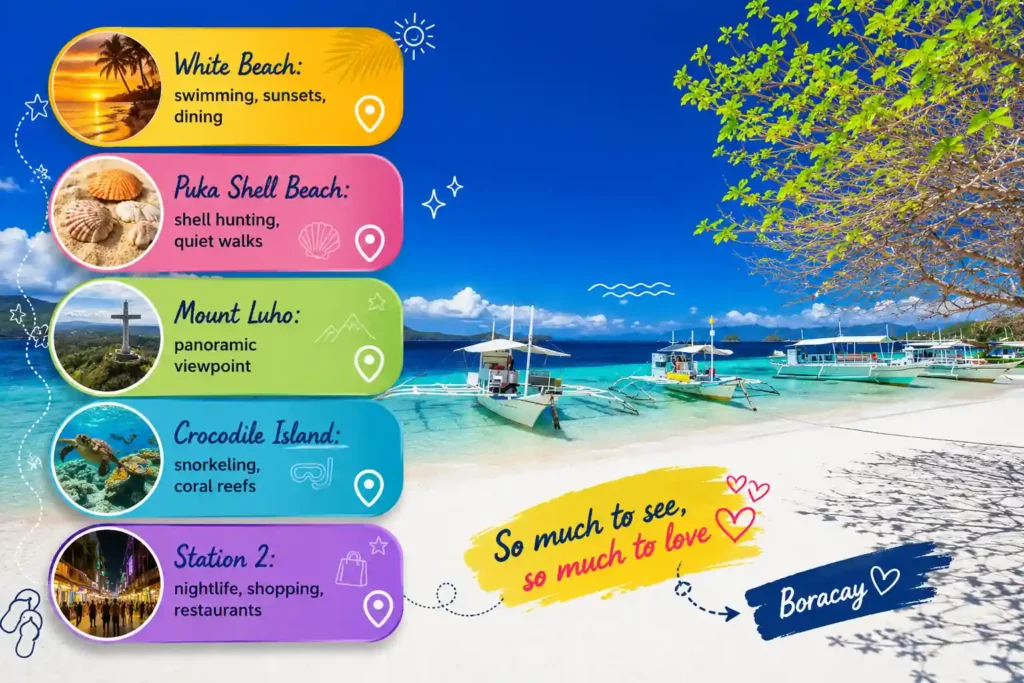
Five spots consistently top most 2026 itineraries: White Beach, Puka Shell Beach, Mount Luho, Crocodile Island, and the three connected stations. Each location offers something different, from calm swimming water to a panoramic viewpoint, so a smart itinerary usually mixes one beach, one scenic stop, and one snorkeling trip per day.
- White Beach: swimming, sunsets, dining
- Puka Shell Beach: shell hunting, quiet walks
- Mount Luho: panoramic viewpoint
- Crocodile Island: snorkeling, coral reefs
- Station 2: nightlife, shopping, restaurants
How Many Days Are Enough for Boracay’s Main Attractions?
Three full days give most travelers enough time to cover White Beach, a scenic viewpoint, and a snorkeling trip without feeling rushed. Two days work for a short escape centered on Station 1 and Station 2, while five days allow a slower pace with added stops at Crocodile Island.
Entrance Fees Every Visitor Should Know in 2026
A mandatory environmental fee of 300 Philippine pesos, about $5, applies to every tourist entering Boracay in 2026, alongside a 150-peso terminal fee charged at both entry and exit. The Provincial Government of Aklan collects these fees through the Boracay iPass system, and the funds go toward keeping beaches and public facilities maintained. The Department of Tourism (DOT) also caps carrying capacity at roughly 19,215 people at any given time, a limit meant to protect the ecology that makes these beaches worth visiting.
Boracay Island Places to Visit
White sand defines most people’s idea of Boracay, yet the island’s six main beaches each carry a distinct mood and crowd size. Families often gravitate toward the calm, developed stretch of White Beach, while shell collectors head north to Puka Shell Beach for a quieter shoreline. Strong wind conditions push kitesurfers toward Bulabog Beach, especially between November and April.
Find Out What Makes Boracay Island So Special. Read more in 9 Reasons Boracay Island Is Famous but Not for Everyone.
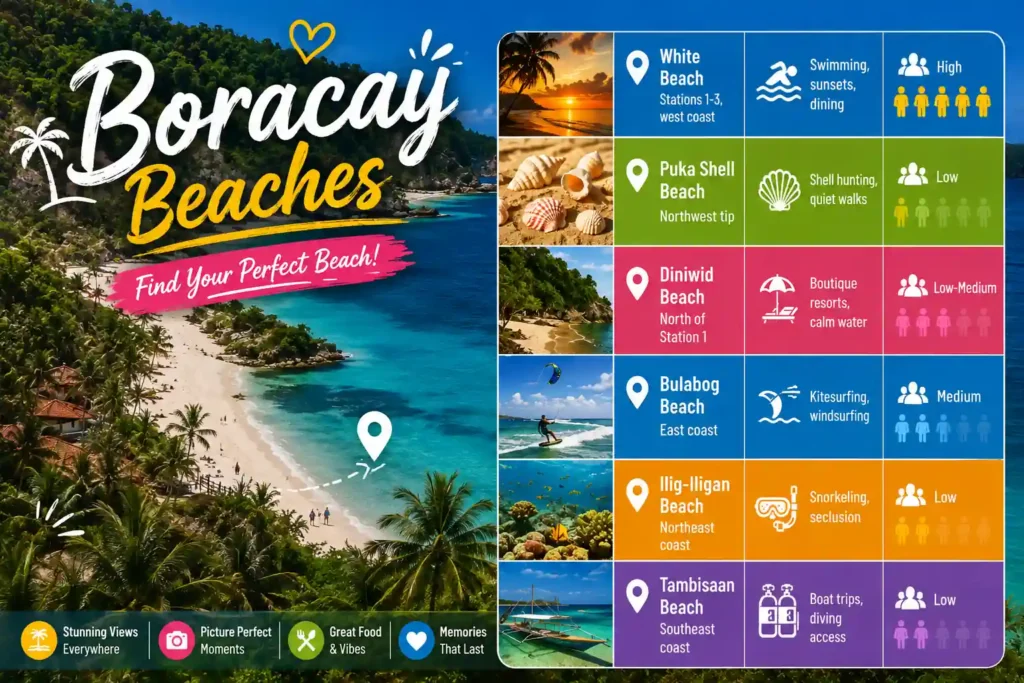
Diniwid Beach sits just north of Station 1, offering a smaller cove that feels calmer than the main strip. Ilig-Iligan Beach and Tambisaan Beach round out the list, both known for calmer water and easier access to dive sites. Weather shifts which beach suits a given day, so checking wind direction first saves a wasted trip. The table below breaks down each beach by location, vibe, and the activity it suits best.
| Beach | Location | Best For | Crowd Level |
| White Beach | Stations 1-3, west coast | Swimming, sunsets, dining | High |
| Puka Shell Beach | Northwest tip | Shell hunting, quiet walks | Low |
| Diniwid Beach | North of Station 1 | Boutique resorts, calm water | Low-Medium |
| Bulabog Beach | East coast | Kitesurfing, windsurfing | Medium |
| Ilig-Iligan Beach | Northeast coast | Snorkeling, seclusion | Low |
| Tambisaan Beach | Southeast coast | Boat trips, diving access | Low |
White Beach
Four kilometers of fine, powder-soft sand stretch along Boracay’s western coast, making White Beach the island’s most famous stop. Three sections, Station 1, Station 2, and Station 3, deliver noticeably different scenes, from upscale resorts to street food stalls. Sunset hour draws the biggest crowds, when the sky turns orange and traditional paraw sailboats drift past the shoreline. Cash still works better than cards here, since many beachfront vendors don’t accept digital payment.
Puka Shell Beach
Named after the shells once collected here for jewelry, this beach sits far from the main tourist strip on Boracay’s northwestern tip. Waves tend to run stronger than at White Beach, so morning swims work better once the wind picks up. Fewer vendors operate along this stretch, which keeps the atmosphere noticeably calmer. A short tricycle ride from Station 1 gets most visitors there in under twenty minutes.
Diniwid Beach
A narrow footpath connects Diniwid Beach to the northern end of White Beach, and that short walk filters out most casual day-trippers. Rock formations frame both ends of the cove, creating natural shade during the afternoon. Boutique resorts line the shore, so lunch options tend to run pricier than along the main strip. Clear, calm water most of the year makes rented snorkeling gear worth bringing.
Bulabog Beach
Steady winds from November through April turn Bulabog Beach into one of Southeast Asia’s better-known kitesurfing spots. Several schools along the shore offer beginner lessons, with equipment rental usually bundled into the rate. Shallow water near the shore keeps practice reasonably safe, though swimmers should stay clear of the marked kite zones. Sunrise views here often beat White Beach, since Bulabog faces east.
Ilig-Iligan Beach
Thick coconut groves surround Ilig-Iligan Beach, keeping the shoreline shaded and noticeably cooler than Station 1. Coral formations sit close enough to shore that snorkelers can explore without a boat trip. Facilities remain limited here, so visitors should pack their own water and sun protection. Pairing this beach with a nearby viewpoint makes for a solid half-day plan.
Tambisaan Beach
Local fishing boats still launch from Tambisaan Beach on Boracay’s southeastern side, giving the area a working shoreline feel. Dive operators use this beach as a launch point for trips to nearby reefs, including Crocodile Island. Rocky patches appear at low tide, so reef shoes come in handy before wading in. Fewer tourists visit this stretch, making it a solid pick for a break from the crowds.
Scenic Places to Visit in Boracay
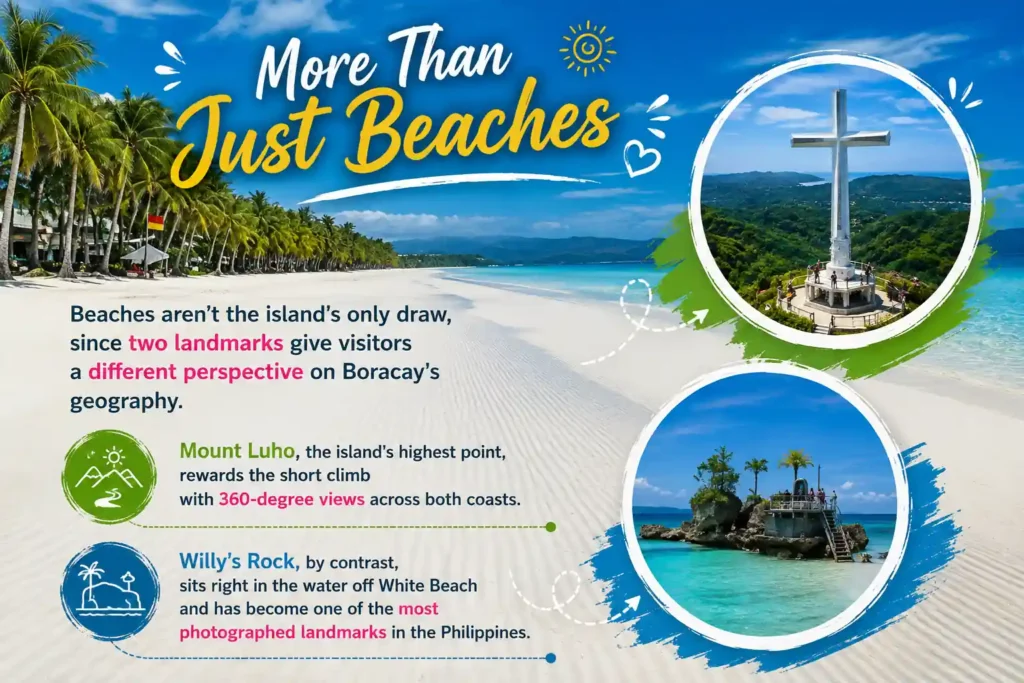
Beaches aren’t the island’s only draw, since two landmarks give visitors a different perspective on Boracay’s geography. Elevation changes everything here, turning a familiar coastline into a sweeping panorama. Mount Luho, the island’s highest point, rewards the short climb with 360-degree views across both coasts.
Willy’s Rock, by contrast, sits right in the water off White Beach and has become one of the most photographed landmarks in the Philippines. Both spots work well as short stops between beach sessions, needing only an hour or two. Weather plays a big role in visibility at Mount Luho, so clear mornings offer the sharpest views.
Mount Luho
Standing at roughly 100 meters above sea level, Mount Luho ranks as Boracay’s highest point and its best all-around viewpoint. Tricycles carry visitors most of the way up, leaving only a short flight of stairs to the observation deck. Entrance fees typically fall between $2 and $2.50, though rates and the deck’s condition vary, so confirming current status before heading up saves a wasted trip. Ziplines and ATV rentals operate nearby for travelers wanting more.
Willy’s Rock
A small shrine sits atop this volcanic rock formation just off White Beach, visible from nearly every point along Station 1. Low tide lets visitors wade out for photos beside the rock, while high tide keeps it surrounded by water. Sunset light hits the rock directly, making late afternoon the busiest time for photographers. No entrance fee applies here, since the rock sits in open water that anyone can reach.
Best Places for Snorkeling and Marine Life
Clear water and healthy coral patches make several spots around Boracay worth a snorkeling detour, even without a diving certification. Visibility usually ranges between 10 and 20 meters during the dry season, roughly November through May. Boat operators near Station 1 and Station 3 run half-day trips that combine two or three sites into one outing.
Crocodile Island and Coral Garden stand out as the most consistent options, both known for calmer water and healthier reefs than the beaches off White Beach. Life vests and gear are included in most tour packages, though renting a mask separately costs only a few dollars. The table below compares both spots by depth, marine life, and access point.
| Site | Depth | Marine Life | Access |
| Crocodile Island | 3-8 meters | Coral, reef fish | Boat trip from Station 3 / Tambisaan |
| Coral Garden | 2-5 meters | Coral, small fish, occasional turtles | Boat trip from Station 1 |
Crocodile Island
Named for its shape rather than any resident reptiles, Crocodile Island sits a short boat ride from Tambisaan Beach and offers some of the clearest water around Boracay. Coral coverage stays healthier here since boat traffic remains lower. Snorkeling tours typically combine this stop with Coral Garden, running around $15 to $25 per person. Strong currents can appear near the edges, so staying within the guided area matters.
Coral Garden
Shallow water and a wide spread of coral formations make Coral Garden a reliable stop for beginner snorkelers, including families with young children. Fish sightings here tend to be frequent, with clownfish, parrotfish, and the occasional sea turtle. Most day tours from Station 1 include this site as part of a three-island hopping package. The Department of Environment and Natural Resources (DENR) continues to monitor coral health across Boracay’s snorkeling sites, encouraging reef-safe sunscreen and no-touch, no-anchor policies to keep reefs intact.
Boracay Places to Visit by Area
Boracay’s White Beach splits into three stations, and each caters to a slightly different traveler despite sitting on the same continuous shoreline. Station 1 attracts travelers seeking upscale resorts and a quieter pace. Station 2 functions as the island’s commercial heart, packed with restaurants, bars, and the D’Mall shopping strip.
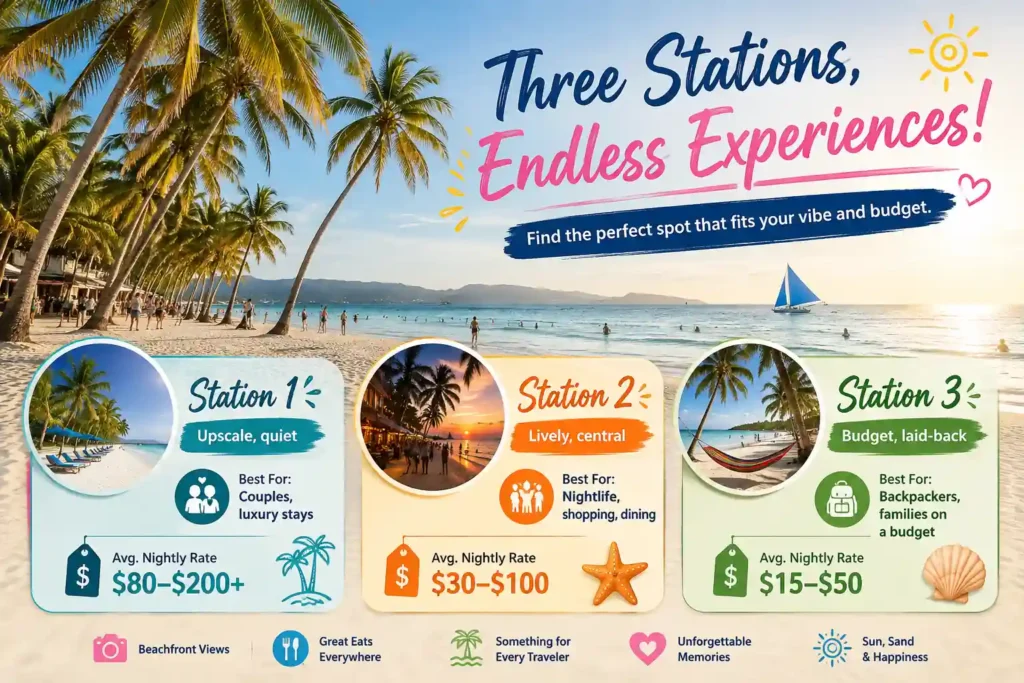
Budget-conscious travelers tend to settle in Station 3, where guesthouses cost noticeably less. Walking between all three stations takes under an hour, so switching areas for dinner rarely requires transport. The comparison below highlights what each station does best and roughly what it costs to stay there.
| Station | Vibe | Best For | Avg. Nightly Rate (USD) |
| Station 1 | Upscale, quiet | Couples, luxury stays | $80-$200+ |
| Station 2 | Lively, central | Nightlife, shopping, dining | $30-$100 |
| Station 3 | Budget, laid-back | Backpackers, families on a budget | $15-$50 |
Station 1
Wide, uncrowded sand and a string of upscale resorts define Station 1, making it Boracay’s quietest and most photogenic stretch. Diniwid Beach and the path to Willy’s Rock both sit within easy reach from here. Restaurant prices run higher than the rest of the island, though the trade-off is fewer crowds. Couples and travelers marking a special occasion often choose this station first.
Station 2
D’Mall anchors Station 2, surrounding visitors with restaurants, souvenir shops, and bars that stay busy well past midnight. Nearly every water sport operator and tour agency on the island keeps a presence somewhere along this stretch. Accommodation spans a wide price range, from mid-range hotels to hostel dorms a few blocks off the beach. First-time visitors usually base themselves here for easy access to everything nearby.
Station 3
Quieter and noticeably cheaper than the other two stations, Station 3 suits travelers who want beach access without resort prices. Local eateries here serve Filipino staples at a fraction of the cost found closer to D’Mall. Fewer beach clubs operate along this stretch, so evenings tend to run calmer. Ilig-Iligan Beach and Tambisaan Beach both sit within a short tricycle ride.
Choosing the Best Places to Visit in Boracay
The best Boracay Island Places to visit offer more than one famous stretch of sand. White Beach and its three stations provide swimming, sunsets, dining, nightlife, and accommodation for different budgets, while Puka Shell Beach, Diniwid Beach, Bulabog Beach, Ilig-Iligan Beach, and Tambisaan Beach offer quieter or more activity-focused alternatives. Mount Luho and Willy’s Rock add scenic views, while Crocodile Island and Coral Garden give visitors opportunities to explore coral reefs and marine life.
For most travelers, three full days are enough to combine a major beach, a scenic viewpoint, and a snorkeling trip without rushing, while five days allow time to explore the island at a slower pace. Whether you prefer luxury at Station 1, the busy atmosphere of Station 2, or the lower-cost and quieter setting of Station 3, planning your stops by area and activity will help you make the most of your Boracay trip.
FAQS
What is the most beautiful place to visit in Boracay?
White Beach generally earns that title, thanks to its powder-soft sand and consistently calm, turquoise water. Willy’s Rock and the sunset views near Station 1 add to the appeal.
What are the best beaches to visit in Boracay?
White Beach, Puka Shell Beach, and Diniwid Beach top most lists, each offering a different pace and crowd size. Bulabog Beach adds a fourth option for watersports fans.
What are the best places to visit in Boracay for first-time visitors?
White Beach, Willy’s Rock, and a snorkeling trip to Coral Garden cover the essentials without overloading a short itinerary. Mount Luho suits travelers with an extra afternoon.
What are the best free places to visit in Boracay?
White Beach, Willy’s Rock, Diniwid Beach, and Bulabog Beach charge no entrance fee, aside from the island-wide environmental and terminal fees.
How many days are enough to explore Boracay?
Three days cover the main highlights comfortably, while five days allow a slower pace with added trips to Crocodile Island. Two days work only for a White Beach-only visit.