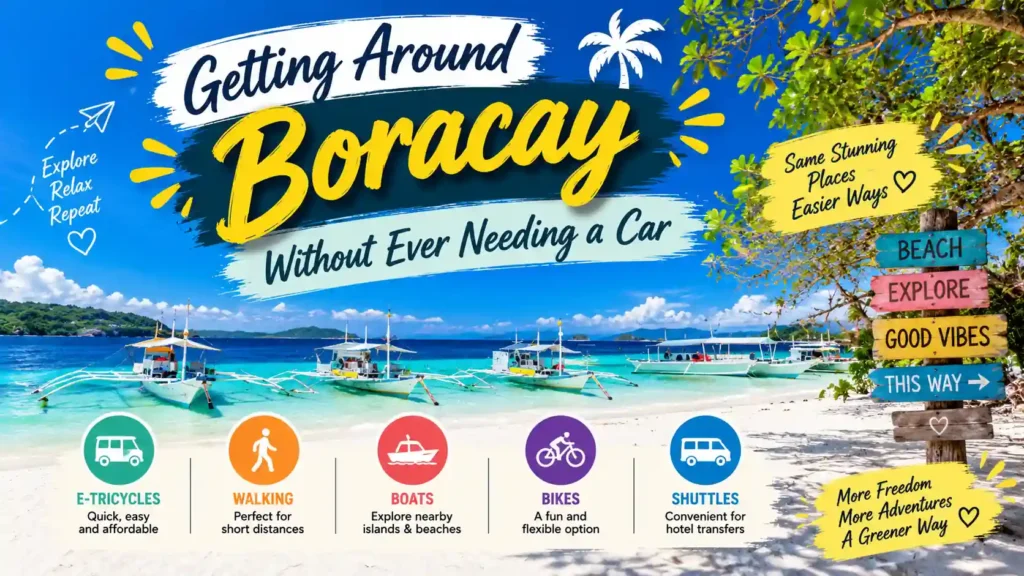
Boracay banned private cars from its 7-kilometer stretch of sand years ago, which means getting around Boracay comes down to three things: e-trikes, your own two feet, and a bit of patience. That single rule reshapes every plan you make on this island, from a $0.33 ride to D’Mall to a chartered land tour that eats half an afternoon. Getting around Boracay isn’t complicated once you know the fares, the routes, and which options actually save money, and that’s exactly what this guide breaks down.
This isn’t a city with grid streets and metered cabs. Boracay is a narrow island split into three main stations, connected by one coastal road and a sandy beach path that doubles as the fastest route on foot. Tricycles rule the road, a hop-on hop-off bus quietly fills the gaps, and ride-hailing apps behave in ways many visitors don’t expect. Here’s how each option actually functions in 2026, with honest costs converted to US dollars so nothing catches anyone off guard.
What Is the Best Way to Get Around Boracay?
E-trikes remain the fastest and most reliable way to cover long distances, especially between stations or out to Puka Beach in the north. Walking wins for anything under fifteen minutes, particularly along the beachfront where sand replaces asphalt and the scenery does most of the work. The hop-on hop-off bus fills the gap for visitors who want fixed fares and air-conditioning without haggling with a driver. Bicycles and e-bikes suit early risers who’d rather explore at their own pace than wait for a ride to fill up. Motorbikes exist too, though a strict local ordinance keeps rental costs high and limits rentals to a single operator. For most travelers, the smartest approach mixes two or three of these options together. Walk the short stretches, flag an e-trike for the rest, and save the HOHO bus for longer north-south trips.
Find the Easiest Ways to Explore Boracay. Read more in How to Get to Boracay Island Without Wasting a Travel Day.
Here’s a quick side-by-side look at every option, so it’s easier to match the right ride to the right trip.
| Mode of Transport | Best For | Approx. Cost (USD) | Availability |
| E-Trike (Shared) | Short-to-medium trips, station-to-station | $0.25 – $0.85 | 5:00 AM – 1:00 AM |
| E-Trike (Charter) | Private rides, land tours | $1.65 – $8.20 | 5:00 AM – 1:00 AM |
| Walking | Trips under 15 minutes, beach path | Free | 24 hours |
| Hop-On Hop-Off Bus | North-south trips, fixed fares | $0.21 – $0.52 | 5:00 AM – 9:00 PM |
| Bicycle / E-Bike | Self-paced sightseeing | $2.45 – $14.75/day | Daylight hours recommended |
| Motorbike Rental | Longer exploration, licensed riders | $16 – $50/day | Business hours, MASCO office |
Is Getting Around Boracay Easy Without a Car?
Yes, moving around the island doesn’t require a car, mainly because private vehicles aren’t allowed in the first place. Car cover the main road end to end, the beach path connects all three stations on foot, and a hop-on hop-off bus now runs the length of the island for a few pesos a ride.
E-Trikes in Boracay
E-trikes became Boracay’s official ride after the island’s 2018 rehabilitation, part of a wider push led by the Department of Transportation (DOTr) to phase out older, noisier tricycles. Today, shared e-trikes run along the main road from roughly 5:00 AM until around 1:00 AM, picking up passengers headed the same general direction. A short shared hop, say from Station 2 to D’Mall, typically costs $0.25 to $0.85 per person, depending on distance and group size.
Chartering the whole vehicle runs $1.65 to $6.55, while an hourly land tour to Puka Beach or Mount Luho costs around $8 for up to four passengers. Fares are technically fixed by an official rate sheet, with students getting a 30% discount and seniors 20% off, though drivers sometimes push for more on quiet nights. Agreeing on the price before the vehicle moves saves the negotiation later.
How Much Does an E-Trike Actually Cost in Boracay?
A shared e-trike ride costs between $0.25 and $0.85 per person, while chartering the whole vehicle runs $1.65 to $6.55. Hourly land tours cost around $8, for up to four riders, making e-trikes one of the cheapest ways to see the island.
Walking Around Boracay
Walking is the most underrated way to experience Boracay, and for short hops between stations, it’s often faster than waiting for a trike to fill up. White Beach stretches roughly 4 kilometers, split fairly evenly across Station 1, Station 2, and Station 3, with about 12 minutes of walking between neighboring stations along the sand. Covering the entire beachfront end to end takes 30 to 45 minutes at a relaxed pace.
The paved coastal road offers a faster, shadier alternative when the tide is high or the sand feels too soft underfoot. Most of the beach path stays lit and populated well into the evening, and it’s generally considered safe, though sticking to busier sections after dark remains sensible. Comfortable sandals or reef shoes help, since the sand near the shoreline gets uncomfortably hot at midday.
Hop-On Hop-Off Bus in Boracay
Boracay’s Hop-On Hop-Off (HOHO) bus, run by Southwest Tours in partnership with Top.ph, gives visitors a fixed-fare alternative to negotiating with e-trike drivers. The air-conditioned mini-buses come with Wi-Fi and CCTV, running the island’s length from Tambisaan and Cagban ports in the south to Puka Beach in the north. It stops at Stations 1 through 3 and Newcoast, with a bus passing roughly every 15 minutes between 5:00 AM and 9:00 PM.
Fares range from $0.21 to $0.52 by distance, and the system accepts only cashless payment through a HOHO QR Pass. Frequent riders can buy a 1-Day Unlimited Pass for around $3.30, often cheaper than several e-trike charters combined, per fare data from the Malay Municipal Transportation Office. It suits anyone who’d rather sit back with a fixed price than haggle.
Here’s how the HOHO bus fares and schedule break down, so there are no surprises at the boarding point.
| Detail | Information |
| Operator | Southwest Tours & Top.ph |
| Route | Tambisaan / Cagban Ports ↔ Puka Beach |
| Stops | Stations 1, 2, 3 & Newcoast |
| Frequency | Every ~15 minutes |
| Operating Hours | 5:00 AM – 9:00 PM |
| Fare Range | $0.21 – $0.52 |
| Day Pass | $3.30, unlimited rides |
Renting a Bike or E-Bike in Boracay
Renting a bicycle gives visitors more freedom to explore beyond the three main stations, including quieter beaches like Diniwid or the Newcoast area that most e-trikes skip. Rental shops cluster around Station 2 and Station 3, with prices starting around $2.45 per hour and dropping significantly for half-day or full-day rentals. Early morning, roughly between 6:00 and 8:00 AM, is the best window for cycling, since the main road carries far less tricycle traffic before the island fully wakes up.
E-bikes and self-drive e-trikes offer a motorized middle ground for travelers who want independence without the physical effort, typically renting for $10 to $30 per day. Both options work best on the paved main road rather than the sandy beach path, which isn’t built for wheels. Helmets and basic locks usually come included, though checking brakes and tires before riding off is always worth the extra minute.
This breakdown shows typical bike rental rates by duration, based on rates from established rental shops on the island.
| Rental Duration | Approx. Price (USD) |
| 1 Hour (2-hr minimum) | $2.45 – $4.90 |
| Half Day (6 hours) | $8.20 |
| Full Day (12 hours) | $14.75 |
| 1 Week | $65.55 |
| E-Bike / E-Trike (Self-Drive, per day) | $10 – $30 |
Renting a Motorbike in Boracay
Motorbike rentals work differently on Boracay than almost anywhere else in the Philippines, and the reason comes down to local policy. Under Municipal Ordinance No. 415, the Malay Local Government Unit (LGU) restricted motorbike rentals to a single authorized operator, the Malay Motorbike Service Cooperative (MASCO), after unregulated habal-habal rides added to island congestion. That keeps prices well above mainland rates: basic scooters run roughly $16 to $25 per day, with peak-season rates climbing to $50.
Renters need a valid driver’s license and must be at least 18, and checkpoints have grown stricter about enforcing this through 2026. An International Driving Permit isn’t legally required for short stays, but it simplifies things if police or insurance get involved after an accident. Given the cost, most visitors find e-trikes or bicycles simpler.
Is Grab Available in Boracay?
Grab does operate in Boracay, but not the way most visitors expect from other Philippine cities. The app’s main function on the island is Grab Dine Out, a restaurant discovery and discount feature covering more than 40 partner establishments, rather than a full ride-hailing service. Standard Grab car rides aren’t possible here, simply because private vehicles are banned from the island entirely.
Some limited e-jeepney and shuttle bookings through Grab have been piloted as part of the island’s transport modernization, though coverage stays inconsistent and isn’t guaranteed everywhere. Food delivery through Grab works reliably across most of the island, with restaurants delivering from late morning through evening. For actual transport, e-trikes and the HOHO bus remain the more dependable choice.
Getting Around Boracay at Night
Night transport runs later than many visitors assume, with e-trikes typically operating until around 1:00 AM near the main tourist stations. The HOHO bus stops earlier, wrapping up by 9:00 PM, so plan on e-trikes for any late dinner or bar-hopping night. Fixed fares still technically apply after dark, but some drivers quietly raise prices for longer routes once midnight passes, especially toward quieter stretches.
Sticking to well-lit areas around Stations 1 through 3 and Bulabog Beach makes walking and flagging a ride noticeably easier late at night. Confirming the fare before getting in, even for short trips, avoids most of the friction travelers report after dark. Booking accommodation near the nightlife hubs also cuts down on how much late-night transport gets needed.
Boracay Transportation Tips for First-Time Visitors
First-time visitors tend to overpay simply because they don’t know the fixed rates before their first ride, so it helps to memorize a few numbers before landing. Agreeing on the fare out loud before boarding an e-trike, even for a short hop, prevents the awkward haggling that catches most tourists off guard. Packing light matters more here than in most destinations, since narrow trike doorways and sandy paths aren’t kind to oversized luggage. Cash in small peso bills covers almost every option except the HOHO bus, which only takes its cashless QR pass. A few extra habits make the first few days smoother:
- Download offline maps beforehand, since signal gets patchy near the northern beaches.
- Carry a saved copy of the official e-trike fare matrix for quick reference.
- Avoid chartering an e-trike for a full day unless multiple stops are planned; shared rides work out cheaper.
- Wear closed shoes or grippy sandals, since trike floors and sandy paths get slippery.
- Keep small bills handy, since drivers rarely carry change for larger notes.
Getting Around Boracay on a Budget
Keeping transport costs low mostly comes down to walking whenever a trip falls under 15 minutes, since the beach path connects every station for free. Sharing e-trikes instead of chartering them cuts the fare from $1.65-plus down to as little as $0.25 to $0.33 per person, which adds up over a multi-day trip. The HOHO bus’s $3.30 unlimited day pass beats paying for individual rides when several trips are planned in one day. Bicycle rentals, starting around $2.45 an hour, offer a cheap middle ground for travelers who want mobility without a full-day motorbike rental.
Discover Why Boracay Island Belongs on Your Bucket List. Read more in 9 Reasons Boracay Island Is Famous but Not for Everyone.
Skipping motorbikes altogether saves the most overall, given the above-mainland pricing and added fuel costs. A realistic daily transport budget lands somewhere between $3 and $8, covering walking, shared e-trikes, and the occasional HOHO ride.
FAQs About Getting Around Boracay
What is the cheapest way to get around Boracay?
Walking and shared e-trikes are cheapest, since the beach path is free and a shared e-trike costs $0.25 to $0.85 per person.
How much does an e-trike cost in Boracay?
A shared ride runs $0.25 to $0.85 per person, a private charter costs $1.65 to $6.55, and an hourly land tour costs around $8 for up to four passengers.
Is there Grab in Boracay?
Grab operates mainly through Dine Out for restaurant discounts and food delivery. Standard ride-hailing is limited, since private vehicles aren’t allowed on the island.
Can I rent a motorbike in Boracay?
Yes, but only through MASCO, the island’s sole authorized rental cooperative. Renters need a valid license and must be at least 18, with rates of $16 to $50 per day.
Is Boracay walkable?
Yes. White Beach stretches about 4 kilometers, and walking between neighboring stations takes roughly 12 minutes.
Does Boracay have taxis or Uber?
No. Boracay has no metered taxis or Uber. E-trikes, tricycles, and the HOHO bus fill that role instead.
What time do e-trikes stop running at night?
Most operate from around 5:00 AM until roughly 1:00 AM, though fares may run higher for longer trips after midnight.