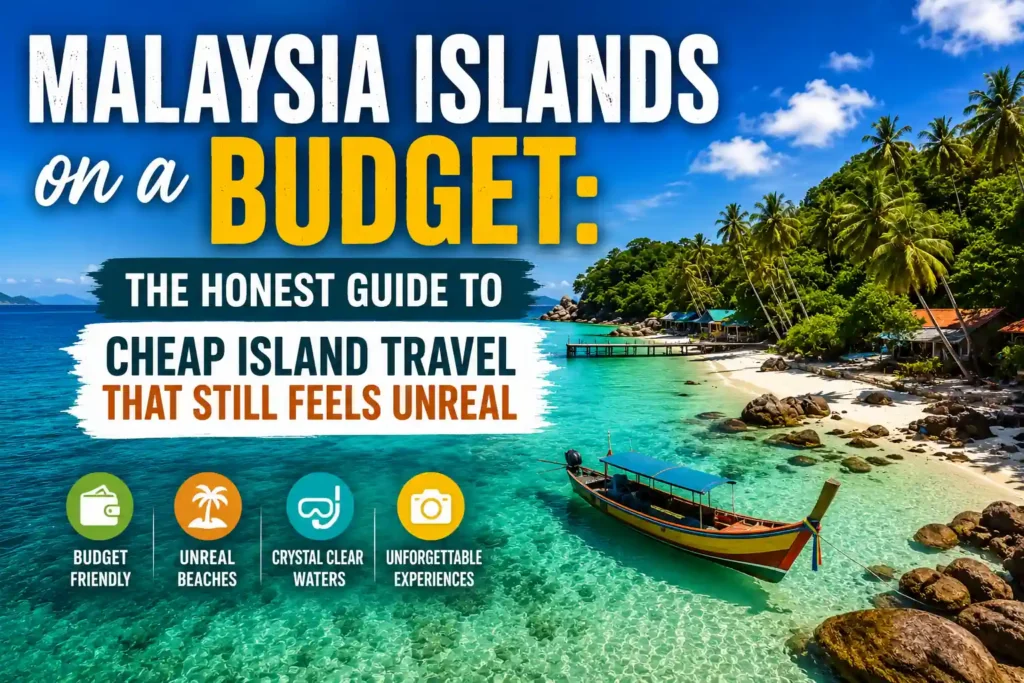
Budget travel in Malaysia’s islands is probably one of the most underrated aspects of Southeast Asia travel. Everyone talks about Thailand’s islands, Bali’s beaches, the Philippines’ turquoise lagoons. But Malaysia? It quietly sits there offering something genuinely wild: island experiences that look like a luxury brochure but cost like a hostel budget. I’m talking crystal water, zero crowds on certain beaches, and enough marine life to make you feel like you’ve accidentally wandered into a nature documentary.
No tourist chaos,just clear water, slow island life, and hidden beaches. Read this Pulau Kapas travel guide before it gets popular.
Seriously. I remember stepping off the boat at Perhentian Kecil for the first time and thinking someone had photoshopped the water. It was that blue. And I’d paid less than RM 80 for a dorm bed within walking distance of the beach. That’s under 17 USD. For that view.
This guide covers everything you actually need to know to do budget travel in Malaysia’s islands properly, from which islands to pick, when to go, what things really cost, and a few mistakes that’ll drain your wallet faster than the midday sun.
Why Malaysia’s Islands Are a Dream for Budget Travelers
Malaysia Tourism Authority data consistently shows that international arrivals to island destinations like Langkawi, Tioman, and the Perhentians have grown year on year, partly because value for money is simply hard to beat here. The ringgit has stayed favorable for most Western and Middle Eastern travelers, and the government has invested in ferry infrastructure to make island hopping far more accessible than it used to be.
But beyond exchange rates, it’s the structure of the place. Food is genuinely cheap. Local transport is reasonable. And somehow, it still doesn’t feel overly commercialized the way some Southeast Asian islands now do. There’s a huge spread of accommodation from RM 30 dorms to RM 400 boutique chalets, which means your budget really does dictate your experience without cutting you off from the good stuff.
The other thing people don’t realize: Malaysia’s islands are geographically diverse. Langkawi, in the northwest, is a duty-free island with a completely different feel to the coral-fringed Perhentians on the east coast. Tioman sits in the South China Sea and has one of the best reef systems in the country. These aren’t interchangeable destinations; each one has its own personality.
Best Cheap Islands in Malaysia That Still Feel Unreal
Langkawi, The Duty-Free Gem

Langkawi is technically a duty-free island, which means alcohol, chocolate, and certain goods cost a fraction of what they do on the mainland. That alone saves some travelers a noticeable amount. But beyond the shopping angle, Langkawi has mangrove tours, the famous Langkawi Sky Bridge at 700 meters above sea level, beach clubs, jungle waterfalls, and a quiet interior that most people skip entirely.
Budget travelers can find guesthouses in Pantai Cenang for RM 60–90 per night. Meals at local hawker stalls average RM 5–12. A full-day island-hopping boat trip booked locally runs about RM 35–50 per person. It adds up to a very manageable day.
Perhentian Islands: The Backpacker’s Favorite

The Perhentians are often described by Lonely Planet and regional travel publications as among the best budget diving destinations in Southeast Asia. The two islands, Besar (big) and Kecil (small), cater to slightly different crowds. Kecil is younger and more backpacker-friendly. Besar is quieter and slightly more upmarket, though still affordable by most standards.
Not sure which Malaysian island to choose? Compare Pulau Kapas and Perhentian Islands for budget, nightlife, beaches, and overall experience.
Snorkeling trips here cost around RM 35–60 for a half day. A basic PADI Open Water course runs about RM 500–700, which is considerably cheaper than what you’d pay in Thailand or Australia. Locals on the island say the turtles are easiest to spot between June and August when nesting activity peaks near Long Beach.
Tioman Island: The Hidden Cost Winner

Tioman Island is a UNESCO-recognized biosphere and was actually named one of the world’s most beautiful islands by Time Magazine decades ago, a fact locals still mention with quiet pride. The reef is genuinely world-class, and the jungle interior is barely explored by most visitors.
The ferry from Mersing or Tanjung Gemok is the main access point. Return fares run RM 70–90. Once on the island, food is cheap in the local kampungs (villages), and budget chalets on the beach start from RM 80 a night. It’s not flashy, but it absolutely delivers.
Malaysia Budget Island Comparison
| Island | Budget Stay (per night) | Food Cost (per day) | Best For | Crowd Level |
| Langkawi | RM 60–120 | RM 25–50 | Duty-free, scenery, couples | Moderate |
| Perhentian Kecil | RM 50–100 | RM 20–40 | Backpackers, diving, snorkeling | High (peak season) |
| Perhentian Besar | RM 80–180 | RM 30–55 | Quieter stays, families | Low–Moderate |
| Tioman Island | RM 80–150 | RM 25–45 | Diving, jungle, reef | Low |
| Redang Island | RM 120–250 | RM 40–70 | Couples, snorkeling packages | Moderate |
| Kapas Island | RM 60–100 | RM 20–35 | Off-the-beaten-path, peace | Very Low |
When Is the Cheapest Time to Visit Malaysia’s Islands?
March to May offers the best balance of good weather and off-peak pricing on the East Coast islands. Langkawi is accessible year-round, with the lowest prices between October and December despite occasional rain.
When to Visit Malaysia’s Islands for Lower Prices
This is more important than most budget guides admit. Malaysia’s east coast islands, including Perhentian, Tioman, and Redang, shut down almost entirely from November to February due to the monsoon season. Boats stop running, resorts close, and trying to visit during this window is genuinely pointless for most travelers.
The sweet spot for both weather and pricing is March to May, right at the start of the season. Accommodation is open, the weather is good, but the school holiday crowds haven’t arrived yet. Malaysian school holidays in June and July push prices up across the board, sometimes by 40–60% for the same room.
Langkawi, on the northwest coast, has a slightly different monsoon pattern. It’s more sheltered and stays accessible year-round, though September and October can be wetter. The Malaysian Meteorological Department publishes monthly rainfall data for each region, so you can check specifics before booking.
.
Budget Hotels and Beach Stays That Don’t Feel Cheap

The accommodation situation in Malaysia’s islands has genuinely improved. A few years ago, budget meant a fan room with a shared bathroom and a ceiling that let the mosquitoes in. That still exists, and honestly, for RM 30 a night, it’s still useful if you’re watching every ringgit. But there’s now a solid mid-range layer of guesthouses and small chalets that offer air conditioning, decent beds, and real showers for RM 80–130.
On Langkawi, the Pantai Cenang strip has a good range. Budget guesthouses like Casa Fina have strong reviews among backpacker communities online. On Perhentian Kecil, Moonlight Chalets and Bubu Long Beach Resort both offer affordable stays that don’t compromise on location.
A word on booking: don’t always trust the online rate. Some guesthouses on Tioman and Kapas will give you a better deal by messaging them directly on WhatsApp, especially for longer stays. It’s a small thing, but it works.
What Is a Realistic Budget Hotel Cost on Malaysia Islands?
Expect to pay RM 50–90 for a basic fan room or dorm bed, RM 90–160 for an air-conditioned chalet with private bathroom, and RM 160–300 for beachfront rooms on more popular islands. Book directly with guesthouses for better rates.
Accommodation Cost Breakdown by Island and Type
| Island | Dorm / Budget Fan Room | AC Chalet (Private) | Beachfront Mid-Range |
| Langkawi | RM 45–70 | RM 90–150 | RM 200–350 |
| Perhentian Kecil | RM 50–80 | RM 90–140 | RM 180–300 |
| Tioman Island | RM 40–70 | RM 80–130 | RM 150–280 |
| Kapas Island | RM 50–75 | RM 90–120 | RM 150–220 |
| Redang Island | RM 80–120 | RM 150–250 | RM 280–450 |
How Much Food Really Costs on Malaysia Islands
Food is where Malaysia’s island travel genuinely shines for budget travelers. The warung and hawker stall culture that’s central to Malaysian daily life extends out to the islands, and it keeps prices honest. A plate of nasi goreng (fried rice) costs RM 5–8. A bowl of laksa runs RM 6–10. Fresh grilled fish at a beachside stall might be RM 15–25, depending on the island.
The biggest food mistake tourists make is defaulting to the tourist-facing restaurants right on the main beach. Honestly, some of the best meals I had were at tiny local warung stalls that didn’t even have proper signs outside. These can charge 2–3x the price for essentially the same food. Walk a few minutes inland on Tioman or Perhentian, and the local options drop substantially in price and usually improve in quality.
Alcohol is the main budget wildcard. Malaysia’s Muslim-majority culture means alcohol isn’t sold everywhere, and where it is, it carries a tax that pushes prices up. Langkawi’s duty-free status is the exception; a large Tiger beer there costs RM 7–10, which is genuinely cheap by regional standards. On Perhentian, the same beer might cost RM 20–25 at a beach bar.
How Much Should I Budget for Food Per Day on Malaysia Islands?
Budget RM 30–50 per day for food if you eat at local warung stalls. If you mix in some restaurant meals, budget RM 60–100. Alcohol and tourist-facing restaurants push daily food costs toward RM 120–150.
Getting Around the Islands Without Overspending
The ferry system is the backbone of island access in Malaysia, and it’s reasonably priced. The boats aren’t luxurious, but that’s honestly part of the experience. From Kuala Perlis or Kuala Kedah to Langkawi: RM 18–23 each way. Kuala Besut to the Perhentians: RM 35–45 return. From Mersing to Tioman: RM 35–45 return. These are public ferries and the prices are regulated, so they’re consistent.
Once you’re on the islands, motorbike rental is the most economical option where it’s available. On Langkawi, renting a scooter costs RM 35–55 per day. On Tioman, some guesthouses rent bicycles for RM 15–20 a day, which is fine for the flat village strips. The Perhentians are small enough that walking covers most of what you need.
Island-hopping day trips are genuinely great value if you book through local operators rather than resort packages. On the Perhentians, a full-day snorkeling island hop runs about RM 45–60 per person and typically covers 4–5 stops, including turtle points, coral gardens, and the famous Shark Point. The Malaysia Fisheries Development Authority recommends booking licensed operators only for marine park areas to ensure proper guidance and responsible reef access.
What Is the Cheapest Way to Get to Malaysia’s Islands?
Public ferries are the most affordable option. Return ferry fares to Perhentian cost around RM 70–90, to Tioman RM 70–90, and to Langkawi RM 40–50. Avoid resort-packaged transfers, which add significant markup.
Free and Cheap Things to Do Beyond the Beach
This is one of the most underwritten parts of Malaysia’s island travel. People assume beach and diving are the only options, but there’s actually quite a bit more that costs nothing or next to nothing.
- Langkawi Geopark trail walks, the island is a UNESCO Global Geopark, and many of the geological sites are free to explore on foot or by scooter.
- Jungle treks on Tioman, the interior trail system from Kampung Tekek to Kampung Juara is a well-known 7km route that takes 3–4 hours and costs nothing. Locals say it’s one of the best jungle walks in peninsular Malaysia.
- Free snorkeling from shore, at Coral Bay on Perhentian Kecil, you can enter the water right from the beach and see reef fish without paying for a boat trip.
- Watching the sunset from Langkawi’s cable car base, the view from below the Sky Bridge is free and genuinely dramatic at golden hour.
- Night market visits, Langkawi’s Kuah town has a weekly night market (pasar malam) where local food, crafts, and produce are available at real local prices.
- Turtle watching on Redang and Perhentian, during nesting season, rangers from the Department of Wildlife and National Parks (PERHILITAN) sometimes run free or low-cost evening sessions for respectful wildlife observation.
Free and Low-Cost Activities on Malaysian Islands
| Activity | Island | Cost | Best Season |
| Shore snorkeling (Coral Bay) | Perhentian Kecil | Free | Mar–Oct |
| Juara Jungle Trek | Tioman | Free | Mar–Oct |
| Geopark trail walks | Langkawi | Free | Year-round |
| Pasar malam (night market) | Langkawi | Free entry | Year-round |
| Turtle Beach watching | Perhentian / Redang | Free–RM 10 | Jun–Aug |
| Sunset from Cenang Beach | Langkawi | Free | Year-round |
| Kampung village walking tour | Tioman | Free | Mar–Oct |
Common Tourist Mistakes That Waste Money Fast
- Booking Package Deals Without Comparing: Resort packages on islands often bundle accommodation, meals, and activities at a markup that adds 30–50% to your costs. Booking each component separately through local operators almost always works out cheaper, sometimes significantly so.
- Arriving Without Cash: ATMs on Tioman and the Perhentians are limited and sometimes out of service. Seriously, don’t assume the next island will have a working ATM. People get caught up in this all the time. Langkawi has better coverage, but island prices are cash-based at most local spots. Bring enough ringgit from the mainland.
- Visiting During Malaysian School Holidays: School holidays in June, July, and December push accommodation and activity prices up noticeably. The Malaysian Ministry of Education publishes the school holiday calendar annually; check it before booking.
- Skipping Travel Insurance: This isn’t strictly a money-wasting mistake, but medical evacuations from remote islands cost thousands. Budget travel in Malaysia’s islands should always include at least basic travel insurance. It protects everything else you’ve saved.
What Mistakes Cost Tourists the Most Money in Malaysia?
The biggest budget mistakes are: booking resort packages instead of independent components, arriving without cash, visiting during Malaysian school holidays (June, July, December), and eating only at tourist-facing beach restaurants instead of local stalls.
What a Realistic Malaysia Island Budget Looks Like
Let’s be honest about numbers. Here’s what a real 7-day trip to the Perhentian Islands looks like on a genuine budget:
Sample 7-Day Perhentian Islands Budget (Per Person)
| Expense | Budget Option | Mid Option | Notes |
| Ferry (return) | RM 70 | RM 90 | From Kuala Besut |
| Accommodation (7 nights) | RM 350–560 | RM 630–980 | RM 50–140/night |
| Food (7 days) | RM 210–350 | RM 420–700 | RM 30–100/day |
| Snorkeling trips (3 trips) | RM 105–150 | RM 180–240 | RM 35–80/trip |
| Diving (1 fun dive) | RM 80–100 | RM 100–120 | PADI certified sites |
| Drinks and miscellaneous | RM 100 | RM 200 | Incl. non-alcoholic |
| TOTAL ESTIMATE | RM 915–1,230 | RM 1,620–2,330 | ~USD 200–500 |
These are real numbers, not aspirational ones. The budget column represents actual costs if you eat at local warung stalls, book activities locally, and stay in fan-cooled dorms or basic chalets. The mid-range column reflects air-conditioned private rooms and a few restaurant meals.
Which Malaysia Island Is Best for Budget Travelers?
Perhentian Kecil offers the best combination of affordability, natural beauty, and traveler infrastructure for budget visitors. Kapas Island is the top choice for those wanting fewer crowds and a more off-the-beaten-path experience.
Hidden Islands Most Tourists Still Ignore
Kapas Island
Kapas sits off the Terengganu coast and is one of those places that barely show up in Western travel guides. The reef is intact, the water is ridiculously clear, and the beach has almost no development. A return speedboat from Marang jetty costs around RM 35–45, and basic chalets on the island start from RM 60 a night. For a genuine escape, it’s hard to beat.
Rawa Island, Johor
Rawa is technically accessible but rarely appears in budget itineraries because it’s mostly known for its one upscale resort. However, day trips from Mersing are possible and affordable, and the water visibility is exceptional. The Johor State Tourism Department has highlighted Rawa as part of its southern island development plan, which may mean more visitor infrastructure in the coming years.
Pulau Besar, Melaka
Yes, there’s an island near Melaka that most people completely miss. It’s small, has a handful of budget chalets, and the ferry from the mainland costs under RM 20 return. It won’t replace Perhentian for snorkeling, but for a quick overnight escape from the city, locals use it and love it.
Can You Do Malaysia Island Hopping on a Budget?
Yes. Island hopping between Tioman, Perhentian, and Kapas using public ferries and local guesthouses is very achievable for RM 1,500–2,500 for 10–12 days, including accommodation, food, and activities. Plan transport connections carefully, as direct routes between the East Coast islands don’t always exist.
Final Tips Before Planning Your Malaysia Island Trip
- Download offline maps before leaving for the islands, cellular coverage on Tioman and Kapas is patchy at best.
- Bring reef-safe sunscreen. Marine Park authorities around Redang and Perhentian actively discourage chemical sunscreens that damage coral. Some operators now require it.
- Book ferries in advance during peak periods (June–August). Boats fill up, especially on weekends.
- Learn a few words of Bahasa Malaysia. Even a simple ‘terima kasih’ (thank you) at a local warung gets you a warmer experience.
- Don’t underestimate the heat. Hydration and shade management matter more on low-facility islands than anywhere else.
- Check the Malaysian Tourism Board (Tourism Malaysia) website for current island access information and any protected area permits before you travel.
Backpacking Malaysia Islands vs Luxury Travel
Here’s the thing that genuinely surprised me: the experience gap between backpacker and luxury travel on Malaysia’s islands is smaller than you’d expect. The water is the same. The reef is the same. The sunset doesn’t charge an entry fee.
Luxury travelers get more comfort, air conditioning, ensuite bathrooms, better beds, and possibly a private beach. But the actual island experience, the snorkeling, the sunsets, the peace, is available to anyone who makes the trip. That’s what makes budget travel to Malaysia’s islands such a compelling choice. You’re not compromising on the main attraction.
Is Malaysia Good for Budget Island Travel?
Yes. Malaysia offers some of the best value island travel in Southeast Asia. Between favorable exchange rates, affordable ferries, RM 5 local meals, and world-class snorkeling and diving available through local operators, it genuinely punches above its weight for budget travelers.
Frequently Asked Questions
Q1: What is the cheapest island to visit in Malaysia?
Kapas Island and Perhentian Kecil are among the cheapest. Kapas is especially low-cost because it’s underdeveloped, basic chalets start from RM 60, and the return boat from Marang costs under RM 45.
Q2: How much money do I need per day on Malaysia islands?
A comfortable budget is RM 100–150 per day covering accommodation, food, and a snorkeling trip. Ultra-budget travelers managing dorms and local food only can get by on RM 70–90 per day.
Q3: Is diving in Malaysia cheap?
Yes. PADI Open Water certification at Perhentian or Tioman costs around RM 500–700, significantly less than Thailand or Australia. Single fun dives run RM 80–120. PADI instructor-led courses at Malaysian dive centers follow internationally recognized standards.
Q4: Can I visit Malaysia islands without a tour package?
Absolutely. Public ferries, local guesthouses, and independently booked activities are all easily available. In fact, traveling independently usually feels more flexible and far less rushed. Going without a package usually saves 20–40% compared to resort-bundled options.
Q5: Are Malaysia islands safe for solo travelers?
Malaysia’s island destinations are generally considered safe for solo travelers, including solo female travelers. The Royal Malaysia Police maintain a presence in major island tourist areas. As with anywhere, standard awareness is sensible, keep valuables secure, and let someone know your plans.
Q6: When do Malaysia’s east coast islands close?
Most East Coast islands, including Perhentian, Tioman, and Redang, close between November and February due to the northeast monsoon. Langkawi on the west coast stays open year-round, though September and October see more rainfall.
Q7: Is food safe to eat at local warung stalls in Malaysia?
Generally yes. Warung stall food is a central part of Malaysian culture, and locals eat at them daily. The Malaysian Ministry of Health runs hygiene inspection programs across tourist areas. Stick to freshly cooked hot food, and you’ll typically be fine.