Nacpan Beach History starts with the fishing families of Barangay Nacpan, who lived off fishing and coconut farming before tourism arrived. Rough dirt roads kept the beach cut off from the rest of El Nido for many years, which kept it undeveloped.
This isolation is central to Nacpan Beach History, since it protected the four kilometers of sand and clear water until travel writers began writing about the twin coves, Nacpan and Calitang, and tourists slowly started to arrive. Local families later opened small cottages and food stalls to serve the growing number of visitors. Roads were eventually improved, making the beach easier to reach from El Nido town.
Nacpan Beach History: The Quick Answer
Nacpan Beach began as a fishing and coconut-farming community on Palawan’s northern coast. Local families relied on the sea and the land for generations before outside attention arrived. International recognition only began around 2016, when TripAdvisor ranked the beach among the world’s top 10, changing its trajectory almost overnight.
Where Is Nacpan Beach? Location in El Nido, Palawan
Palawan Island holds Nacpan Beach on its northern coast, roughly 17 to 20 kilometers north of El Nido town proper. A 45-minute drive along a mostly paved road connects El Nido town to this coastline, though the final few kilometers still carry rough patches as of 2026. West Philippine Sea waters wash directly onto the shore, giving Nacpan a wide, open feel compared to the sheltered lagoons closer to town. Four kilometers of pale sand line the coast, backed by coconut palms and low green hills. Getting there is straightforward, with a few common options for travelers:
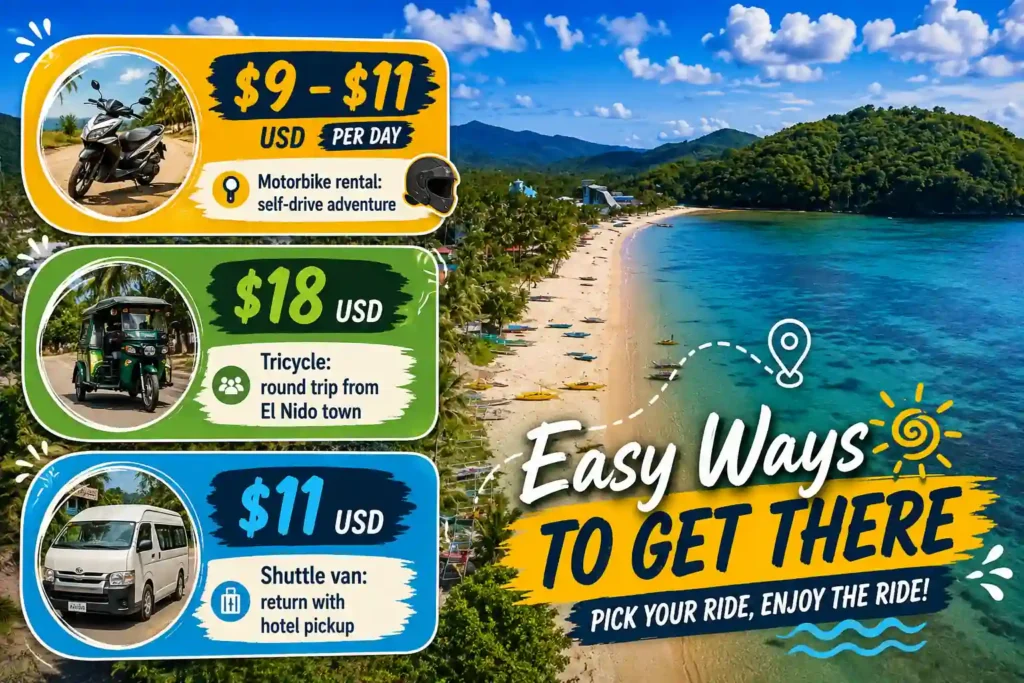
- Motorbike rental: about $9-$11 USD per day, self-drive
- Tricycle: roughly $18 USD for a round trip from El Nido town
- Shuttle van: around $11 USD return, with hotel pickup
A quick snapshot of the essentials appears in the table below.
| Detail | Information |
| Location | El Nido, Palawan, Philippines |
| Distance from El Nido town | 17-20 km (about 45 min drive) |
| Beach length | Approximately 4 km |
| Twin beach | Calitang Beach |
| Protected area status | El Nido-Taytay Managed Resource Protected Area |
| Entrance fee (2026) | None; parking fee only |
Nacpan Beach History: How a Quiet Fishing Cove Became World-Famous
Local fishing families lived along this coastline for generations, well before any resort or beach club existed nearby. Rice farming and small-scale fishing formed the backbone of daily life in the barangays surrounding Nacpan. Coconut plantations covered much of the land behind the shoreline, and locals used the beach mainly to launch bancas, the traditional Filipino outrigger boats.
Change arrived slowly at first, then all at once, once international travel media discovered the coastline in the mid-2010s. That shift from obscurity to global attention forms the real turning point in this story. Consequently, Nacpan Beach history divides fairly neatly into a before and an after, with 2016 marking the hinge point.
Nacpan Beach Before Tourism Arrived
Barangay Pasadeña and its surrounding sitios governed daily life around Nacpan long before travel blogs existed. Copra production, made from dried coconut meat, supported many households throughout the twentieth century. Small karendarias, simple local eateries, served fishermen and farmers rather than foreign visitors.
Roads leading to the beach remained unpaved dirt tracks for decades, which kept outside visitors to a minimum. Electricity and reliable mobile signal both arrived later here than in most of mainland El Nido. Nacpan, in this era, functioned as a working coastline rather than a tourist destination.
The Local Community Behind Nacpan Beach
Families from Cuyonon and Tagbanua communities hold long-standing ties to this section of northern Palawan. Fishing remains an active livelihood today, with small boats still visible along the shoreline most mornings. Beachfront restaurants and guesthouses, largely family-run, now supplement income once earned solely through farming and fishing.
Local vendors sell fresh seafood, coconuts, and simple Filipino dishes at prices well below those in more developed tourist zones. Community-run stalls line the main access point, giving residents direct participation in the tourism economy. Balance between tradition and tourism income continues to shape daily life for many families here.
Nacpan Beach Tourism History: Awards and Global Recognition
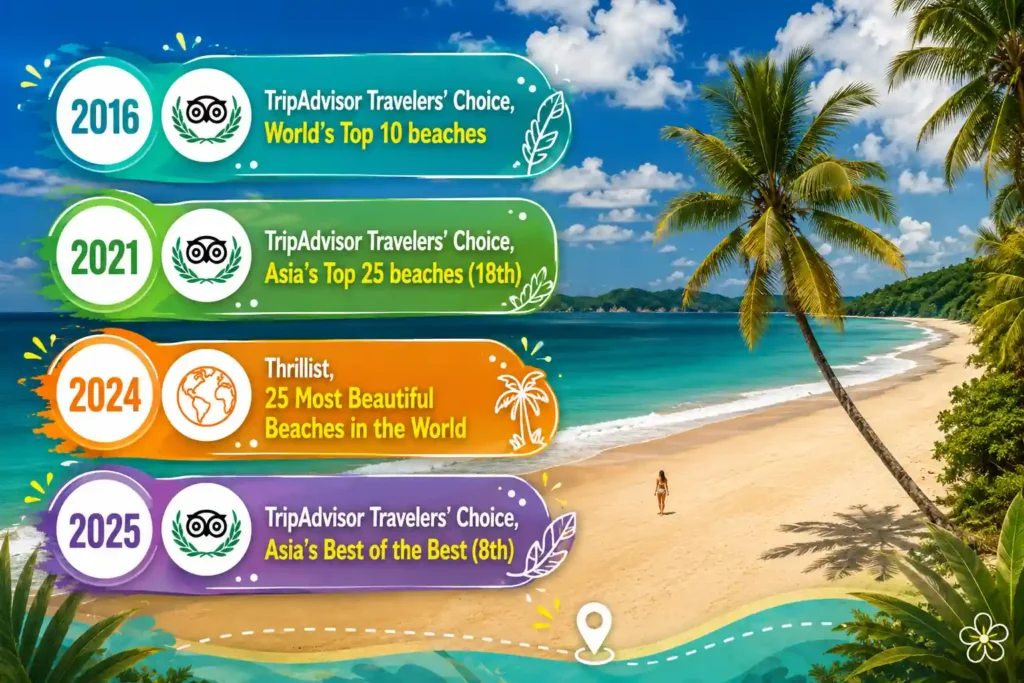
TripAdvisor’s Travelers’ Choice Awards first placed Nacpan among the world’s ten best beaches in 2016, a recognition that changed how travelers viewed this stretch of Palawan. Philippine Department of Tourism officials publicly welcomed the ranking soon after.
Subsequent years brought further recognition: the beach appeared in TripAdvisor’s Asia rankings again in 2021 and 2025, and Thrillist named it among the world’s 25 most beautiful beaches in June 2024. Each new mention pulled more visitors north from El Nido town. That pattern, award followed by surge, repeats throughout the more recent chapters of Nacpan Beach history.
The table below lays out exactly which awards Nacpan Beach has collected and when.
| Year | Recognition |
| 2016 | TripAdvisor Travelers’ Choice, World’s Top 10 beaches |
| 2021 | TripAdvisor Travelers’ Choice, Asia’s Top 25 beaches (18th) |
| 2024 | Thrillist, 25 Most Beautiful Beaches in the World |
| 2025 | TripAdvisor Travelers’ Choice, Asia’s Best of the Best (8th) |
When Did Nacpan Beach Become Famous?
Nacpan Beach first gained major international attention in 2016, after TripAdvisor’s Travelers’ Choice Awards ranked it among the ten best beaches in the world. That single ranking triggered a steady rise in visitor numbers and media coverage that has continued through 2025 and into 2026.
Nacpan Beach Development: From Nipa Huts to Beach Clubs
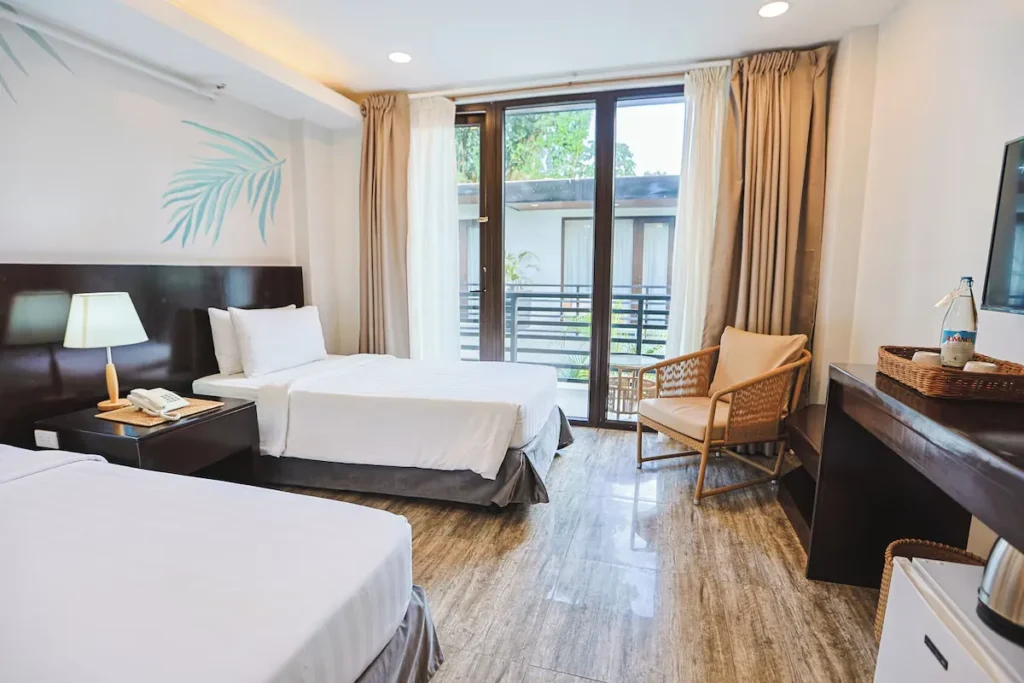
Beachfront structures at Nacpan looked nothing like today’s setup even a decade ago, consisting mostly of simple nipa huts run by local families. ANGKLA Beach Club and similar mid-range resorts arrived later, bringing air-conditioned rooms and higher price points to a coast once defined by rustic simplicity.
Paved sections of the access road, completed in phases through 2026, have cut travel time and reduced the bumpy ride. Despite this growth, no large hotel chains or high-rise developments have appeared, keeping Nacpan noticeably less commercial than Boracay’s White Beach. Development here has stayed gradual rather than explosive. A few changes stand out most clearly:
- Glamping tents now sit alongside traditional beach cottages
- Beachfront cafes and bars have multiplied since the mid-2010s
- Road paving has cut typical travel time from El Nido town
The Twin Beaches: Nacpan and Calitang
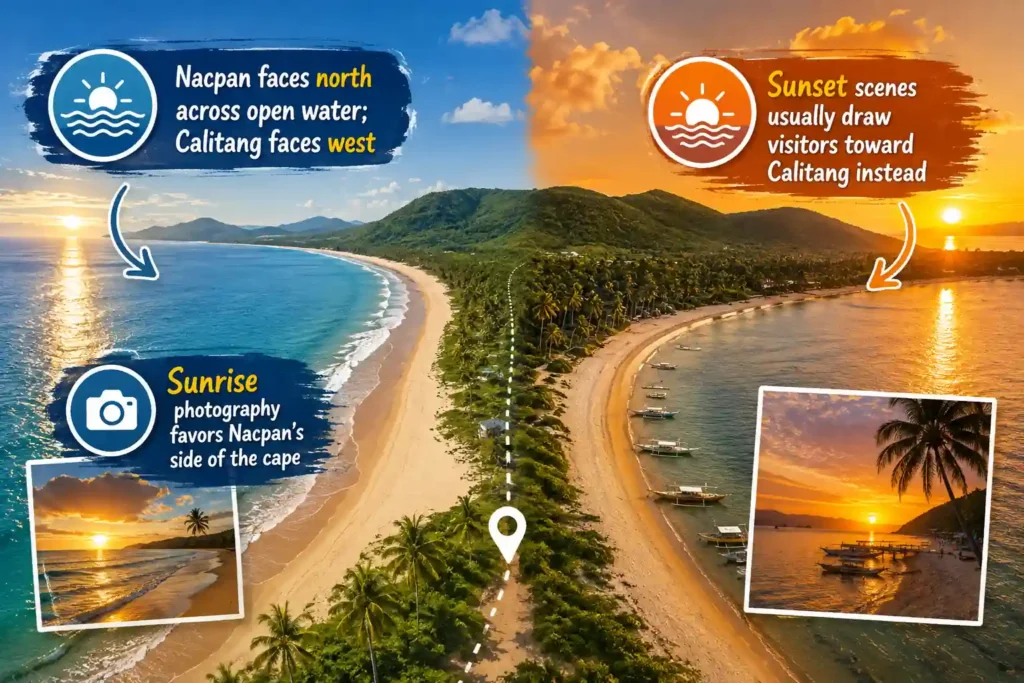
Calitang Beach sits just beyond Nacpan’s northern tip, separated only by a small forested cape that travelers can climb for panoramic views. Together, these two stretches of sand form what locals call the Twin Beaches of El Nido. Fewer visitors make the walk to Calitang, which keeps that side noticeably quieter. Viewpoint access from the connecting hill remains free, though a short, occasionally steep climb is required. The two beaches differ in a few clear ways:
- Nacpan faces north across open water; Calitang faces west
- Sunrise photography favors Nacpan’s side of the cape
- Sunset scenes usually draw visitors toward Calitang instead
How Nacpan Beach Has Changed Over Time
Comparing Nacpan Beach today against photographs from a decade ago reveals a coastline transformed by steady, incremental change. Dirt roads have given way to partially paved routes, cutting the journey from El Nido town to roughly 45 minutes. Restaurant options expanded from a handful of local eateries into dozens of beachfront cafes and dining spots.
Accommodation choices grew from basic homestays into a mix of budget cottages, resorts, and glamping setups. Visitor numbers rose sharply after each major award announcement. Environmental pressure has grown alongside these changes, prompting agencies to introduce protective measures for the coastline.
The comparison below highlights exactly what has shifted at Nacpan Beach over roughly ten years.
| Feature | Around 2015 | 2026 |
| Road access | Unpaved dirt track, 60+ min | Mostly paved, about 45 min |
| Accommodation | Basic homestays only | Resorts, glamping, cottages |
| Dining options | A handful of local eateries | Dozens of beachfront restaurants |
| International recognition | Largely unknown abroad | Repeated global beach awards |
| Entrance and fees | Small informal fee | No entrance fee, parking fee only |
Nacpan Beach Today and What Visitors Can Expect
Visitors arriving in 2026 find a beach that balances genuine natural beauty with a light layer of tourism infrastructure. Morning hours between 7 AM and 10 AM still offer the calmest water and thinnest crowds. Beachfront restaurants serve fresh seafood and coconuts at prices noticeably lower than central El Nido town. Overnight stays remain popular among travelers hoping to catch both sunrise and sunset here. A few practical points are worth knowing before a visit:
- No official entrance fee applies to Nacpan Beach itself
- El Nido’s Eco-Tourism Development Fee runs about $6.90 USD, valid for 10 days
- Motorbike parking costs around $0.35 USD near the main access point
The Future of Nacpan Beach
Road paving projects, already underway through parts of 2026, are expected to shorten travel times and bring more day-trippers north from El Nido town. The Department of Environment and Natural Resources, sharing oversight with the municipal government, aims to keep development inside the El Nido-Taytay Managed Resource Protected Area.
The Palawan Council for Sustainable Development continues to shape how much construction the coastline can absorb. Local business owners generally hope to avoid the fate of Boracay, where rapid growth once forced a six-month closure for rehabilitation. Sustainable tourism messaging has become more visible across brochures and municipal signage. Careful management now looks like the deciding factor in whether Nacpan keeps its character.
Is Nacpan Beach Still Worth Visiting in 2026?
Yes, Nacpan Beach remains worth visiting in 2026, especially for travelers seeking wide open sand without Boracay-level crowds. Morning visits during dry season months still offer calm water and none of the formal entrance fees found at some other Philippine beaches.
Why Nacpan Beach’s History Still Matters Today
Fishing families and quiet mornings once defined this stretch of Palawan long before international rankings existed. Nacpan Beach’s history shows a place that grew gradually, gained global attention through a handful of major awards, and still holds onto much of its original character.
Careful management, continued community involvement, and steady rather than explosive growth all point toward a beach that can remain special for years to come. Anyone planning a trip north from El Nido town gains far more by understanding this backstory first.
Frequently Asked Questions About Nacpan Beach
What is the history of Nacpan Beach?
Nacpan Beach started as a fishing and coconut-farming community on Palawan’s northern coast. International attention arrived much later, beginning around 2016 when TripAdvisor ranked it among the world’s ten best beaches.
When did Nacpan Beach become famous?
Nacpan Beach became internationally famous in 2016, following its placement in TripAdvisor’s Travelers’ Choice Awards. Additional rankings in 2021, 2024, and 2025 kept it in the global spotlight.
Is there an entrance fee at Nacpan Beach in 2026?
No formal entrance fee applies to Nacpan Beach itself as of 2026. Visitors typically pay a small parking fee, plus El Nido’s municipal Eco-Tourism Development Fee if not already covered elsewhere.
How far is Nacpan Beach from El Nido town?
Nacpan Beach sits roughly 17 to 20 kilometers north of El Nido town, about 45 minutes by motorbike, tricycle, or shuttle van.
What is Calitang Beach’s connection to Nacpan?
Calitang Beach forms the other half of Nacpan’s Twin Beaches, separated by a small forested cape with a lookout point. The two beaches face different directions, giving each a distinct atmosphere.
Is Nacpan Beach still worth visiting today?
Yes, Nacpan Beach remains one of Palawan’s most rewarding day trips, offering four kilometers of open sand and a growing but still low-key food and lodging scene.