
The best time to watch the Nacpan Beach sunset is between 5:30 and 6:15 PM, though exact minutes shift a little each month. The sun sinks directly into the open sea, with no islands or cliffs in the way, so the whole sky turns orange, pink, and purple in a slow, wide arc. Most travelers arrive by 5:00 PM to claim a good spot near the shoreline, where the wet sand reflects the colors like a mirror.
Dry season, from November to May, gives the clearest skies and the sharpest Nacpan Beach sunset views, while rainy months can bring thick clouds that hide the horizon completely. Bring a light jacket, since the beach breeze picks up fast once the sun disappears.
Why Nacpan Beach Sunset Is So Famous
Nacpan Beach earned its reputation through word of mouth and countless sunset photos shared online. The beach faces almost due west, so the sun sinks directly into open water instead of reflecting off distant islands. That single detail sets it apart from most sunset spots near El Nido town. Four kilometers of soft, pale sand lined with leaning coconut palms create a natural amphitheater for golden hour.
Nacpan also still feels rural compared to busier beaches closer to town, with a handful of beach shacks instead of resort rows. Many travelers compare it to how Boracay looked decades ago, before the crowds arrived. That mix of untouched scenery and a world-class sunset keeps people coming back.
Best Time to Watch the Nacpan Beach Sunset
Because El Nido sits close to the equator, sunset times at Nacpan don’t shift dramatically across the year. Expect the sun to disappear somewhere between 5:35 PM and 6:20 PM, depending on the month. Most guides recommend arriving one to two hours early, giving you time to swim and settle in before the sky starts changing. Golden hour, roughly 30 to 45 minutes before sunset, is when the light turns softest and the colors richest.
Arriving late means fighting for a spot, since the beach’s popularity has grown fast in recent years. If you’re on a motorbike or trike, leave a buffer, since the access road turns dark fast once the sun sets. Planning around these windows is really the whole secret to catching Nacpan at its best.
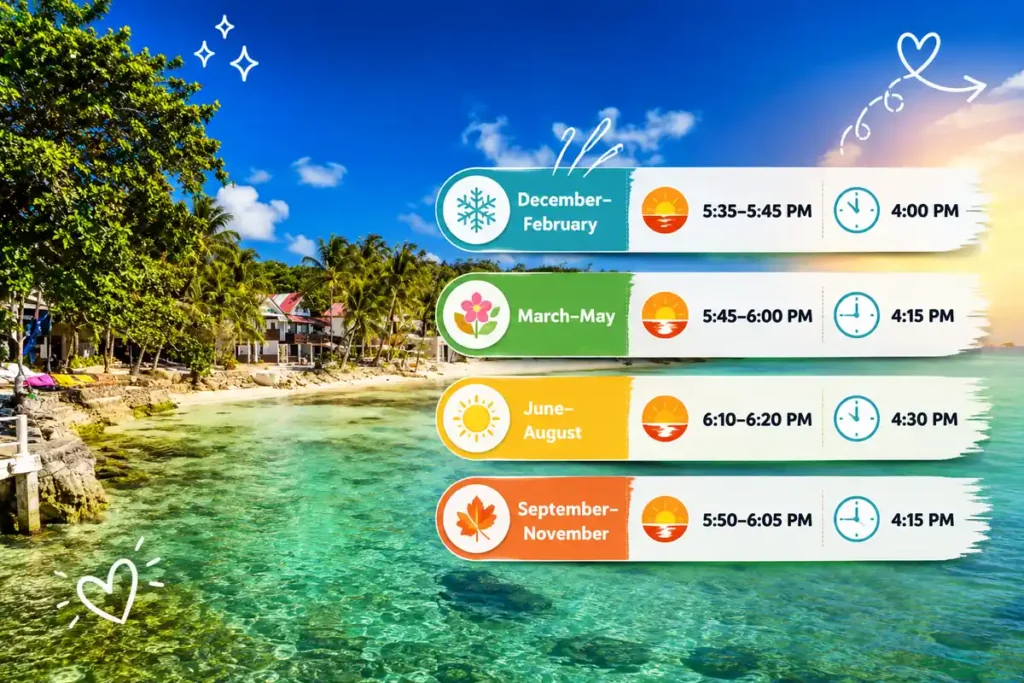
Here’s a quick month-by-month snapshot of when the sun actually sets at Nacpan, so you can plan your arrival with confidence.
| Month / Season | Approx. Sunset Time | Recommended Arrival |
| December–February | 5:35–5:45 PM | 4:00 PM |
| March–May | 5:45–6:00 PM | 4:15 PM |
| June–August | 6:10–6:20 PM | 4:30 PM |
| September–November | 5:50–6:05 PM | 4:15 PM |
What Is the Best Nacpan Beach Sunset Time?
The Nacpan Beach sunset generally happens between 5:35 PM and 6:20 PM Philippine time, depending on the season, with the earliest sunsets in December and the latest around June. Arriving by 4:00 to 4:30 PM gives you enough daylight to relax first and still claim a good spot before golden hour begins.
Best Spots to Watch the Sunset
Not all sections of Nacpan offer the same view, so where you sit matters. The middle stretch gives the widest, most unobstructed sightline, since it sits away from the bars and boat traffic near the entrance. The northern end, close to most beach shacks and restaurants, is more social and convenient for food or a cold drink. For something quieter, the sandbar connecting to Calitang Beach offers a different angle and far fewer people. A few elevated spots on the nearby hills let you see both twin beaches at once, though access can be limited. Arrive early enough to claim your spot, since prime real estate fills up fast in peak season.
- Mid-beach: the widest, most open horizon view, away from the crowds
- Northern beach shacks: convenient for food and drinks while you watch
- Calitang sandbar: quieter, with a slightly different angle
- Hilltop viewpoints: panoramic views of both twin beaches, access varies
What Makes the Nacpan Beach Sunset Special
What separates the Nacpan Beach sunset from other Palawan sunsets is the sheer scale of open water in front of you. There’s no island silhouette breaking up the horizon, so the sky gets to perform, stretching from deep orange near the water to soft pink and purple higher up. The wide, flat sand acts like a natural mirror, doubling the colors and making the scene feel bigger than it is.
Coconut palms leaning toward the water add natural framing without blocking the view. Because the beach is less commercial than spots closer to town, the atmosphere stays relaxed rather than rushed. Even the sound fits, with gentle waves and distant chatter and not much else. It’s a simple formula: open horizon, soft sand, quiet surroundings, but rare to find all three together.
Weather Conditions for the Best Sunset Views
Weather plays a bigger role in sunset quality than most travelers expect. Clear or partly cloudy skies typically produce the most dramatic colors, since scattered clouds catch and reflect light rather than block it. Heavy overcast skies, more common in wetter months, can hide the sunset almost entirely. According to the Philippine Atmospheric, Geophysical and Astronomical Services Administration (PAGASA), Palawan generally has a dry season from November through May and a wetter season from June through October.
Wind matters too, since stronger winds during the amihan, or northeast monsoon, can kick up haze near the coast. Locals and beachfront staff are usually a reliable source for same-day conditions. Checking a short-term forecast the morning of your visit is still the smartest move.
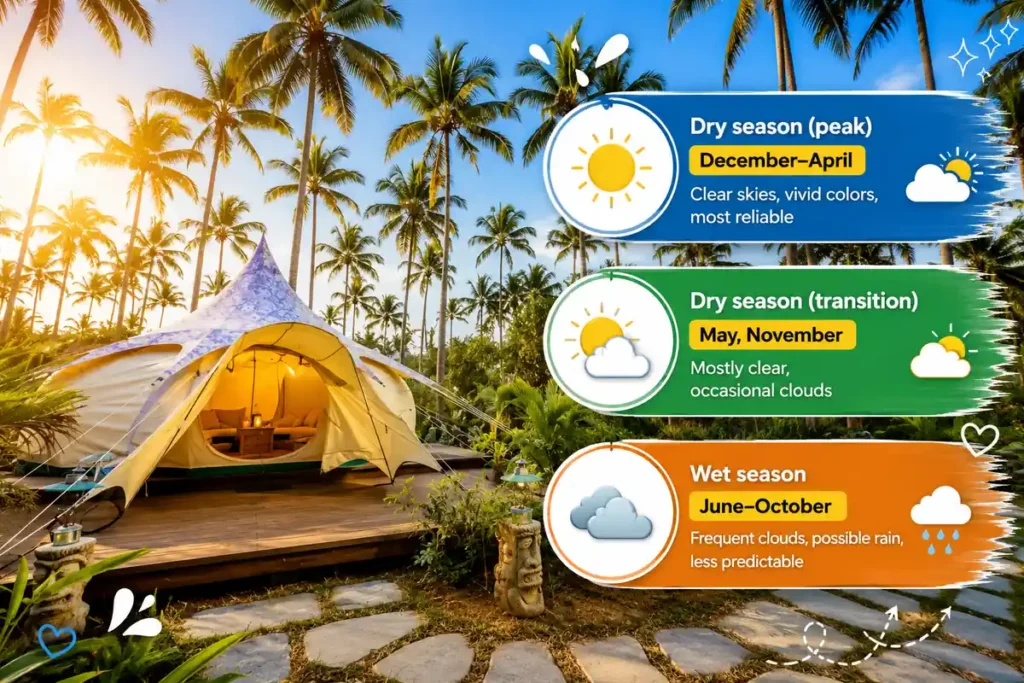
To help you plan around the seasons, here’s how weather conditions at Nacpan typically compare throughout the year.
| Season | Months | Typical Sunset Conditions |
| Dry season (peak) | December–April | Clear skies, vivid colors, most reliable |
| Dry season (transition) | May, November | Mostly clear, occasional clouds |
| Wet season | June–October | Frequent clouds, possible rain, less predictable |
Is the Nacpan Beach Sunset Better Than Las Cabanas?
Both are worth seeing, but they offer different experiences. Las Cabanas sits closer to El Nido town and frames its sunset around small islands, while the Nacpan Beach sunset drops straight into open ocean with a wider, uninterrupted horizon. Nacpan tends to feel calmer and less crowded, mostly because of the extra travel time involved.
Best Months for a Clear Sunset
If clear skies are your priority, December through April generally delivers the most consistent Nacpan Beach sunset views. January and February often bring stronger winds, so expect slightly hazier horizons even on dry days. March and April tend to offer the calmest, clearest conditions before the wet season builds. May is a transition month, with a mix of clear evenings and occasional early rain.
From June through October, expect more cloud cover and a higher chance of missing the sunset to rain. The Department of Tourism Philippines and regional weather advisories are useful references for planning. Booking flexibility, where possible, gives you a better shot at a genuinely clear evening.
Photography Tips for the Nacpan Beach Sunset
Getting a great shot at Nacpan isn’t complicated, but a little preparation helps. Arrive during golden hour, roughly 45 minutes before sunset, when the light turns soft and warm instead of harsh. A wide-angle lens, or your phone’s standard setting, usually captures the beach’s scale better than zooming in. Silhouettes work especially well here, thanks to the palm trees and occasional boats along the shore.
If you’re flying a drone, the Civil Aviation Authority of the Philippines (CAAP) requires registration and permits for drone use, so check current rules first. Shooting in RAW format, if your camera supports it, gives you more room to adjust color and exposure later. And don’t spend the whole sunset behind a screen; a few unfiltered minutes just watching are worth it too.
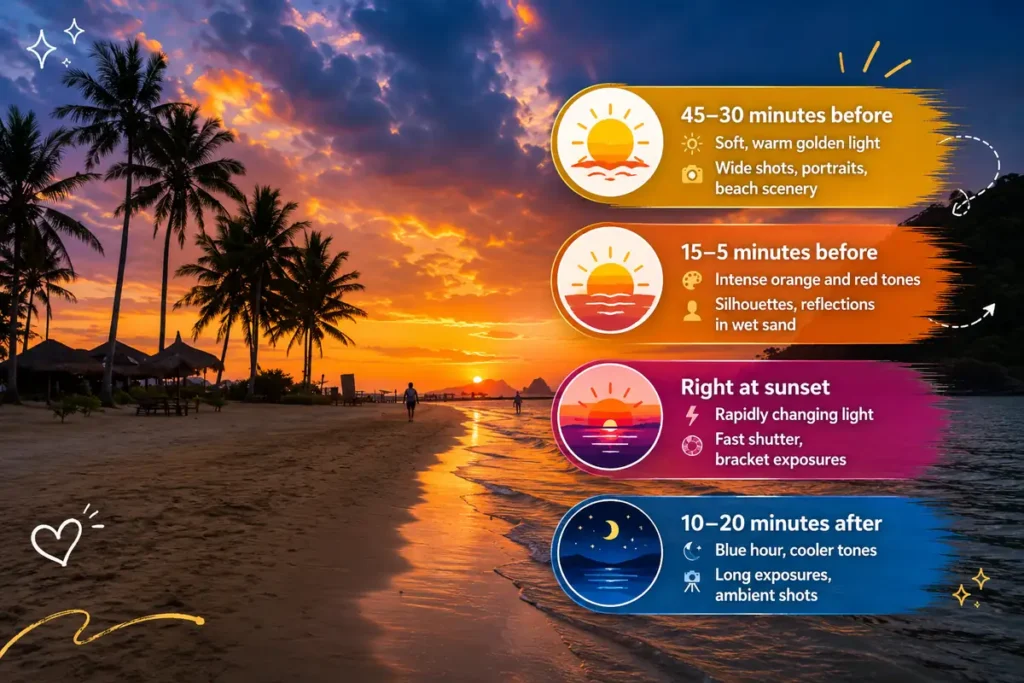
For anyone serious about photography, here’s a simple settings guide based on the stage of sunset you’re shooting.
| Time Before Sunset | Light Quality | Suggested Approach |
| 45–30 minutes before | Soft, warm golden light | Wide shots, portraits, beach scenery |
| 15–5 minutes before | Intense orange and red tones | Silhouettes, reflections in wet sand |
| Right at sunset | Rapidly changing light | Fast shutter, bracket exposures |
| 10–20 minutes after | Blue hour, cooler tones | Long exposures, ambient shots |
Best Sunset Photo Spots
A few specific spots at Nacpan consistently produce the best photos. The wide, open mid-beach section gives a clean horizon without people or structures cutting through the frame. Near the shoreline, wet sand at low tide creates a mirror-like reflection of the sky. The sandbar connecting Nacpan to Calitang Beach offers a slightly elevated, uncluttered angle many photographers prefer. Leaning coconut palms near the beach shacks make natural frames for silhouette shots. Getting slightly elevated, even on a small dune, helps capture more of the beach’s curve in one frame.
- Mid-beach: a clean, unobstructed horizon
- Wet sand at low tide: mirror-like reflections
- Calitang sandbar: an elevated, quieter angle
- Palm-lined shore: natural silhouette framing
Can You Watch the Nacpan Beach Sunset Without a Tour?
Yes. Nacpan Beach is open to independent travelers, and you don’t need a guided tour to watch the sunset there. Renting a scooter, or hiring a trike or van from El Nido town, roughly $14 to $18 USD round trip, is enough to get you there and back on your own schedule.
What to Expect During Sunset at Nacpan Beach
As the afternoon crowd thins out, Nacpan takes on a calmer mood heading into evening. Beach shacks set up simple seating right on the sand, and a cold drink or fresh seafood dinner is easy to find without breaking the bank. There are no lifeguards on duty in the evening, so swimming after dark isn’t recommended even though the water looks inviting.
Vendors selling snacks and souvenirs thin out too, so it’s best to buy what you need earlier in the day. Once the sun is down, the beach gets dark fast, with minimal lighting along the shore or access road. If you’re driving back yourself, plan to leave shortly after sunset rather than lingering. Staying overnight nearby is the easiest way to enjoy the full experience without rushing.
Is the Nacpan Beach Sunset Worth Seeing?
Given the travel time involved, it’s a fair question, and the honest answer is yes for most travelers. The Nacpan Beach sunset delivers a genuinely different experience from spots closer to El Nido town, mainly because of that unobstructed, open-ocean view. It does take some planning: a 45-minute drive each way, extra cash for transport, and enough daylight buffer to get back safely.
See Why Travelers Can’t Stop Talking About Nacpan Beach. Read more in Nacpan Beach in El Nido That Looks Remote but Feels Worth the Ride.
For photographers, beach lovers, or anyone wanting a quieter alternative to crowded viewpoints, the trip pays off. If your schedule is tight, or you’re traveling with young kids and prefer shorter transfers, a closer sunset spot might suit you better. But for those with a free afternoon and evening to spare, Nacpan is one of the more memorable ways to end a day in Palawan.
FAQs About the Nacpan Beach Sunset
What time is sunset at Nacpan Beach?
Sunset generally falls between 5:35 PM and 6:20 PM depending on the month, with earlier sunsets in December and later ones around June.
How do I get to Nacpan Beach from El Nido town?
It’s roughly a 45-minute drive by scooter, trike, or van, costing approximately $14 to $18 USD round trip depending on the vehicle and negotiation.
Is Nacpan Beach crowded at sunset?
It’s less crowded than beaches closer to El Nido town, though popularity has grown, so arriving early still helps secure a good spot.
What’s the best month to see a clear Nacpan Beach sunset?
March and April, near the end of the dry season, typically offer the clearest and calmest sunset conditions.
Can I stay overnight near Nacpan Beach to watch sunset without rushing back?
Yes, a handful of basic guesthouses, glamping sites, and beach camps operate near Nacpan for travelers who want to skip the evening drive back to town.