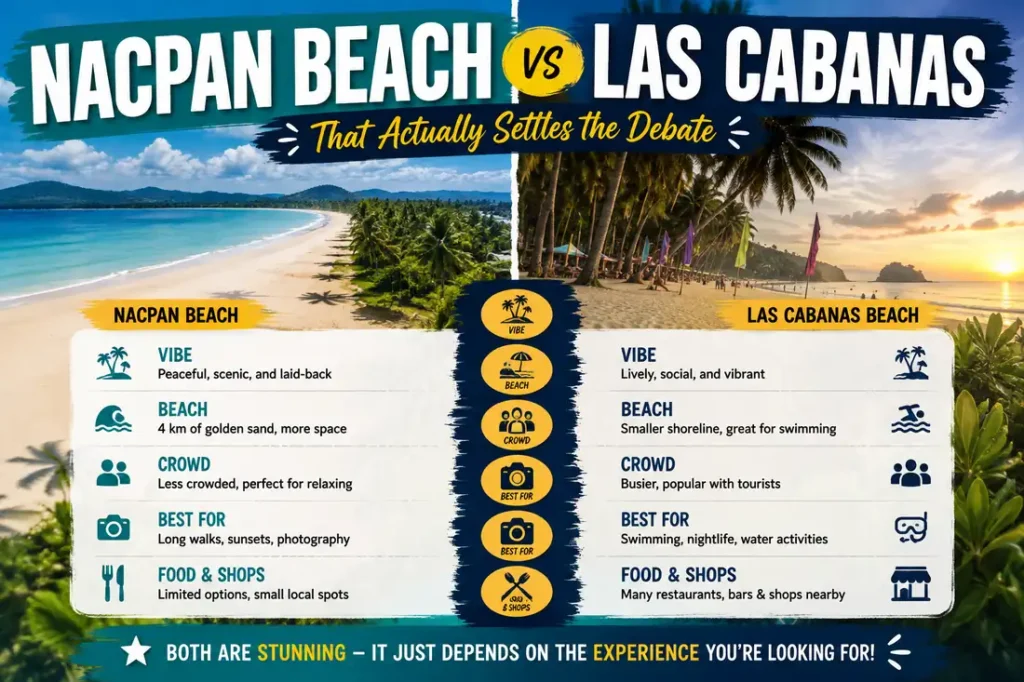
In the Nacpan Beach vs Las Cabanas comparison, the biggest difference is space: Nacpan stretches almost 4 kilometers of wide, golden sand with very few people, while Las Cabanas is a short, narrow strip that gets crowded every evening for sunset. Nacpan sits about 45 minutes to an hour north of El Nido town by tricycle or scooter, and charges a small entrance fee, usually under $1 per person. Las Cabanas, on the other hand, is only 15 to 20 minutes away and completely free to enter, which is why it draws bigger crowds daily, especially around 5 PM.
If you want calm water, fewer tourists, and room to spread out, Nacpan wins easily. If you want an easy, affordable sunset spot with bars and hammocks right on the beach, Las Cabanas is the practical choice. So when people ask Nacpan Beach vs Las Cabanas, the real answer depends on whether you’re chasing solitude or convenience.
Quick Comparison: Nacpan Beach vs Las Cabanas
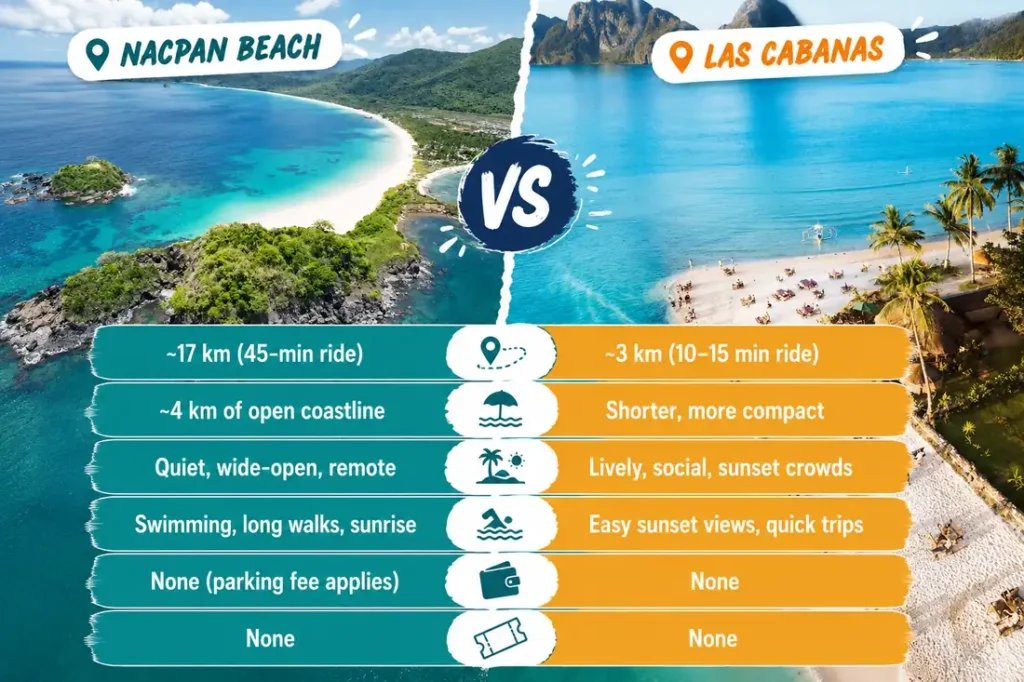
If you’re short on time, here’s the short version. Choose Nacpan Beach for space, quiet, and that “we have this place to ourselves” feeling. Choose Las Cabanas if you’re staying in El Nido town and want an easy sunset without renting a scooter. Nacpan sits roughly 17 kilometers north of town, a 45-minute ride away, while Las Cabanas is only about 3 kilometers southwest, just 10 to 15 minutes by tricycle. Neither beach charges its own standalone entrance fee in 2026, though every visitor to the municipality still pays a separate eco-tourism fee.
The table below sums up the core differences at a glance, so you can decide which beach fits your day before reading on.
| Feature | Nacpan Beach | Las Cabanas Beach |
| Distance from town | ~17 km (45-min ride) | ~3 km (10–15 min ride) |
| Beach length | ~4 km of open coastline | Shorter, more compact |
| Overall vibe | Quiet, wide-open, remote | Lively, social, sunset crowds |
| Best suited for | Swimming, long walks, sunrise | Easy sunset views, quick trips |
| Entrance fee | None (parking fee applies) | None |
Location and Accessibility
Getting to each beach says a lot about the experience you’ll have. Nacpan Beach sits on El Nido’s northern coastline, in Barangay Bucana, and reaching it usually means renting a motorbike or hiring a tricycle for the 45-minute ride from town. The road is mostly paved now, though the final stretch can get rough, so slow, steady riding is safer. Las Cabanas Beach sits on the western side of the Bacuit Peninsula and is barely a 10- to 15-minute tricycle ride from town.
That short distance is exactly why it’s become the default sunset stop for travelers without their own transport. If you don’t want to plan around a long ride, Las Cabanas wins on convenience alone.
Find the Best Route to Nacpan Beach from El Nido. Read more in How to Get to Nacpan Beach When El Nido Feels Too Busy.
How far is Las Cabanas Beach from El Nido Town?
Las Cabanas Beach is about 3 kilometers southwest of El Nido town center, on the western coast of the Bacuit Peninsula. Most visitors reach it in 10 to 15 minutes by tricycle, at roughly $2.60 to $3.50 (₱150–₱200) one way.
Beach Size and Atmosphere
Size is where these two beaches really part ways. Nacpan stretches for close to 4 kilometers, backed by coconut palms, and rarely feels crowded because there’s simply so much sand to spread out on. Its twin beach, Calitang, sits just across a narrow sandbar and sees even fewer visitors. Nacpan and Calitang fall within a protected resource zone co-managed by the Department of Environment and Natural Resources (DENR), which limits large-scale development here.
Las Cabanas is far smaller and more contained, framed by two limestone karsts that give it a dramatic backdrop. That compact size, combined with beachfront bars, DJ sets, and a zip-line overhead, gives it a livelier, more social atmosphere. If solitude is what you’re after, Nacpan delivers it; if you like a bit of energy with your sunset, Las Cabanas has that covered.
Sand and Water Quality
Both beaches are known for soft, pale sand, though Nacpan’s is often described as finer and more powdery, thanks to its more exposed, less developed coastline. The water turns a striking turquoise on sunny days, particularly near the isthmus connecting Nacpan to Calitang. Las Cabanas has good sand, too, though the beach is narrower and shaded in places by resort structures and karst formations.
Coastal waters across the province fall under the environmental oversight of the Palawan Council for Sustainable Development (PCSD), which monitors shoreline development. Neither beach has serious pollution concerns, but Nacpan’s larger, open stretch generally feels less disturbed.
Swimming Experience
Swimming conditions depend heavily on the season, so timing matters. Nacpan faces north, and the water stays calm and shallow near shore from November through May, making it genuinely good for casual swimming and even young children. Between June and October, the northwest monsoon can bring rougher waves and stronger currents near the headlands, so a bit of caution is worth it.
Las Cabanas faces the open South China Sea, and while it’s swimmable, its main draw is the view rather than long swims, since boat traffic and zip-line activity share the same water. For a proper swim, Nacpan is the stronger pick.
Sunset Views
Sunset is where Las Cabanas earns its reputation. Its west-facing position gives an unobstructed view of the sun dropping behind Delpeldat Island, and the beach fills with visitors, live music, and DJ sets on almost every clear evening. It’s beautiful, though you’ll share the moment with a fairly large crowd.
Nacpan, by contrast, faces north rather than west, so it doesn’t get that direct ocean sunset. What it lacks in dramatic sunsets, it makes up for with an equally striking sunrise, best caught by arriving before 6:30 AM when the beach is empty and the light is soft and golden.
Nacpan Beach vs Las Cabanas: Which Has Better Sunsets?
Las Cabanas Beach has the better sunset, thanks to its west-facing location overlooking Delpeldat Island. Nacpan Beach faces north and doesn’t offer a direct ocean sunset, though it’s widely considered the better spot for a quiet, uncrowded sunrise instead.
Food and Beachfront Dining
Both beaches offer simple, fresh food, but pricing and setting differ. At Nacpan, small beach shacks serve local dishes like adobo and pancit at fair prices, generally $3 to $6 (₱170–₱340) for a full meal, with cold drinks and coconuts available too. There are no ATMs nearby, so bring enough cash, around $9 to $18 (₱500–₱1,000) for a full day.
Las Cabanas has more polished beachfront bars and restaurants, thanks to the resorts lining the sand, with mains running $6 to $11 (₱350–₱600) and beers around $1.40 to $2 (₱80–₱120). It’s pricier, but you’re paying for front-row sunset seating too.
Accommodation Near Both Beaches
Nacpan has a small cluster of budget guesthouses, beach camps, and a couple of mid-range resorts, including glamping-style setups, though options remain limited compared to El Nido town. Staying overnight means waking up to that empty-beach sunrise, which many travelers say is worth the isolation.
Las Cabanas, meanwhile, has more established beachfront resorts, several sitting directly on the sand at the best sunset-viewing point. Because it’s so close to town, it also works well as a day trip, letting you base yourself in El Nido proper while still catching the sunset. If convenience matters more than seclusion, Las Cabanas is the easier choice.
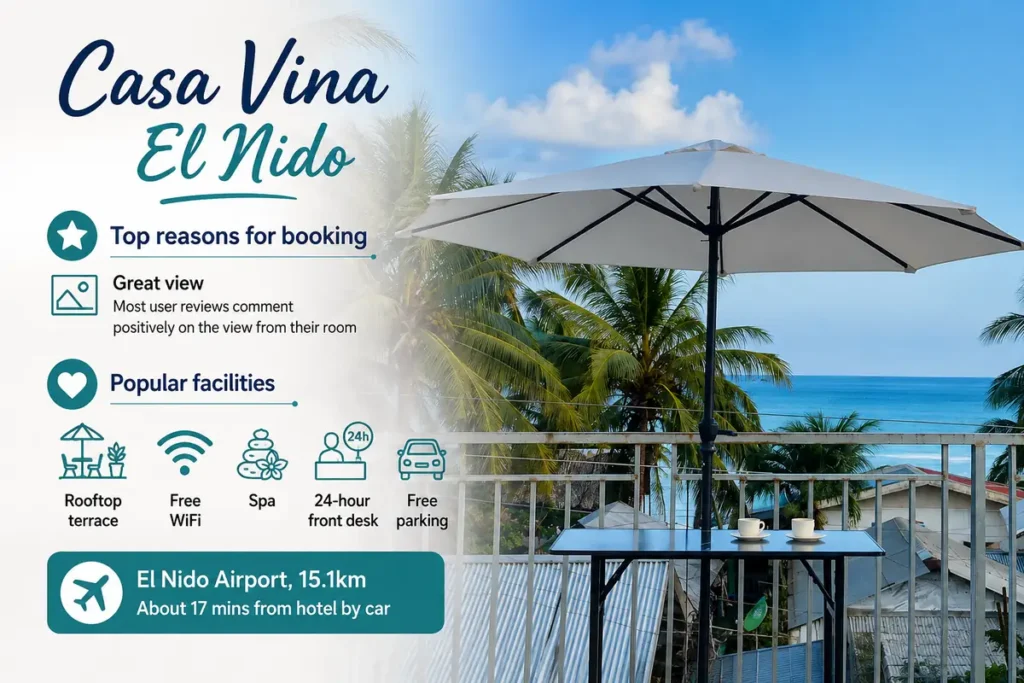
A great match for budget travelers who care more about genuine local hospitality than luxury. The cozy rooms and helpful hosts make it a comfortable base for exploring Nacpan Beach and northern El Nido.
Entrance Fees and Costs
Neither Nacpan Beach nor Las Cabanas Beach charges its own separate entrance fee as of 2026, despite what some tricycle drivers might tell first-time visitors. What every visitor does pay is the municipality-wide Eco-Tourism Development Fee, set under Municipal Ordinance No. 01, Series of 2024, and enforced by the El Nido Municipal Tourism Office.
This fee is ₱400, or roughly $6.90, and stays valid for 10 days across most tourism sites in the area, including the Tour A, B, C, and D island-hopping routes. Beyond that, expect small add-on costs: motorbike parking at Nacpan runs about ₱20, while the Las Cabanas zip-line costs roughly $14 to $17 (₱800–₱1,000) per ride if you want to try it.
Discover the Real Cost of Visiting Nacpan Beach. Read more in Nacpan Beach Entrance Fee and Rules Locals Won’t Warn You About.
Here’s a rough breakdown of what you’ll actually spend at each beach, in US dollars, once transport and food are factored in.
| Item | Nacpan Beach | Las Cabanas Beach |
| Eco-Tourism Development Fee | $6.90 (₱400, 10-day) | $6.90 (₱400, 10-day) |
| Transport from town (round trip) | $9–$12 | $5–$7 |
| Beach entrance fee | None | None |
| Typical meal | $3–$6 | $6–$11 |
| Signature extra activity | None specific | Zip-line, $14–$17 |
How Much Does It Cost to Visit Nacpan Beach and Las Cabanas in 2026?
Neither beach charges its own entrance fee in 2026. Every visitor to El Nido pays the ₱400 (about $6.90) Eco-Tourism Development Fee once, valid for 10 days. Beyond that, expect $9 to $12 for transport to Nacpan, or $5 to $7 to Las Cabanas, plus meals and optional activities.
Best Time to Visit
Timing changes the experience at both beaches more than most people realize. The dry season, November through May, is the better window for both, offering calmer seas, clearer skies, and more reliable sunsets. Nacpan is at its best early in the morning; arriving between 9 and 10 AM lets you enjoy the beach before day-tour groups show up around midday.
Las Cabanas, by comparison, is naturally an afternoon and evening destination, since the appeal centers on the sunset between roughly 5:30 and 6:30 PM, depending on the month. Avoid the June to October monsoon season if swimming and clear views matter, since both beaches see rougher conditions then.
Pros and Cons of Nacpan Beach
Nacpan’s biggest strength is space, and its main drawback is distance. Here’s how it breaks down:
- Nearly 4 km of open, uncrowded sand
- Calm, shallow swimming conditions from November through May
- No standalone entrance fee, just a small parking charge
- Budget-friendly local food at honest prices
- Quiet, photogenic sunrise instead of sunset crowds
- 45-minute ride from El Nido town
- No ATMs nearby, so cash is essential
- Rougher seas and weaker mobile signal from June through October
- Limited accommodation options compared to town
- No direct ocean sunset, since the beach faces north
Find Out Why Nacpan Beach Is Worth the Trip. Read more in Nacpan Beach in El Nido That Looks Remote but Feels Worth the Ride.
Pros and Cons of Las Cabanas Beach
Las Cabanas trades space for convenience, and that trade-off shows up clearly here:
- Only 10–15 minutes from El Nido town
- Some of the best sunset views in all of El Nido
- Beachfront resorts, bars, and a scenic zip-line
- Easy to visit without renting a motorbike
- Lively atmosphere with live music and DJ sets
- Crowded, especially right at sunset
- Higher food and drink prices than Nacpan
- Smaller beach with less room to spread out
- More boat and zip-line traffic near the shore
- Sandflies can be active around sunset hours
Nacpan Beach vs Las Cabanas: Side-by-Side Comparison Table
Now that we’ve covered every angle individually, here’s everything side by side in one place. Use this table as your final reference when deciding between Nacpan Beach and Las Cabanas, especially if you’re trying to fit one or both into a tight El Nido itinerary. Keep in mind that many travelers end up doing both: Nacpan for a relaxed swim earlier in the day, and Las Cabanas for sunset drinks in the evening, since neither requires a full day on its own.
This comprehensive comparison pulls together distance, cost, atmosphere, and practical details so you can compare Nacpan Beach and Las Cabanas at a glance.
| Category | Nacpan Beach | Las Cabanas Beach |
| Distance from town | ~17 km / 45 min | ~3 km / 10–15 min |
| Beach length | ~4 km | Compact, shorter |
| Entrance fee | None | None |
| Transport cost (round trip) | $9–$12 | $5–$7 |
| Meal cost | $3–$6 | $6–$11 |
| Swimming | Excellent, Nov–May | Good, view-focused |
| Sunset quality | North-facing, no direct sunset | West-facing, excellent |
| Crowd level | Low | High, especially evenings |
| Accommodation | Limited, budget to mid-range | More resorts, beachfront |
| Signature activity | Sunrise, walk to Calitang | Zip-line, sunset bars |
Which Wins? Nacpan Beach vs Las Cabanas
So, Nacpan Beach vs Las Cabanas, which one should actually make your itinerary? Honestly, they’re not really competing for the same moment. Nacpan is the beach you visit for space, quiet, and a proper swim, ideally in the morning before the day-tour vans arrive. Las Cabanas is the beach you visit for convenience and a genuinely spectacular sunset, best enjoyed with a cold drink in hand around 5:30 PM.
If you only have time for one, let your priorities decide: pick Nacpan if solitude matters more than logistics, and pick Las Cabanas if you want maximum reward for minimum travel time. But if your schedule allows it, doing both, Nacpan for the morning and Las Cabanas for the evening, gives you a genuinely complete picture of what El Nido’s beaches have to offer, without spending an entire day getting between them.
Frequently Asked Questions
Is Nacpan Beach or Las Cabanas better for families with kids?
Nacpan Beach is generally better for families, thanks to its calm, shallow water from November to May and its wide, uncrowded sand for kids to play on.
Do I need a motorbike to visit Nacpan Beach?
Not necessarily. You can hire a tricycle or join a group tour, though a rented motorbike, around $9 to $11 per day, gives you more flexibility for the 45-minute ride.
Can I visit both Nacpan Beach and Las Cabanas in one day?
Yes, many travelers combine a morning at Nacpan with a sunset stop at Las Cabanas, since the two sit on opposite sides of El Nido town and the timing works well together.
Is the Eco-Tourism Development Fee required for both beaches?
Yes. The ₱400 (about $6.90) fee applies municipality-wide under Municipal Ordinance No. 01, Series of 2024, and is valid for 10 days, so it only needs to be paid once per trip.
What is the best month to visit Nacpan Beach and Las Cabanas?
The dry season, from November to May, offers the calmest seas, clearest skies, and most reliable sunsets at both beaches.