

Nacpan Beach weather stays warm all year, with temperatures ranging from 24°C to 33°C depending on the season. The dry season runs from December to May, bringing sunny skies, low humidity, and calm seas that are ideal for swimming, island hopping, and camping on the sand. From June to November, Nacpan Beach weather shifts into the rainy season, when short but heavy showers, higher humidity, and stronger winds become more common.
Even during these wetter months, storms usually pass quickly rather than lasting all day, and Palawan’s spot in a typhoon shadow keeps conditions calmer here than in many other parts of the Philippines. Mornings tend to stay clear even in the wet season, so early beach walks and photography are rarely disrupted. Travelers who check monthly averages before booking can time their trip around the driest, sunniest stretch of weeks.
What to Expect From Nacpan Beach Weather
Nacpan Beach sees a tropical climate with two clear seasons instead of four. Daytime temperatures stay warm all year, typically between 24°C and 33°C (75–91°F), so packing for cold weather is never necessary.
Rainfall is the variable that actually changes a trip, swinging from under 50 mm in February to well over 350 mm in July or August. Humidity sits high most months, often above 75%, which makes the sea breeze along the four-kilometer shoreline especially welcome.
Everything You Need to Know about Nacpan Beach Weather. Read more in Nacpan Beach in El Nido That Looks Remote but Feels Worth the Ride.
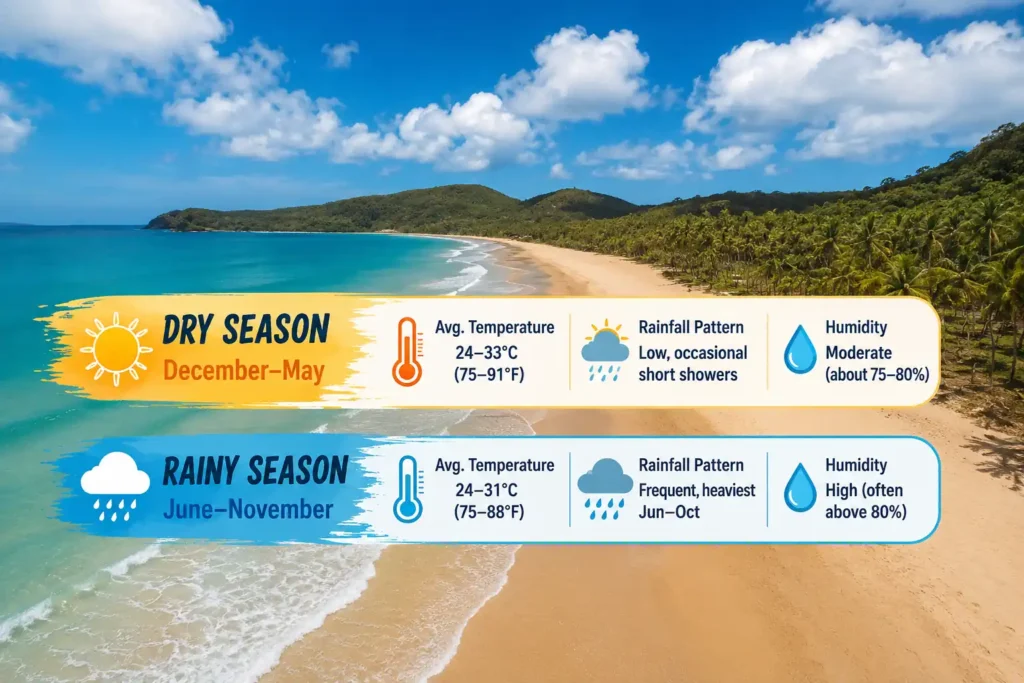
The table below summarizes what to expect in each season at a glance.
| Season | Months | Avg. Temperature | Rainfall Pattern | Humidity |
| Dry Season | December–May | 24–33°C (75–91°F) | Low, occasional short showers | Moderate (about 75–80%) |
| Rainy Season | June–November | 24–31°C (75–88°F) | Frequent, heaviest Jun–Oct | High (often above 80%) |
Nacpan Beach Weather by Season
Palawan’s weather runs on two monsoon winds rather than four seasons, and Nacpan Beach follows the same rhythm as the rest of El Nido. Knowing which wind is active tells you more about a trip than the calendar date alone.
Dry Season
The dry season runs roughly from December to May, driven by the amihan, or northeast monsoon. Skies stay mostly clear, rainfall drops sharply, and the sea flattens out, which makes this the busiest stretch for boat tours and beach camping.
April and May bring the hottest temperatures of the year, sometimes touching 33°C, so shade and sun protection matter more than rain gear. Humidity is lower than in the wet months, though it never disappears completely this close to the equator. December through February tend to feel the most comfortable, with warm days and slightly cooler nights.
Rainy Season
From June to November, the habagat, or southwest monsoon, takes over, bringing daily showers, higher humidity, and rougher water. Rain rarely falls all day; short, heavy downpours are more common than continuous drizzle, so mornings or late afternoons often stay dry.
July and August are usually the wettest months, with the heaviest rainfall totals of the year.
The Palawan Council for Sustainable Development (PCSD) also monitors coastal conditions during heavier rains, since runoff can affect nearby reef systems. Boat operators sometimes cancel island-hopping trips when swells pick up, so it helps to build flexibility into any itinerary during these months.
Nacpan Beach Weather by Month
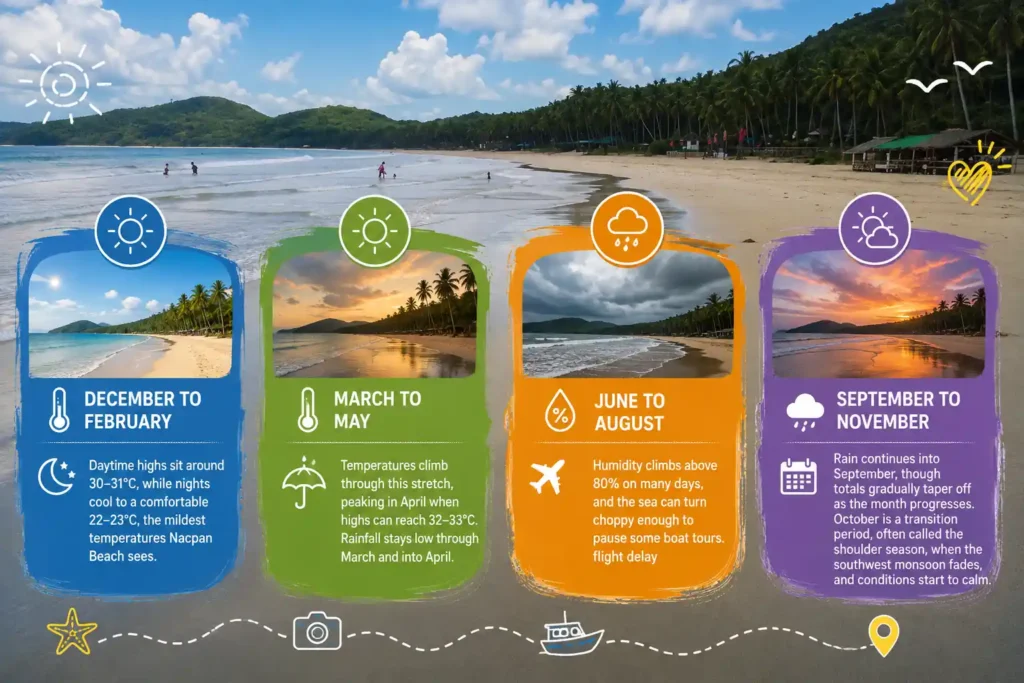
Breaking the year into four stretches makes it easier to match travel dates with the kind of weather actually wanted. Here is what typically happens across each block of months.
December to February
This stretch marks the heart of the dry season, with plenty of sunshine and rainfall totals under 50 mm in most months. February usually records the least rain of the entire year.
Daytime highs sit around 30–31°C, while nights cool to a comfortable 22–23°C, the mildest temperatures Nacpan Beach sees. Seas stay calm, making it a reliable window for swimming, snorkeling, and multi-island boat trips. Hotel and hostel rates climb during this period since it overlaps with the December holidays and the peak international travel season.
March to May
Temperatures climb through this stretch, peaking in April when highs can reach 32–33°C. Rainfall stays low through March and into April before a few more showers appear by May as the wet season approaches.
Humidity is often at its lowest around April, though the stronger sun means sunburn risk is higher than earlier in the dry season. Sea temperatures also warm up, making this a good window for diving and snorkeling around Nacpan and nearby Calitang Beach. Afternoon heat can be intense, so many travelers plan beach time for morning or late afternoon.
June to August
The southwest monsoon settles in fully by June, and rainfall increases sharply through July and August, the wettest months of the year. Daily showers are common, though they tend to arrive in bursts rather than lasting from morning to night.
Humidity climbs above 80% on many days, and the sea can turn choppy enough to pause some boat tours.
Flight delays into nearby airstrips also tick up during peak monsoon weeks, something the Civil Aviation Authority of the Philippines (CAAP) flags in its advisories when storms roll through. Flexible plans and travel insurance are worth considering when visiting during these months.
September to November
Rain continues into September, though totals gradually taper off as the month progresses. October is a transition period, often called the shoulder season, when the southwest monsoon fades, and conditions start to calm.
By November, the northeast monsoon typically reasserts itself, drying things out and pulling crowds back before the December peak. This stretch offers a useful compromise: fewer tourists than the dry season proper, paired with steadily improving weather. Prices also tend to be lower than the December to February window, which appeals to budget-conscious travelers.
Temperature, Rainfall, and Humidity
Nacpan Beach weather stays warm year-round, but the details shift enough month to month to matter for planning. Average highs range from about 30°C in the cooler months to 33°C at the April peak, while overnight lows rarely dip below 22°C.
Rainfall is the biggest swing factor, moving from roughly 47 mm in February to more than 380 mm during the wettest months. Humidity tracks a similar pattern, generally lowest in the dry season and highest from August through October.
The table below lays out approximate monthly averages so conditions can be compared before booking.
| Month | Avg. High | Avg. Low | Rainfall | Humidity |
| January | 31°C / 88°F | 23°C / 73°F | ~55 mm | ~78% |
| February | 31°C / 88°F | 23°C / 73°F | ~47 mm | ~76% |
| March | 32°C / 90°F | 24°C / 75°F | ~65 mm | ~76% |
| April | 33°C / 91°F | 24°C / 75°F | ~70 mm | ~75% |
| May | 32°C / 90°F | 25°C / 77°F | ~150 mm | ~78% |
| June | 31°C / 88°F | 24°C / 75°F | ~330 mm | ~82% |
| July | 30°C / 86°F | 24°C / 75°F | ~380 mm | ~83% |
| August | 30°C / 86°F | 24°C / 75°F | ~400 mm | ~84% |
| September | 30°C / 86°F | 24°C / 75°F | ~300 mm | ~85% |
| October | 30°C / 86°F | 24°C / 75°F | ~250 mm | ~82% |
| November | 30°C / 86°F | 23°C / 73°F | ~150 mm | ~80% |
| December | 30°C / 86°F | 23°C / 73°F | ~90 mm | ~79% |
Figures are long-term averages drawn from regional climate records; year-to-year conditions can vary, so it is worth checking the Philippine Atmospheric, Geophysical and Astronomical Services Administration (PAGASA) for updated forecasts closer to a travel date.
Best Time to Visit Nacpan Beach for Good Weather
The best time to visit Nacpan Beach for good weather is December through May, when the amihan keeps skies clear and the sea calm enough for reliable island hopping. Within that window, December to February offers the mildest temperatures, while March to May trades slightly hotter days for the lowest rainfall totals of the year.
The Department of Tourism generally promotes November through May as Palawan’s peak travel window, which lines up with the driest and calmest stretch of the year. Travelers who prioritize lower costs and do not mind occasional rain sometimes choose September or October instead, since storms are less frequent than in July and August.
Whatever window is chosen, checking a short-range forecast a few days before travel is still worth doing, since even dry-season days can bring a passing shower.
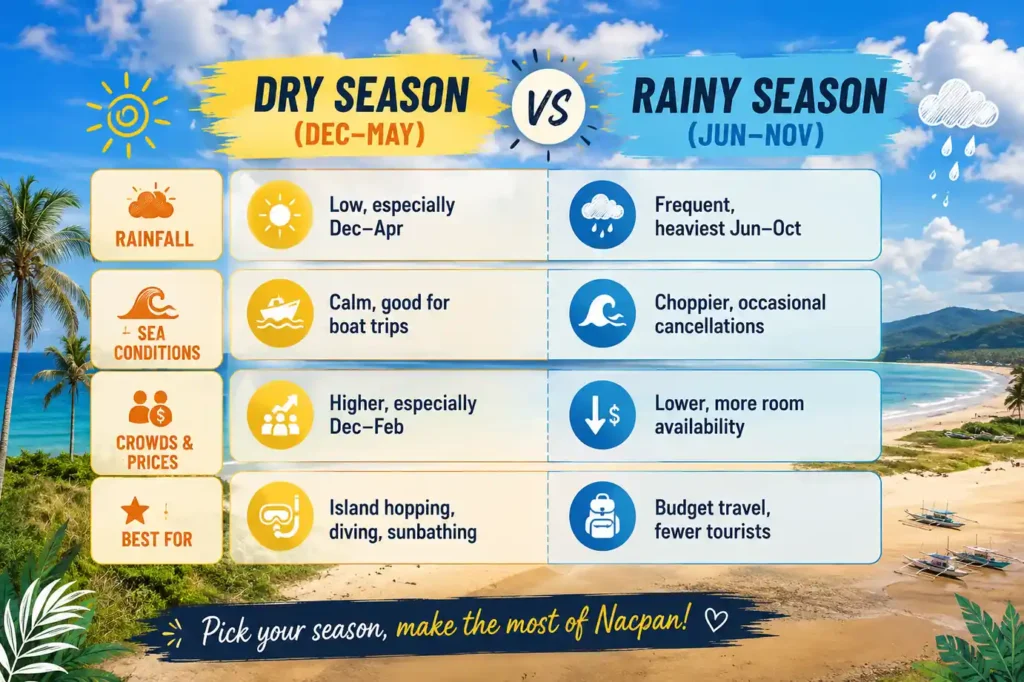
| Factor | Dry Season (Dec–May) | Rainy Season (Jun–Nov) |
| Rainfall | Low, especially Dec–Apr | Frequent, heaviest Jun–Oct |
| Sea Conditions | Calm, good for boat trips | Choppier, occasional cancellations |
| Crowds & Prices | Higher, especially Dec–Feb | Lower, more room availability |
| Best For | Island hopping, diving, sunbathing | Budget travel, fewer tourists |
Nacpan Beach Weather Recap
Nacpan Beach weather comes down to two seasons rather than a complicated forecast: dry and sunny from December to May, wetter and more humid from June to November. Choosing a travel window depends on what matters most, whether that is calm seas for boat trips, lower prices, or fewer crowds on the sand.
Checking PAGASA’s short-range updates a few days before travel is still the most reliable way to plan around any last-minute shifts. Once the pattern is clear, packing and planning around Nacpan Beach weather becomes straightforward.
Frequently Asked Questions
What is the best month to visit Nacpan Beach?
February and March usually offer the best mix of low rainfall, comfortable heat, and calm seas at Nacpan Beach. Rain totals are near their yearly low, and the sea stays flat enough for island-hopping tours. April is a close second, though its temperatures run a few degrees hotter.
Does it rain a lot at Nacpan Beach?
Yes, but mainly from June to November. Nacpan Beach receives roughly 2,400–2,500 mm of rain a year, with July and August the wettest months. Even then, downpours are usually short and heavy rather than continuous, so most days still include stretches of sunshine.
What is the hottest time of year at Nacpan Beach?
April is typically the hottest month, with daytime highs reaching 32–33°C (90–91°F). Humidity is comparatively lower then, but strong midday sun still makes shade, sunscreen, and hydration essential for anyone spending long hours on the sand.
How much rain falls at Nacpan Beach in a year?
Nacpan Beach receives around 2,400–2,500 mm of rainfall annually, based on long-term regional averages. Most of that total falls between June and October, while the dry months from December to April see only a small fraction of the yearly amount.
Is Nacpan Beach affected by typhoons?
Palawan sits in what is often called a typhoon shadow, so Nacpan Beach sees far fewer direct hits than Luzon or the Visayas. It is not completely immune, though, and PAGASA still issues advisories during the June to November storm season, so it is worth checking updates before travel.
How accurate is the Nacpan Beach weather forecast?
Short-range forecasts, three to five days out, tend to be fairly reliable for Nacpan Beach weather, especially for rainfall timing during the wet season. Longer-range seasonal patterns are easier to predict than day-to-day details, so it helps to check PAGASA updates close to a travel date rather than months in advance.