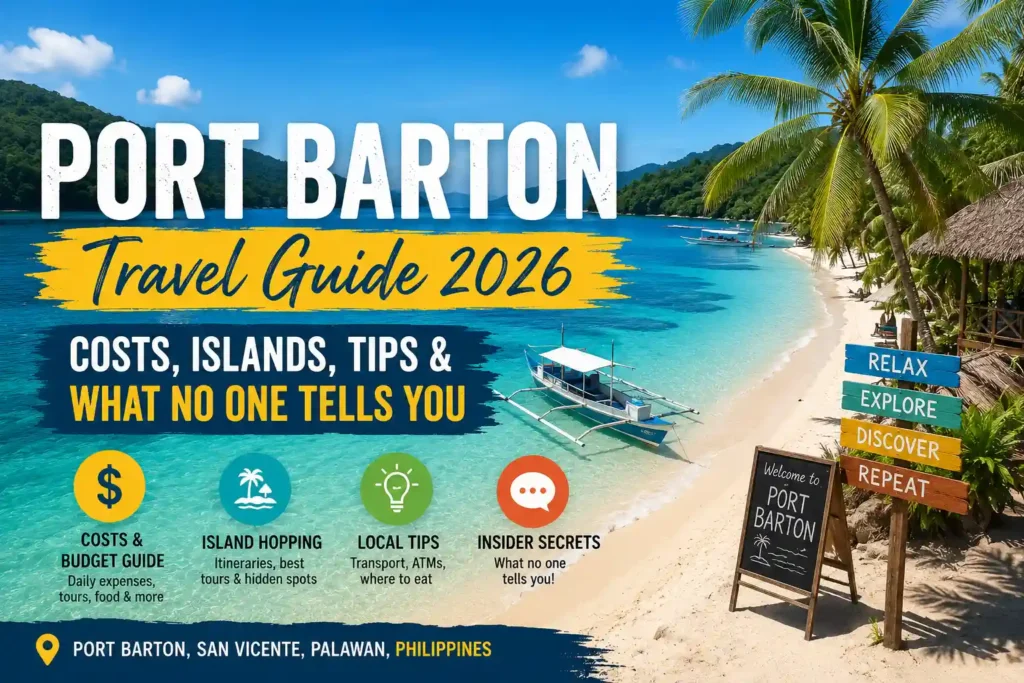
Port Barton, a quiet fishing village in San Vicente, Northern Palawan, is easy to miss if you only follow the usual travel guides. This Port Barton guide covers the essentials: how to get there, what to budget, where to stay, and which islands to visit first. You won’t find ATMs in the village, and Wi-Fi often stops working after 9 PM, so plan your cash and connectivity needs before you arrive.
From Hidden Lagoons to Quiet Beaches: Why Port Barton Belongs on Your Palawan Itinerary
Getting here usually means a 5 to 6 hour van ride from Puerto Princesa, or a shorter trip from El Nido if you’re combining destinations. Once you’re settled, island-hopping tours to spots like Exotic Island and German Island cost far less than similar trips in El Nido or Coron, making this Port Barton guide especially useful for budget-conscious travelers who still want postcard-worthy views without the crowds.
How to Get to Port Barton from Puerto Princesa?
Fly into Puerto Princesa Airport (PPS) from Manila; 1.5 hours via Cebu Pacific, Philippine Airlines, or AirAsia.
- Head to San Jose Terminal in Puerto Princesa City.
- Board a shared van to Port Barton; ₱400–₱500 per person.
- Journey takes 3.5 to 4 hours, depending on road conditions.
- Book your seat the day before during the December–April peak season.
Getting to Port Barton: Travel Routes, Transfers, and Tips

Port Barton has no direct flights. You fly into Puerto Princesa Airport (PPS), which is well-connected from Manila (1.5 hours) via Philippine Airlines, Cebu Pacific, and AirAsia. From there, you travel overland.
From Puerto Princesa City, you have two realistic options:
- Shared van (most common): ₱400–₱500 per person, 3.5 to 4 hours. Operators like JoyCraft Travel and local vans at the San Jose Terminal in Puerto Princesa run daily trips. Book a seat the day before during peak season, spots fill fast.
- Private van transfer: ₱3,500–₱4,500 for the whole vehicle. Worth it for groups of three or more who want flexibility and door-to-door service.
- From El Nido: Van or jeepney via Roxas, ₱400–₱500 per person, roughly 3 to 3.5 hours. Less comfortable than the Puerto Princesa route, but completely doable for budget travelers.
The road to Port Barton is partially unpaved. After rain, it slows down considerably. Build buffer time into your schedule; don’t plan tight same-day connections.
Travel Tip: Secure your bags properly. The road is bumpy. If you’re carrying camera gear or electronics, wrap them. Dust and vibration are both real issues on this route.
Best Time to Visit Port Barton for Ideal Weather

Port Barton follows Palawan’s general climate pattern, but its coastal position makes it slightly more exposed to westerly monsoon winds than El Nido from June through September.
| Season | Months | Sea Conditions | Recommendation |
| Dry Season | November – May | Calm, clear, excellent visibility | Best time to visit |
| Shoulder Season | October, late May | Light rain, occasional swell | Good value, still manageable |
| Wet / Monsoon Season | June – September | Rough seas, heavy rain, tours suspended | Avoid island hopping |
According to PAGASA climate data (Philippine Atmospheric, Geophysical and Astronomical Services Administration), historical records for Northern Palawan, January through March consistently deliver the lowest rainfall totals and best sea conditions of the year. March and April sit firmly in peak season, accommodation books out early, so plan 3 to 4 weeks if you’re visiting during this window.
December also attracts strong volume due to the Philippine holiday season. If you want good weather without the full peak-season prices or crowds, November and early February are the sweet spots.
Does Port Barton Have an ATM?
No. There is no ATM in Port Barton. The nearest ATM is in Roxas town, 1.5 hours away, or in Puerto Princesa City. Cash-only services are the norm across all accommodation, restaurants, and island-hopping operators. Bring your full trip budget in Philippine Pesos before leaving Puerto Princesa.
Budget Guide: Costs, ATMs, and Cash Essentials

This is the section most first-timers skip, and it’s the one that causes the most problems.
There is no ATM in Port Barton. The nearest working ATM is in Roxas town, approximately 1.5 hours away by tricycle or hired van, or back in Puerto Princesa itself. The overwhelming majority of guesthouses, restaurants, and tour operators run on cash only.
Withdraw enough Philippine Pesos for your entire stay before leaving Puerto Princesa. Carry small denominations; change for ₱1,000 notes is often unavailable at small eateries.
| Expense Category | Daily Cost (PHP) | Notes |
| Accommodation | ₱600 – ₱2,500 | Fan rooms to beachfront bungalows |
| Food (3 meals) | ₱400 – ₱800 | Local eateries to mid-range restaurants |
| Island Hopping (shared) | ₱600 – ₱1,200 | Per person; includes snorkeling gear |
| Private boat hire | ₱3,500 – ₱5,000 | Full-day, fits 4–8 people |
| Tricycle rides | ₱20 – ₱100 | Short village trips |
| Entrance fees | ₱50 – ₱150 | Some islands charge separately |
| Estimated daily total | ₱1,650 – ₱4,750 | Budget to mid-range traveler |
For a 3-night stay, bring at least ₱6,000–₱10,000 per person. More if you want private boat tours or higher-end accommodation. Cash, not cards.
Where to Stay: Best Areas and Accommodation Types
Port Barton is laid out simply. One beach road runs parallel to the shore, roughly 1.5 km end to end. Where you position yourself on that strip matters more than you’d think.
- Beachfront guesthouses (₱1,500–₱2,500/night): Closest to the water. You wake up to the ocean and walk straight onto the sand. Chill Out Guesthouse and Greenviews Resort are consistently well-reviewed by long-term travelers for reliability and cleanliness.
- Budget fan rooms behind the main strip (₱600–₱900/night): Clean and basic. Shared bathrooms are common at this price. Good for solo travelers watching costs.
- Mid-range bungalow resorts (₱1,200–₱2,000/night): Better air circulation than enclosed rooms, usually with private bathrooms and either beach or garden access.
Port Barton has an estimated 40–50 guesthouses in total. That sounds like a lot until you factor in peak season traffic between December and April. Book in advance. Unlike El Nido, there’s no overflow accommodation to absorb last-minute arrivals.
Internet & Connectivity: What to Expect (Very Limited Wi-Fi)

Port Barton WiFi & Mobile Data Guide: What Internet Is Really Like in 2026
Be honest with yourself about this before you go.
Most guesthouses offer Wi-Fi that works between roughly 6 AM and 9 PM. After 9 PM, it’s mostly dead. Even during active hours, streaming video or running video calls reliably is not realistic. This is a remote fishing village, not a digital nomad hub.
- Globe SIM outperforms Smart in this specific area based on consistent traveler reports from 2023–2025.
- Buy and test your SIM with data while still in Puerto Princesa.
- Load your entertainment before you leave, download podcasts, playlists, offline maps, and reading material.
If remote work is a necessity, Port Barton is not the right destination. Plan your offline windows before you arrive, and you’ll enjoy the disconnection rather than fight it.
Island Hopping Guide: Must-Visit Spots and Booking Tips
Island hopping is the primary activity, and it genuinely delivers. The main advantage Port Barton has over El Nido is space; the islands are significantly less crowded, which means you actually experience the place rather than queue at it.
Top stops on the standard circuit:
- Exotic Island – White sand bar, clear turquoise water, strong snorkeling around the reef
- German Island – Calm, sheltered lagoon, excellent swimming, consistent coral visibility
- Turtle Island – Named for regular sea turtle sightings; snorkeling here is a highlight of most itineraries
- Cacnipa Island – Larger island with jungle trails, beach camping options, and quieter coves
- Capsalay Island – The least-visited stop on most tours; beautiful coral, almost no crowds
Quick Booking Facts
Shared tours: ₱600–₱1,200/person | Departs: 9–9:30 AM | Returns: 4–5 PM Private boats: ₱3,500–₱5,000/day (fits 4–8 people) Book through your guesthouse, most arrange directly with local operators Philippine Coast Guard advisories may suspend tours during bad weather, no reputable operator will sail against an active advisory
Snorkeling gear is included in most shared tours. Confirm before paying. Bring underwater cameras, visibility here regularly hits 15–20 meters on calm days.
Food & Dining: What to Eat and Where to Go

The food in Port Barton is simple, affordable, and genuinely good. Fresh seafood dominates most menus, grilled fish, prawns, and squid caught locally and served the same day. A proper plate of grilled tuna with rice costs ₱150–₱250 at most local eateries.
Worth visiting:
- El Busero Restaurant : Long-running spot popular with returning visitors. Reliable grilled seafood, cold San Miguel, and a straightforward menu that doesn’t try too hard.
- Chill Out Restaurant: Beachfront setting, solid variety, casual atmosphere. Good for watching the sunset over a meal.
- Local sari-sari stores: For breakfast snacks, instant coffee, and seasonal fresh fruit from the small market.
A few honest expectations: menus are short, kitchen pace is slow (this is remote Palawan, not a restaurant district), and vegetarian options exist but are limited. Bring patience. The food rewards it.
Safety Tips for First-Time Travelers
Port Barton is one of the safer destinations in the Philippines for independent travelers. The community is small, tight-knit, and visitors stand out, which generally helps with security.
- Petty theft is rare, but standard precautions apply. Don’t leave valuables unattended on the beach.
- Ocean safety is more serious. Currents shift during the wet season. During island hopping, respect your guide’s judgment on water conditions. Don’t swim alone in unfamiliar spots.
- The village is dimly lit after dark. Bring a flashlight or use your phone torch when walking the beach road at night.
- There is a basic rural health unit in Port Barton. For anything beyond minor issues, you need Puerto Princesa. Travel insurance with medical evacuation coverage is not optional here; it’s necessary.
Register your accommodation details with your embassy’s travel notification system before you leave your home country.
Packing Essentials for Port Barton
Standard beach packing applies, but Port Barton’s remoteness changes the stakes. If you forget something here, you can’t replace it easily.
Non-negotiable items:
- Reef-safe sunscreen: coral damage is real, and some local operators now actively check at boat boarding
- Water shoes: some island entries are rocky and slippery
- Cash in small bills: no ATMs; this cannot be overstated
- Portable power bank: electricity cuts out occasionally, especially during weather events
- Insect repellent: mosquitoes activate heavily at dusk near the mangrove areas
- Lightweight rain jacket: even the dry season brings brief afternoon showers
- Dry bags: protect phones and cameras during open-water boat transfers
Leave structured luggage at home. A 30–40 liter backpack handles everything you need comfortably.
Transportation: Getting Around the Town Easily
Port Barton is walkable end-to-end in under 20 minutes. Most of your time here, you move on foot.
- Tricycles (motorized three-wheelers) handle anything beyond walking distance. ₱20–₱50 for short rides, ₱100+ for further pickups.
- Bangkas (traditional wooden outrigger boats) are your transport for all island tours and snorkeling trips.
- There are no ride-hailing apps. No Grab, no Angkas. Wave down a tricycle, agree on a price, and go.
Eco-Friendly Travel Tips: Respect Nature and Locals
Port Barton sits inside a protected marine sanctuary area under the jurisdiction of the San Vicente Local Government Unit (LGU). Since 2022, enforcement of marine protection rules has increased noticeably, with local rangers and boat operators more actively monitoring behavior on tours.
- Bring a reusable water bottle. Plastic waste is one of the most visible environmental issues in remote Philippine villages, and the infrastructure to process it doesn’t exist here.
- No touching coral. No standing on the reef. No exceptions, regardless of what you see other tourists doing.
- Hire local bangka operators and stay at locally-owned guesthouses. Tourism money that circulates within the community is what preserves the destination long-term.
- Do not feed fish, sea turtles, or other marine wildlife.
Nightlife & Things to Do After Sunset
Honest Reality Check: Port Barton has no clubs, no bars with DJs, and no nightlife district. What it does have is a genuinely dark sky, bioluminescent plankton in season, fireflies near the mangroves, and occasional acoustic music at beachfront bars on weekends. If that sounds disappointing, this is not the right destination. If that sounds exactly right, you’ll understand within the first hour why people come back.
After-dark activities that actually exist:
- Bioluminescent plankton kayaking; available through select tour operators, seasonal (typically October–January)
- Firefly watching near the mangrove areas; arrange through your guesthouse
- Beach bonfires at several guesthouses; informal, no charge
- Open-air bars with cold drinks, card games, and other travelers
El Nido has the nightlife. Port Barton has the silence. Decide what you’re actually looking for before you book.
Common Mistakes First-Timers Should Avoid
These are the ones that actually cost people time or money:
- Bringing insufficient cash. Carry at minimum ₱5,000–₱8,000 per person for a 3-night stay. More if you plan island hopping.
- Arriving without a reservation. In peak season (December–April), walking in without a booking means limited options at inflated last-minute prices, if anything’s available at all.
- Underestimating travel time. Puerto Princesa to Port Barton can take 4.5 hours in wet conditions. Don’t plan arrivals that cut it close to ferry or flight departures.
- Using non-reef-safe sunscreen. Some boat operators now check at boarding. Coral protection matters here, and locals take it seriously.
- Skipping travel insurance. A medical evacuation from remote Palawan starts at ₱50,000 and climbs fast. This is not negotiable for remote Philippine travel.
Port Barton vs El Nido vs Coron
Port Barton → quiet, budget-friendly
El Nido → crowded, premium
Coron → best for wreck diving
Final Verdict
Port Barton is not for everyone. That’s a feature, not a flaw.
It doesn’t have developed resorts, reliable internet, or a real nightlife scene. What it has is uncrowded islands, honest prices, some of the best snorkeling in Palawan, and a fishing village that still feels like itself rather than a curated tourist destination.
Go before it changes. It’s already starting to.
Frequently Asked Questions
Q1: Is there an ATM in Port Barton?
No. There is no ATM in Port Barton. The nearest functioning ATMs are in Roxas town (roughly 1.5 hours away) or in Puerto Princesa City. Always withdraw and carry enough cash before leaving Puerto Princesa.
Q2: How do I get to Port Barton from Puerto Princesa?
Take a shared van from the San Jose Terminal in Puerto Princesa. The journey costs ₱400–₱500 per person and takes approximately 3.5 to 4 hours. Private transfers cost ₱3,500–₱4,500 for the whole vehicle and are worth it for groups.
Q3: What is the best time to visit Port Barton?
November through May is the dry season and the recommended window. January to March offers the most consistently calm seas and the lowest rainfall. Avoid June through September, the westerly monsoon makes sea conditions rough, and most island-hopping tours are suspended.
Q4: Is Port Barton safe for solo travelers?
Yes. Port Barton is considered one of the safer destinations in the Philippines. The community is small and close-knit. Standard travel precautions apply, especially around ocean safety during island hopping, and carrying travel insurance given the limited medical facilities.
Q5: Does Port Barton have Wi-Fi?
Most guesthouses offer Wi-Fi, but it is limited in speed and reliability, generally functioning between 6 AM and 9 PM. Streaming and video calls are usually not possible. Globe SIM cards outperform Smart in this area. Load up data and offline content before leaving Puerto Princesa.
Q6: How much does island hopping cost in Port Barton?
Shared island hopping tours cost ₱600–₱1,200 per person, including snorkeling gear. Private boat hire runs ₱3,500–₱5,000 per day for a bangka that fits 4–8 people. Book through your guesthouse; most arrange tours directly with local operators.
Q7: What should I pack specifically for Port Barton?
Key items beyond standard beach gear: reef-safe sunscreen (enforced at some boat boardings), water shoes, cash in small bills, a portable power bank, insect repellent for dusk hours, a lightweight rain jacket, and dry bags for electronics during boat transfers.
Q8: Is Port Barton better than El Nido?
They offer different experiences. El Nido is more developed, more expensive, and more crowded. Port Barton is quieter, cheaper, and significantly less touristy. If you want a pristine,