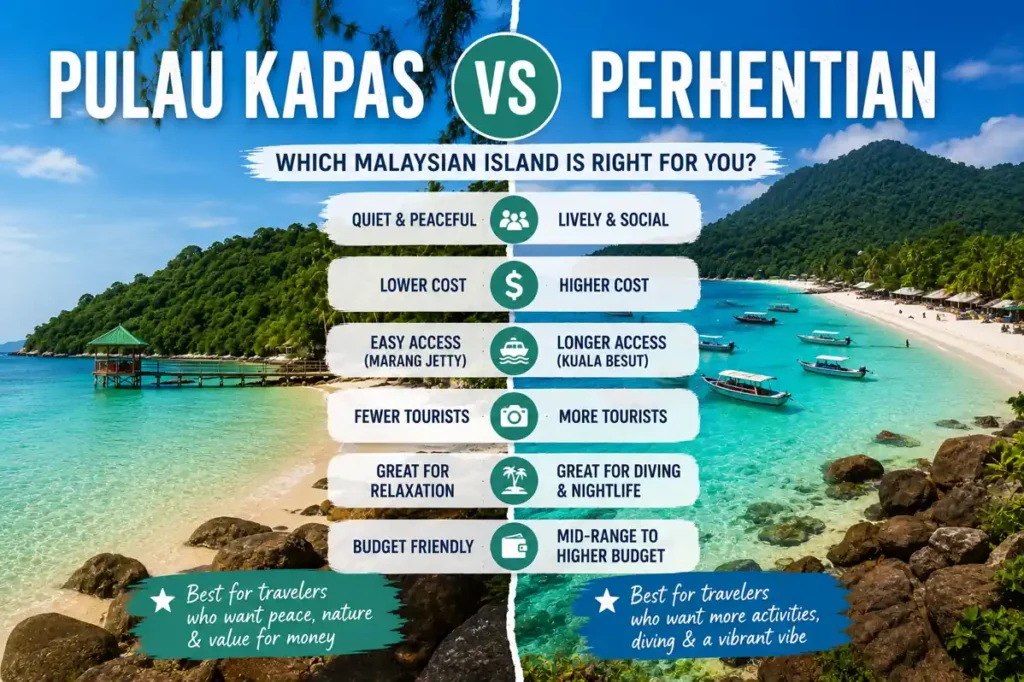
Pulau Kapas vs Perhentian Islands comes down to one simple trade-off: peace or energy. Pulau Kapas is a tiny island near Marang, just a 20 to 30-minute boat ride from the mainland, with clear water, quiet beaches, and only a handful of guesthouses. Perhentian Islands, made up of Perhentian Kecil and Perhentian Besar, sit further out and offer a bigger range of hostels, dive shops, beach bars, and daily boat trips.
From snorkeling with turtles to empty beaches and sunset views, this Pulau Kapas travel guide explains why the island still feels untouched.
If you compare the two directly, Pulau Kapas vs Perhentian Islands is really a choice between a slow, low-key island with almost no nightlife, and a livelier destination packed with backpackers, snorkeling tours, and things to do after dark. Both have beautiful clear water and good snorkeling spots, but the size, crowd, and overall vibe are very different once you’re actually standing on the sand.
Where Exactly Are These Islands?
Pulau Kapas is a tiny island off the coast of Marang in Terengganu. It’s about 6 km from the mainland, and the ferry from Marang Jetty takes roughly 15 to 20 minutes. The island is only about 1.5 square kilometres in size, genuinely small.
The Perhentian Islands sit further north, off Kuala Besut in Terengganu. There are two main islands: Perhentian Besar (the bigger one, slightly calmer) and Perhentian Kecil (smaller, more backpacker-heavy).
According to Tourism Malaysia, both island groups fall under protected marine park zones managed by the Department of Marine Parks Malaysia, which explains why the water clarity in both locations is generally excellent.
| Want | Choose |
| Quiet romance | Kapas |
| Backpacker vibe | Perhentian |
| Better snorkeling | Perhentian |
| Easier trip | Kapas |
Quick Location Comparison
| Detail | Pulau Kapas | Perhentian Islands |
| Location | Off Marang, Terengganu | Off Kuala Besut, Terengganu |
| Distance from the mainland | ~6 km | ~21 km |
| Ferry time | 15–20 minutes | 60–75 minutes |
| Island size | ~1.5 km² | Besar: ~8 km² / Kecil: ~5 km² |
| Marine Park status | Yes | Yes |
Beaches That Actually Feel Different

Kapas has a few small beaches that are calm and uncrowded. Teluk Kapas on the west side is the main landing spot, with soft sand, clear shallow water, and just a handful of chalets lining the shore. It’s the kind of beach where you can lie out a towel and not have anyone within ten metres of you on a weekday.
The Perhentian Islands have longer stretches of beach, especially on Perhentian Besar. Long Beach on Kecil gets fairly packed during peak season, July and August especially. Coral Bay, also on Kecil, is smaller and calmer. Locals I spoke to at a dive shop on Besar said tourists often underestimate how different the two Perhentian islands feel from each other.
If sheer beach solitude is your thing, Kapas wins easily. If you want more variety, more to explore, and don’t mind some company, Perhentian gives you more options. One evening on Kapas, the beach got so quiet after sunset that all I could hear were waves and cutlery from a tiny chalet kitchen nearby. It didn’t feel like a tourist island at all.
Snorkeling and Marine Life: What You’ll Really See

Both islands sit inside Terengganu’s marine park zone. The Department of Marine Parks Malaysia enforces no-fishing zones around both, which keeps the reefs in decent shape. That said, the snorkeling experience is quite different.
At Kapas, the snorkeling spots are close to shore and easy to access without a boat. I snorkelled right off the beach near Kapas Garden Resort and spotted turtles within 20 minutes. Honestly didn’t expect that. The coral coverage isn’t perfect, but there’s real marine life, reef fish, sea turtles, and the occasional moray eel tucked under a rock.
Perhentian is more structured for snorkelling. Most resorts offer snorkelling packages with a guide, and the diversity is higher. According to a marine biodiversity assessment conducted by Universiti Malaysia Terengganu researchers, Perhentian’s reef systems support over 50 coral genera.
Blacktip reef sharks, turtles, and massive schools of fish are common sightings, especially around Shark Point and Sugar Ray Point.
Snorkeling & Marine Life Side by Side
| Feature | Pulau Kapas | Perhentian Islands |
| Turtle sightings | Common, near shore | Very common, most spots |
| Shark sightings | Rare | Regular (blacktip reef sharks) |
| Coral health | Moderate | Good to very good |
| Shore snorkeling | Yes, easy access | Limited, mostly boat trips |
| Visibility (avg) | 10–15 m | 15–20 m |
| Best for beginners? | Yes | Yes, with a guide |
Which Island Offers Better Underwater Visibility?
Perhentian wins on average visibility, but Kapas surprises you.
Which Island Has the Clearer Water?

Perhentian’s deeper reef systems and distance from the mainland contribute to better water clarity. During the dry season (March to October), visibility of 15 to 20 metres is common. Kapas, being closer to shore, can see slight variations in clarity after rain or heavy boat traffic, but on calm days, it’s genuinely stunning.
Both islands enforce strict no-anchoring rules over reef areas, a regulation backed by the Department of Fisheries Malaysia. That helps. A lot.
Peaceful Days vs Backpacker Energy

This is honestly where the two islands split most clearly.
Kapas is slow. There are maybe a dozen or so accommodation options and a handful of restaurants. No bars. No nightlife. Just the sound of waves, frogs after dark, and fireflies near the treeline if you’re lucky. I met a couple on their third visit who just came to read books and unplug. That’s the Kapas crowd.
Perhentian, especially Kecil’s Long Beach, has a real social scene. Budget chalets sit side by side. There are beach bars, fire shows on some evenings, and the kind of hostel common rooms where you end up planning a dive trip with strangers you met an hour ago. Besar is calmer but still more developed than Kapas.
Neither vibe is wrong. It totally depends on what kind of trip you need right now. By my second night on Perhentian Kecil, I’d somehow ended up sharing grilled fish with three backpackers I met an hour earlier. Kapas gave me silence. Perhentian gave me stories.
Food, Cafes, and Nightlife Compared

Kapas has basic but decent food. Most accommodation options serve set meals, grilled fish, fried rice, and simple Malay dishes. There are a couple of small stalls near the jetty. Don’t come expecting a coffee shop or a proper menu, but the food is fresh and satisfying. One restaurant at Zana Beach Resort even does a surprisingly good tuna steak.
Perhentian has way more variety. You’ll find Western food, fresh seafood, BBQ dinners on the beach, smoothie bowls, and the occasional surprisingly good pasta. Restaurants like Mama’s Warung on Kecil have been serving travellers for years and are well-loved by returning visitors.
Nightlife is low-key by global standards but active for a remote Malaysian island, with a few beach bars, acoustic sets, and communal fire pits.
Staying on the Islands: Budget Rooms or Beach Resorts?
Kapas has a small range of accommodation, think simple chalets, a few mid-range resorts, and that’s mostly it. Kapas Turtle Valley is one of the better-known stays and has a solid reputation for eco-conscious tourism, something increasingly tracked by Malaysia’s Ministry of Tourism, Arts and Culture in their sustainable island travel initiatives.
Perhentian offers much more variety. Budget dorms on Kecil go as low as RM 30–50 a night. Mid-range beach chalets are around RM 100–250. And on Besar, you have nicer resorts like Bubu Long Beach Resort and Tuna Bay Island Resort with proper amenities. There’s genuinely something for every type of traveller.
Accommodation Quick Comparison
| Type | Pulau Kapas (est. price/night) | Perhentian Islands (est. price/night) |
| Budget dorm/room | RM 60–120 | RM 30–70 |
| Mid-range chalet | RM 130–220 | RM 100–250 |
| Resort / upscale | RM 250–400 | RM 280–600+ |
| Camping options | Limited | Some operators offer it |
Getting There Without the Confusion
To reach Pulau Kapas: Take a bus or taxi to Marang (about 30 mins from Kuala Terengganu town). From Marang Jetty, boats run regularly from around 8 am to 5 pm, weather permitting. The boat fare is usually RM 25–35 return. Simple.
To reach the Perhentian Islands: Head to Kuala Besut Jetty (about an hour from Kota Bharu or 2.5 hours from Kuala Terengganu). Speedboats run throughout the day during the open season. The return ferry is roughly RM 70–90.
The journey takes just over an hour, and seas can be choppy, worth knowing if you get seasick easily. The ride to Perhentian felt more like a mini adventure than just a transfer. Half the boat was laughing, the other half was holding on for dear life.
Both islands are closed to visitors during the monsoon season from November to early March. The Malaysia Meteorological Department typically advises against island travel to east coast destinations during this window due to high seas and strong northeast monsoon winds.
Which Island Is Better for Couples?
For couples, Pulau Kapas offers a more private and romantic atmosphere with quieter beaches and fewer crowds. Perhentian Besar is a good middle ground if you want comfort and scenery without full isolation.
Which Island Is Better for Couples: Pulau Kapas or Perhentian Islands?
If you’re planning a slower trip filled with quiet mornings, long beach walks, and minimal distractions, Kapas feels more personal and peaceful. Perhentian Besar works better for couples who still want comfort, organised activities, and a few dining options without losing the island atmosphere.
Best for Couples
- Choose Kapas for privacy, unplugging, and peaceful beach time
- Choose Perhentian Besar for resort comfort, snorkeling trips, and easier facilities
- Avoid Perhentian Kecil if you want quiet nights and fewer crowds during peak season
Kapas is genuinely one of the better romantic island escapes in Malaysia that most people haven’t overrun yet. Sunsets from the west beach, no loud music at night, and little wooden chalets right by the water. It’s the kind of place where you actually talk to each other. Perhentian Besar is a solid runner-up for couples, with more resort options, calmer than Kecil, and beautiful enough to feel special.
Which Island Is Better for Families and First-Time Travelers?
The Perhentian Islands are generally better for families due to wider accommodation choices, more restaurant options, and structured snorkelling and diving activities. Pulau Kapas suits first-time visitors who prefer small, easygoing islands.
Best Pick for Families and First-Time Travelers
First-time island hoppers in Malaysia often feel more comfortable on Perhentian because there’s more infrastructure, clearer activity options, and more people around if anything goes wrong. That said, Kapas is incredibly easy too, just smaller. If you’re travelling with kids who don’t need entertainment every five minutes, Kapas is genuinely lovely.
Why families often prefer Perhentian:
- Wider range of resorts and family rooms
- More restaurant choices for picky eaters
- Easier access to guided snorkelling trips
- Better availability of mini marts and essentials
- More activity options for longer stays
Why some families still choose Kapas:
- Quieter beaches with fewer crowds
- Shorter and calmer ferry ride
- Easier pace for younger children
- Less noise at night
- More relaxing for parents wanting downtime
Is Pulau Kapas Too Quiet?
Pulau Kapas is very quiet by design. There’s no nightlife, limited food variety, and few activities beyond swimming, snorkelling, and relaxing. For those seeking peace, this is a feature. For social travellers, it might feel boring after day two.
Is Pulau Kapas Too Quiet for Most Travelers?
Honestly? For some people, yes. If you’re the type who likes having options, different restaurants, activities, and other travellers to hang out with, Kapas will feel limiting by day two. It’s a place for intentional rest, not adventure. But if that’s exactly what you need, it’s near perfect.
I remember checking my phone the first evening out of habit and realizing I genuinely didn’t care whether there was signal or not. That rarely happens.
Is Perhentian Too Crowded in Peak Season?
Quick Answer: Yes, the Perhentian Islands can get very crowded in July and August, particularly Long Beach on Perhentian Kecil. Visiting in May, June, or September helps you enjoy good weather with noticeably fewer tourists.
Peak school holiday season hits Perhentian hard. Long Beach in July looks very different from Long Beach in early June. The reef gets more boat traffic, accommodation books out weeks in advance, and prices creep up. The Malaysian Association of Tour and Travel Agents (MATTA) notes that shoulder season visits to East Coast islands tend to offer a significantly better experience-to-cost ratio.
Costs Compared: Which Island Feels More Worth It?
Overall, the Perhentian Islands have a slightly broader price range, from truly budget to mid-upscale. Kapas sits in a narrower middle range. Both are cheaper than the more commercialised Langkawi or Tioman.
Average Trip Cost Breakdown (3 Nights, Solo Traveller)
| Expense | Pulau Kapas (est.) | Perhentian Islands (est.) |
| Accommodation (3 nights) | RM 300–600 | RM 200–650 |
| Ferry (return) | RM 25–35 | RM 70–90 |
| Food per day | RM 40–60 | RM 50–80 |
| Snorkelling trip | RM 40–70 | RM 60–100 |
| Estimated total | RM 550–900 | RM 600–950 |
When is the best time to visit?
The best time to visit both Pulau Kapas and the Perhentian Islands is between March and October, when both islands are open, and sea conditions are calm. May, June, and September are ideal for avoiding peak crowds while still having good weather.
Best Time to Visit Without Rain Ruining the Trip
Both islands close during the northeast monsoon, which the Malaysian Meteorological Department identifies as running roughly from November through February. Opening dates vary each year slightly, typically around mid-February to early March. Plan accordingly, especially if booking flights to Kuala Terengganu or Kota Bharu from international hubs.
So… Pulau Kapas vs Perhentian Islands? Final Thoughts
If you’ve read this Pulau Kapas vs Perhentian Islands far, you probably already have a gut feeling. Here’s mine:
- Choose Pulau Kapas if you want quiet, privacy, a slower pace, and don’t need entertainment beyond the sea and sky.
- Choose Perhentian Islands if you want more variety, better snorkelling diversity, a social scene, and more comfortable accommodation options.
- If you have time, visit both. Many travellers do a night or two on Kapas and then head up to Perhentian. Totally doable.
Both islands are genuinely worth the trip. The pulau kapas vs perhentian islands debate doesn’t really have a loser, just different winners depending on what you’re looking for. Trust your travel instincts and go.
For most first-time travellers wanting activity and snorkeling diversity, Perhentian is usually the safer recommendation. Kapas works best for travellers intentionally seeking slower, quieter island travel.
FAQs: Pulau Kapas vs Perhentian Islands
1. Which island is cheaper to visit, Kapas or Perhentian?
Both are similarly affordable, but Perhentian offers more budget accommodation options like dorm beds. Kapas is slightly pricier per night on average simply because choices are limited and mid-range chalets dominate.
2. Can you see turtles at Pulau Kapas?
Yes, and quite easily. Sea turtles are regularly spotted near the shore, especially early morning near rocky outcrops. No boat trip needed in most cases.
3. Is Pulau Kapas good for solo travellers?
It’s peaceful and safe, but social opportunities are limited. Solo travellers who enjoy quiet time will love it. Those looking to meet people should head to Perhentian instead.
4. How far in advance should I book for Perhentian in peak season?
At least 4 to 6 weeks ahead for July and August. Popular resorts in Besar sell out quickly during Malaysian school holidays and the international backpacker peak season.
5. Are both islands suitable for non-swimmers?
Yes. Both have calm, shallow areas suitable for non-swimmers. Snorkelling vests and guided trips are available at both locations. You don’t need to be a strong swimmer to enjoy the marine life.
6. Do both islands have Wi-Fi?
Most accommodation in both locations offers some Wi-Fi, but connectivity is limited and inconsistent. Come prepared to disconnect, which, honestly, is part of the appeal.