
Siquijor travel cost can be as low as $35 a day for budget travelers, and that low number is the main reason this island is gaining popularity. A simple daily budget covers a cheap guesthouse, local food, and a scooter rental to explore the island freely. If you want more comfort, like a nicer hotel room and paid tours to waterfalls or old churches, your Siquijor travel cost rises to about $60 to $75 a day. For travelers who prefer beach resorts and private trips, the cost can range from $150 to $200 per day.
Ferries to Siquijor are cheap too, usually just a few dollars from Dumaguete or Cebu, so most of your budget goes to food and lodging, not to getting there. Entrance fees for waterfalls, beaches, and small tourist spots are also low, often just a dollar or two each, so sightseeing rarely breaks the bank. Overall, Siquijor stays one of the most wallet-friendly islands in the Philippines, no matter which travel style you choose.
Average Siquijor Travel Cost
Let’s start with the number everyone actually wants: what does a normal day cost here? Based on 2026 pricing from local operators and guesthouses, the average Siquijor travel cost lands around $42 to $70 per day for most travelers, covering a room, meals, a scooter, and a couple of small entrance fees. Backpackers who eat local and share a scooter can push that down closer to $35.
Couples chasing a bit more comfort, with an aircon room and a beach dinner or two, usually land closer to $70 to $105 combined per person, per day. Prices swing with seasons too; expect to pay more from December through April, and less from June to November. None of these numbers include your international flight into the Philippines or the connecting boat fare, so budget those separately.
What Is the Average Siquijor Travel Cost per Day?
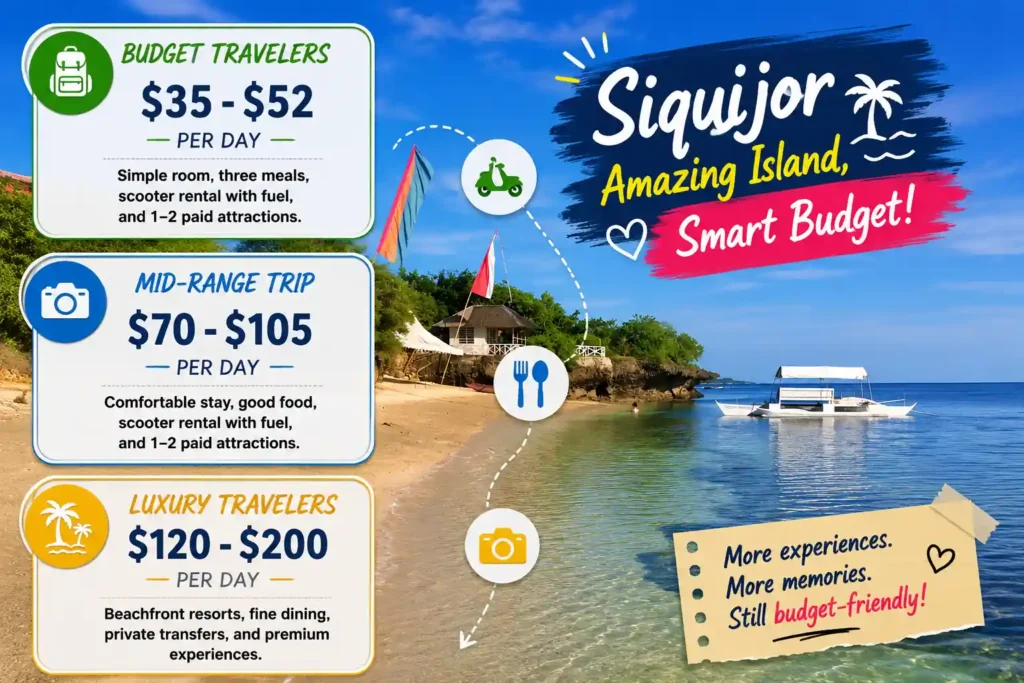
A realistic Siquijor travel cost averages $35 to $52 a day for budget travelers, and $70 to $105 a day for a comfortable mid-range trip, based on 2026 local pricing. That covers a simple room, three meals, scooter rental with fuel, and one or two paid attractions. Luxury travelers staying at beachfront resorts should plan closer to $120 to $200 per day.
Siquijor Travel Cost by Budget
Not every traveler spends the same way, obviously, so it helps to break this down by style rather than one flat number. A backpacker sharing a fan room and eating at carinderias spends drastically less than someone booking a private resort with breakfast included.
The good news is that Siquijor genuinely rewards low-budget travel; free beaches, free sunset spots, and cheap local food mean you don’t need much cash to have a great time. Still, a few extras like diving, island hopping, or a private driver can nudge your total up quickly if you’re not paying attention. Here’s how the three main travel styles typically compare on the island.
Below is a snapshot of how daily spending shifts across the three most common travel styles on the island.
| Travel Style | Daily Cost (USD) | What’s Included |
| Budget / Backpacker | $35 – $52 | Fan room or hostel dorm, local carinderia meals, shared scooter, free attractions. |
| Mid-Range / Comfortable | $70 – $105 | Private aircon room, mixed dining, solo scooter rental, a few paid tours |
| Luxury | $120 – $200+ | Beachfront resort, restaurant dining, private tours, diving trips |
Siquijor Transportation Cost
Getting around the island and getting to it in the first place makes up a meaningful chunk of your total Siquijor travel cost. Most travelers arrive via Dumaguete, where fastcraft boats run roughly every two hours and take about 50 minutes to cross. Coming from Cebu is pricier since it usually involves a connecting trip through Tagbilaran, Bohol.
Once you’re actually on the island, a rented scooter is by far the most practical way to explore the circumferential road, waterfalls, and viewpoints at your own pace. Tricycles work fine for short hops around town but add up fast if you’re relying on them all day. Fuel is cheap, roads are manageable, and most rental shops will deliver the scooter straight to your accommodation.
Transportation costs vary quite a bit depending on whether you rent a scooter or rely on tricycles for the whole trip, so it’s worth comparing both before deciding.
| Transport Option | Typical Cost (USD) | Notes |
| Fastcraft ferry (Dumaguete–Siquijor) | $3.50 – $10 | 50-minute crossing, runs every 1–2 hours |
| Slow roro ferry | ~$3 | 1.5 hours, cheapest option |
| Connecting ferry via Cebu/Bohol | $28 – $35 | Longer route, less frequent |
| Scooter rental (per day) | $6 – $12 | Fuel not included, cheaper weekly |
| Fuel (full island loop) | $2 – $4 | Budget per day of riding |
| Short tricycle ride | $0.35 – $0.85 | Around town, port transfers |
| Full-day tricycle with driver | $17 – $26 | Alternative if not licensed to ride |

One thing I’d definitely do is book the OceanJet ferry in advance. With several departures every day and budget-friendly fares, it’s the simplest way to keep your travel plans running smoothly.
Scooter Rental Cost in Siquijor
Scooter rental cost in Siquijor typically runs $6 to $12 per day (₱350–₱700), depending on the model and rental length. Weekly rentals usually knock 15–25% off the daily rate. Fuel is separate, usually another $2 to $4 for a full loop around the island, and a valid driver’s license is required before any shop will hand over the keys.
Siquijor Accommodation Cost
Where you sleep will likely be your biggest single expense, so it’s worth getting this part right. San Juan is the busiest tourist hub, packed with beach bars and budget guesthouses, while quieter towns inland or along the east coast tend to be noticeably cheaper for a similar quality room.
A basic fan room or hostel bed can be found for well under $20 a night if you’re not picky about beachfront access. Mid-range travelers looking for aircon, hot water, and a decent breakfast should expect to pay $40 to $80. Full resort experiences with pools, spa access, and beachfront views push into the $100-plus range, and prices climb sharply during peak season and Holy Week.
- Hostel dorm bed: $8 – $15/night
- Budget private fan room: $15 – $30/night
- Mid-range aircon guesthouse: $40 – $80/night
- Beachfront or boutique resort: $100 – $250+/night

If you’re after a peaceful beachfront stay in Siquijor, I’d definitely recommend Coco Sunset Beach Resort. The private beach, spacious rooms, and relaxed atmosphere make it a wonderful place to unwind.
Food and Drink Cost in Siquijor
Eating well here doesn’t have to be expensive, and that’s a big reason the overall Siquijor travel cost stays low compared to other Philippine islands. Local carinderias, the small turo-turo style eateries, serve filling rice-and-viand meals for just a couple of dollars. Beach cafes and restaurants aimed at tourists charge more, naturally, but even those rarely feel overpriced compared to Boracay or Bohol.
San Miguel beer is famously cheap on the island, and a decent seafood dinner at a beach bar won’t break $15. If you mix local meals with the occasional restaurant treat, food becomes one of the smallest lines in your daily budget.
Here’s a quick look at what typical meals and drinks cost around the island.
| Meal or Drink | Typical Cost (USD) |
| Local carinderia meal | $1 – $2 |
| Mid-range restaurant meal | $3.50 – $7 |
| Beach bar seafood dinner | $7 – $14 |
| Bottle of local beer (San Miguel) | $0.90 – $1.20 |
| Coffee or fresh fruit shake | $1.40 – $2.60 |
Siquijor Entrance Fees, Island Hopping, and Activity Cost
Beyond food and transport, small entrance fees are where your Siquijor travel cost quietly adds up if you’re visiting several sites in one day. Most natural attractions, waterfalls, springs, and heritage sites charge only a token fee, often under a dollar, though guides and rope-swing add-ons at spots like Cambugahay Falls cost a little extra.
Since 1 February 2026, the Province of Siquijor has also collected a Tourism Ecological Fee of roughly $0.85 per visitor, a change that catches some travelers off guard if they’re reading older blog posts. Island hopping and snorkeling trips to nearby Apo Island are the priciest single activity most people book, and diving costs more again if you’re certified. Budgeting an extra few dollars per attraction keeps your daily total realistic.
- Cambugahay Falls entrance: ~$0.35, plus optional rope swing tip
- Balete Tree fish spa: ~$0.35
- Salagdoong Beach entrance: $0.35 – $0.50
- Lazi Church heritage site: ~$0.20
- Cantabon Cave with guide: $2.60 – $5
- Tourism Ecological Fee (island-wide, since Feb 2026): ~$0.85
- Island hopping/snorkeling tour (Apo Island): $45 – $55
- Two-tank scuba dive: $70 – $90
Daily and 3-Day Siquijor Travel Cost
Putting all these pieces together makes the numbers feel far more real than a single average figure ever could. A traveler mixing local food, a rented scooter, and two or three attractions a day tends to land right around the mid-range estimate mentioned earlier. Stretching a trip to three full days lets you cover the island’s highlights, waterfalls, viewpoints, a heritage church, and maybe one boat tour, without feeling rushed.
It also spreads out fixed costs like ferry fares, which matters more the shorter your trip is. Below is a realistic three-day snapshot for a solo mid-range traveler, excluding international flights.
3-Day Siquijor Travel Cost Breakdown
A typical 3-day Siquijor travel cost for a mid-range solo traveler runs about $210 to $320 total, or roughly $70 to $105 per day. That figure covers two nights of accommodation, all meals, a 3-day scooter rental, entrance fees at four or five sites, and one paid tour such as island hopping. Budget travelers can bring this down to around $110 to $155 for the same three days by sticking to fan rooms and local food.
| Expense Category | 3-Day Total (USD) |
| Accommodation (2 nights, mid-range) | $80 – $160 |
| Food (3 days) | $30 – $50 |
| Scooter rental + fuel (3 days) | $24 – $48 |
| Entrance fees | $5 – $10 |
| One island hopping tour | $45 – $55 |
| Ferry (round trip) | $7 – $20 |
Budget vs Mid-Range vs Luxury Siquijor Travel Cost
Choosing a travel style really just means deciding which comforts matter to you and which ones you’re happy to skip. Budget travelers trade aircon and beachfront views for savings, and honestly don’t miss out on much since the island’s best spots, waterfalls, viewpoints, and sunsets are free anyway. Mid-range travel buys comfort without extravagance, and it’s where most couples and short-trip visitors naturally land.
Luxury travel in Siquijor still costs a fraction of what you’d pay in Boracay or Palawan for a similar resort standard, which is part of why high-end travelers are increasingly curious about the island too. Whichever tier you pick, the gap between them is smaller here than almost anywhere else in the Philippines.
- Budget: hostel or fan room, carinderia meals, shared scooter, free attractions only
- Mid-range: private aircon room, mixed dining, solo scooter, one or two paid tours
- Luxury: beachfront resort, restaurant dining daily, private tours, diving included
Hidden Costs to Include in Your Siquijor Travel Budget
A few expenses rarely make it into the headline numbers but show up on almost every trip anyway. Cash is one of the biggest; ATMs exist only in Siquijor Town, San Juan, and Larena, and they occasionally run dry during peak season, so carrying a buffer matters more here than on bigger islands. Fuel for your scooter is easy to underestimate if you’re doing multiple loops around the island in one trip.
Tips for tricycle drivers, tour guides, and dive instructors aren’t mandatory under Philippine custom but are genuinely appreciated and worth planning a few dollars for. Damage waivers on scooter rentals, second-helmet fees, and delivery charges can also quietly add up.
Everything You Need to Know About Siquijor Beach. Read more in Siquijor Beach That Locals Call Magical for a Reason.
Finally, exchange rates fluctuate, so it’s worth checking the current peso rate through the Bangko Sentral ng Pilipinas before converting a large amount of cash.
- Cash buffer for ATM shortages: $20 – $40
- Second helmet fee (riding two-up): $1 – $2/day
- Tips for guides and drivers: $5 – $10 total
- Scooter damage waiver or deposit: varies by shop
- Tourism Ecological Fee: ~$0.85 per visitor
FAQs About Siquijor Travel Cost
Is Siquijor cheaper than Boracay or El Nido?
Yes, noticeably. Siquijor’s overall travel cost runs lower than both, largely because accommodation and food prices haven’t caught up to the more established tourist islands yet.
How much cash should I bring to Siquijor?
Enough for your entire stay plus a buffer, since ATMs are limited to Siquijor Town, San Juan, and Larena and can run out during busy periods.
What is the Tourism Ecological Fee in Siquijor?
Since 1 February 2026, visitors pay a small Tourism Ecological Fee of roughly $0.85, collected by the provincial government to fund environmental upkeep.
Do I need a visa to visit Siquijor?
Most nationalities can enter the Philippines visa-free for up to 30 days; check current rules with the Bureau of Immigration before you travel, since requirements can change.
Is renting a scooter worth it in Siquijor?
For most travelers, yes. It’s cheaper than hiring a tricycle for a full day and gives you far more flexibility to reach waterfalls, viewpoints, and beaches on your own schedule.