
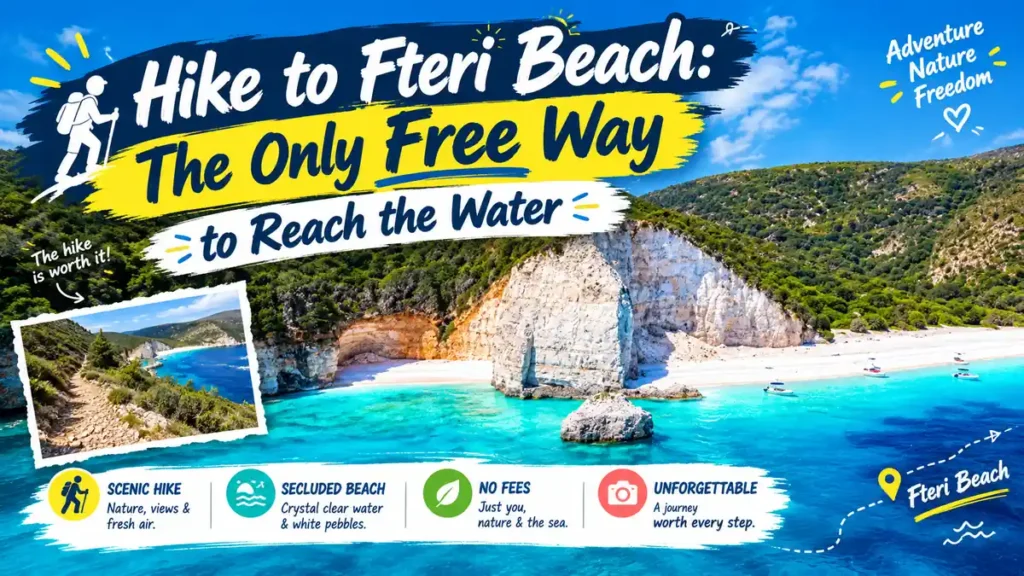
The hike to Fteri Beach starts near the small village of Zola, on the northern edge of Kefalonia’s Paliki peninsula, and takes most walkers between 40 and 60 minutes each way. The path drops steeply down a bare limestone hillside, with limited shade for much of the route, so the sun hits you the entire way down and back up. Loose gravel and uneven rock make solid shoes essential, since sandals or flip-flops slip easily on the steeper sections.
Most people who hike to Fteri Beach start early in the morning or late in the afternoon, when temperatures are lower, and the light is softer for photos. Bringing at least one litre of water per person is not optional here, because there are no shops, taps, or shaded rest spots anywhere along the trail.
Fteri Beach Hiking Trail
Limestone cliffs frame nearly every step of this trail, and the contrast between the white rock and the turquoise water below becomes visible long before the beach itself does. The path sits inside the Kefalonia-Ithaca UNESCO Global Geopark, a designation that reflects the region’s unusual geology and protected coastal terrain. Loose gravel, exposed tree roots, and a few narrow ledges make sturdy footwear essential. Local hikers frequently describe the trail as more of an adventure than a walk, since it winds through small ravines and over fallen branches rather than following a groomed footpath.
Signage is minimal, so a downloaded offline map or a GPS hiking app genuinely helps first-time visitors avoid backtracking. Wind exposure is common along the upper cliff sections, which can make an already uneven surface feel less stable. Because there is no official maintenance crew grooming this route, conditions can shift slightly after heavy rain or strong winter storms.
Ready for a Secluded Beach Escape? Discover Fteri Beach. Read more in Fteri Beach Kefalonia Just Became the World’s Number 2 Beach.
Fteri Beach Hike Distance
Roughly 1.8 kilometres separates the small parking area from the beach itself, based on figures widely reported by hikers who have logged the route on GPS tracking apps. That number sounds short on paper, yet the terrain adds enough difficulty to make it feel considerably longer than a flat 1.8-kilometre walk anywhere else. Elevation change along the descent averages around 150 to 200 metres, depending on the exact line a hiker takes down the cliff face.
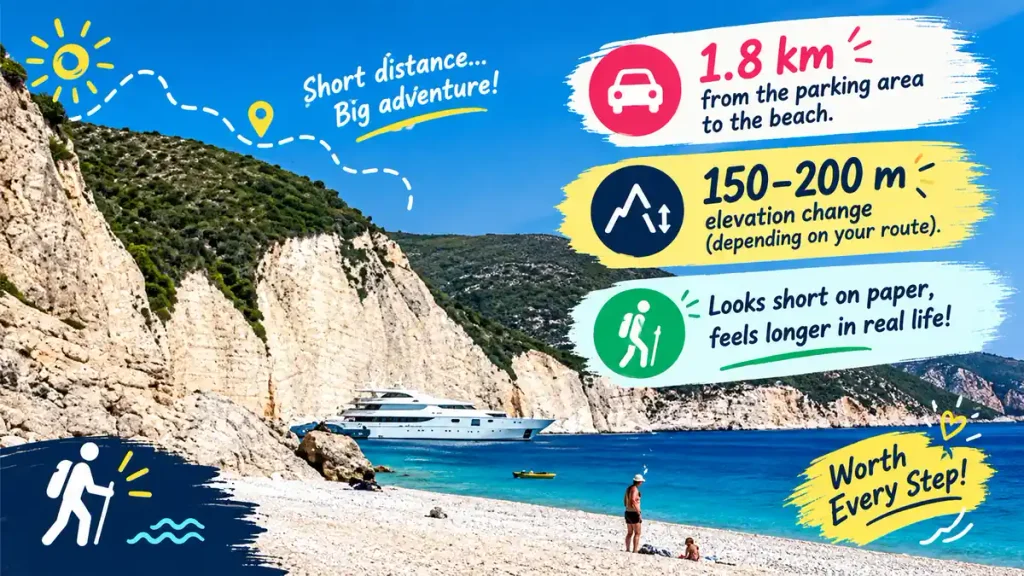
A round trip therefore totals close to 3.6 kilometres, all on uneven ground with almost no flat sections. Distance alone rarely tells the full story on trails like this one, since surface quality and incline usually matter more than raw kilometres. The table below summarises the core distance figures so visitors can plan realistically before setting out.
| Metric | Approximate Value |
| One-way distance | 1.8 km |
| Round-trip distance | 3.6 km |
| Elevation change | 150–200 m |
| Surface type | Loose gravel, rock, dirt path |
How Long Is the Hike to Fteri Beach?
This trail typically takes between 40 and 60 minutes one way for an average hiker moving at a steady pace. Descending is faster than climbing back up, though many visitors report that the downhill stretch demands more concentration because loose stones can shift underfoot. Add another 45 to 70 minutes for the uphill return, since fatigue and heat both slow the pace considerably by that point. A realistic total for the round trip sits between 90 minutes and two hours, not counting any time spent relaxing on the beach. Hikers carrying children, heavier bags, or camera equipment should budget extra time on both legs of the trail.
Fteri Beach Hike Difficulty
Moderate to challenging is the fairest description of this trail, and it should not be treated as a casual beach walk. Footing changes constantly between loose gravel, smooth rock, and compacted dirt, which keeps hikers alert for the entire descent. Several short scrambles require using hands for balance, particularly where the path crosses fallen trees or narrow rock shelves. Heat amplifies the difficulty significantly during summer months, since the exposed limestone reflects sunlight with almost no shade cover along the route.
Anyone with knee problems, balance issues, or limited hiking experience should think carefully before attempting this trail without assistance. Comparisons with other coastal trails in Kefalonia consistently place this one among the more demanding short hikes on the island, mainly because of the steep gradient packed into such a short distance.
Where Does the Fteri Beach Hike Start?
A small unpaved parking area near Zola village marks the official starting point for this trail. Zola sits on the northern edge of the Paliki peninsula in western Kefalonia, reached from Argostoli either by the Lixouri car ferry or by the scenic coastal road known locally as the gyra. From Lixouri, the drive north through Paliki toward Zola takes roughly 20 to 30 minutes depending on traffic and road conditions.
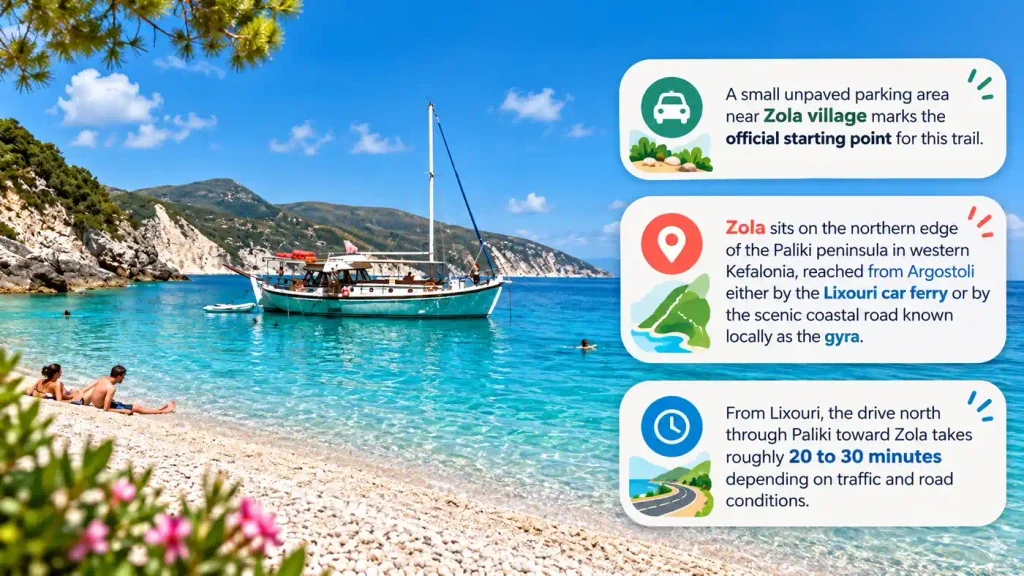
The trailhead itself is marked but easy to miss, since there is no formal visitor centre or ranger station at the entrance. Drivers should arrive early during peak season, since the limited parking spaces near Zola fill up quickly once tour boats begin their morning departures. GPS coordinates for the parking area are widely shared on hiking apps and travel forums, which is far more reliable than relying on road signage alone.
Fteri Beach Trail Route
Dense Mediterranean scrubland covers the first stretch of the route, offering brief pockets of shade before the trail opens onto exposed cliffside terrain. The path then descends through a series of switchbacks cut into the limestone, gradually revealing wider views of the bay below. Several sections narrow considerably, forcing single-file walking and careful foot placement near the cliff edge. Small ravines cross the trail at multiple points, and fallen trees sometimes block the most direct line, requiring short detours around them.
The final approach levels out slightly before dropping onto the beach itself, where pebbles replace the dirt and rock underfoot. Trail markers exist but are inconsistent, so following a downloaded GPX file removes most of the guesswork on this route. Shade disappears almost entirely once the trail leaves the scrubland, which is exactly the stretch where most hikers report feeling the heat most intensely. The Hellenic Ministry of Environment and Energy lists the surrounding hillside among the protected habitats within the wider geopark boundary, which is part of why the path remains undeveloped rather than paved or fitted with railings.
How to Hike to Fteri Beach
Early morning starts work best for this hike, both for cooler temperatures and for avoiding the crowds that arrive later by boat. Proper hiking shoes with ankle support and solid grip matter more here than on almost any other beach trail in Kefalonia. Carrying at least 1.5 litres of water per person is essential, since there is no kiosk, tap, or shop anywhere along the route or on the beach.
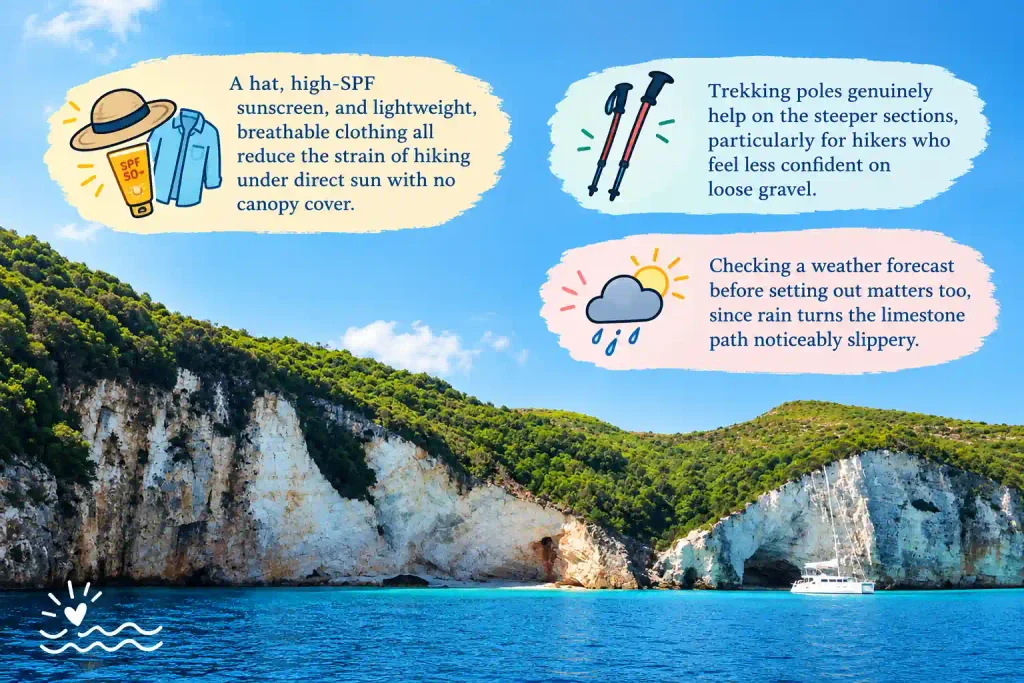
- A hat, high-SPF sunscreen, and lightweight, breathable clothing all reduce the strain of hiking under direct sun with no canopy cover.
- Trekking poles genuinely help on the steeper sections, particularly for hikers who feel less confident on loose gravel.
- Checking a weather forecast before setting out matters too, since rain turns the limestone path noticeably slippery.
- Anyone attempting this trail for the first time should also tell someone their planned route and expected return time, given the limited mobile signal in parts of the trail.
Fteri Beach Hiking Time
Most fit adults complete the full round trip, including 60 to 90 minutes of rest on the beach, within three to three and a half hours total. Families with young children should plan closer to four hours, factoring in slower movement and more frequent breaks along the way. Photographers wanting to capture the cliffs in soft morning or late afternoon light often extend their visit further, since midday sun flattens the dramatic colour contrast the beach is known for.
- Arriving by nine in the morning gives hikers the best combination of manageable temperatures and fewer people sharing the narrow trail.
- Late afternoon starts are riskier, since descending the trail after dark without proper lighting is genuinely dangerous given the uneven surface.
Is the Fteri Beach Trail Hard?
Yes, this trail is considered moderately hard rather than easy, mainly due to its steep gradient and loose, uneven footing rather than its short length. The descent alone drops roughly 150 to 200 metres over less than two kilometres, which is a steeper average grade than most casual beach walks in the region. Heat, lack of shade, and the demanding uphill return all add to the overall difficulty, especially for anyone unaccustomed to scrambling on rock. Hikers with good general fitness and proper footwear usually manage the trail without major issues, though it remains unsuitable for very young children or anyone with mobility limitations.
Fteri Beach Hike Tips
Sturdy footwear ranks as the single most important preparation step, since flip-flops and thin-soled sandals are genuinely unsafe on this terrain.
- Start early to avoid both the midday heat and the crowds arriving later by water taxi.
- Carry more water than feels necessary, since there is nowhere to refill along the route.
- Wear swim shoes on the beach itself, because the shoreline includes sharp-edged rocks mixed with pebbles.
- Pack out all rubbish, since the beach has no bins and sits inside a protected geopark area.
- Check tide and wind conditions if planning to swim, as currents near the cliffs can strengthen unexpectedly.
Respecting the fragile coastal vegetation along the trail also matters, since erosion from off-path shortcuts damages the surrounding scrubland over time. Local conservation groups and the Kefalonia-Ithaca UNESCO Global Geopark actively encourage visitors to stay on marked paths for exactly this reason. Mobile signal drops in and out across several stretches of the descent, so downloading an offline trail map before leaving the parking area removes a genuine source of stress. Telling accommodation staff or a travel companion the planned return time adds a simple safety net that costs nothing and takes only a minute.
What to Bring for the Fteri Beach Hike
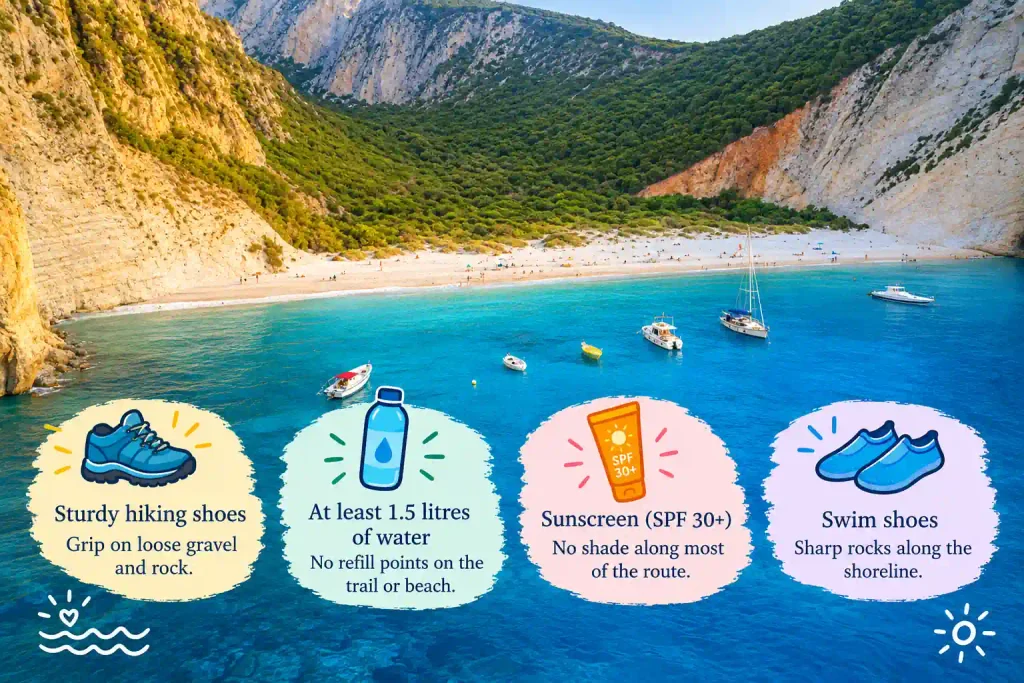
Packing correctly for this route matters more than for most beach trips, given the total lack of facilities at the destination. A well-planned bag removes most of the risk associated with the steep terrain and long stretches without shade. The table below outlines the core essentials worth carrying on this walk down to the beach.
| Item | Why It Matters |
| Sturdy hiking shoes | Grip on loose gravel and rock |
| At least 1.5 litres of water | No refill points on the trail or beach |
| Sunscreen (SPF 30+) | No shade along most of the route |
| Swim shoes | Sharp rocks along the shoreline |
| Trekking poles (optional) | Extra stability on steep sections |
| Small first-aid kit | No medical facilities nearby |
Fteri Beach Hike vs Water Taxi
Cost, effort, and flexibility all differ sharply between hiking down and taking a water taxi from Zola harbour. Boat transfers currently run around 10 to 15 US dollars per person for the short crossing, according to prices commonly quoted by local operators, and typically take under ten minutes each way. Hiking costs nothing beyond the physical effort involved, but it demands roughly 90 minutes to two hours round trip and a reasonable level of fitness. Weather cancels water taxis more often than it affects the trail, since rough seas make the short crossing genuinely uncomfortable or unsafe. Independence is the main advantage of hiking, since walkers are not tied to boat schedules or waiting for other passengers to fill a taxi. The comparison below lays out the practical trade-offs side by side.
| Factor | Hiking | Water Taxi |
| Approximate cost | Free | $10–$15 per person |
| One-way time | 40–60 minutes | Under 10 minutes |
| Physical effort | Moderate to high | Minimal |
| Weather dependency | Low | High |
| Schedule flexibility | Full control | Depends on boat availability |
Is Fteri Beach Accessible by Hiking?
Yes, Fteri Beach is accessible by hiking via a roughly 1.8-kilometre trail that starts near Zola village and descends steep limestone cliffs to reach the shoreline. This remains the only free way to reach the beach, since there is no road leading directly down to the water. The trail suits reasonably fit hikers wearing proper footwear, though it is not recommended for young children, elderly visitors, or anyone with mobility restrictions. Confirming current conditions locally before setting out is worthwhile, since seasonal erosion occasionally affects sections of the path.
Is the Hike to Fteri Beach Worth It?
The hike to Fteri Beach rewards every steep step with one of Europe’s most striking coastlines, but it only goes smoothly with the right preparation. Solid shoes, enough water, and an early start turn a demanding trail into a manageable one, while ignoring these basics can turn a short walk into a genuine ordeal. Whether you choose to hike down or take the water taxi from Zola, reaching this beach is worth the effort, and the view from the cliffs above makes the final descent feel earned rather than just endured.
Frequently Asked Questions
How long is the hike to Fteri Beach one way?
The one-way hike typically takes between 40 and 60 minutes, covering roughly 1.8 kilometres of steep, uneven terrain.
Is the hike to Fteri Beach suitable for beginners?
Moderately fit beginners can usually manage it with proper footwear, though the steep descent and lack of shade make it more demanding than typical beach walks.
What is the cheaper option, hiking or the water taxi?
Hiking is free, while the water taxi from Zola village costs around 10 to 15 US dollars per person for a short crossing.
Are there facilities at Fteri Beach?
No, the beach has no shops, bins, restrooms, or shade structures, so visitors need to bring everything they require.
When is the best time to visit on foot?
Early morning, ideally before 9 a.m., offers cooler temperatures, softer light, and fewer people sharing the trail.





3 Responses