
The best Things to do in Arugam Bay include surfing its famous point breaks, swimming at calmer sections of the beach, taking a Pottuvil Lagoon safari, visiting ancient temples, and joining a wildlife safari in Kumana National Park. The town is best known for its surf scene, but its lagoons, wildlife and historic sites make it worthwhile even if you don’t surf. Main Point remains the top draw for experienced surfers, while Baby Point and Whiskey Point suit beginners and families looking for gentler waves closer to shore.
Just a short drive away, Pottuvil Lagoon offers a quieter side of the trip, with boat rides past mangroves, elephants and birdlife. History and nature lovers can add a stop at the ancient rock temples nearby, then head into Kumana National Park for a chance to spot leopards, elephants and hundreds of bird species in their natural habitat. Together, these spots give visitors a full mix of adventure, culture and wildlife within easy reach of the town centre.
Best Things to Do in Arugam Bay at a Glance
The table below breaks down where to spend each part of the day, from sunrise paddle-outs to sunset viewpoints, before the detailed sections cover every stop.
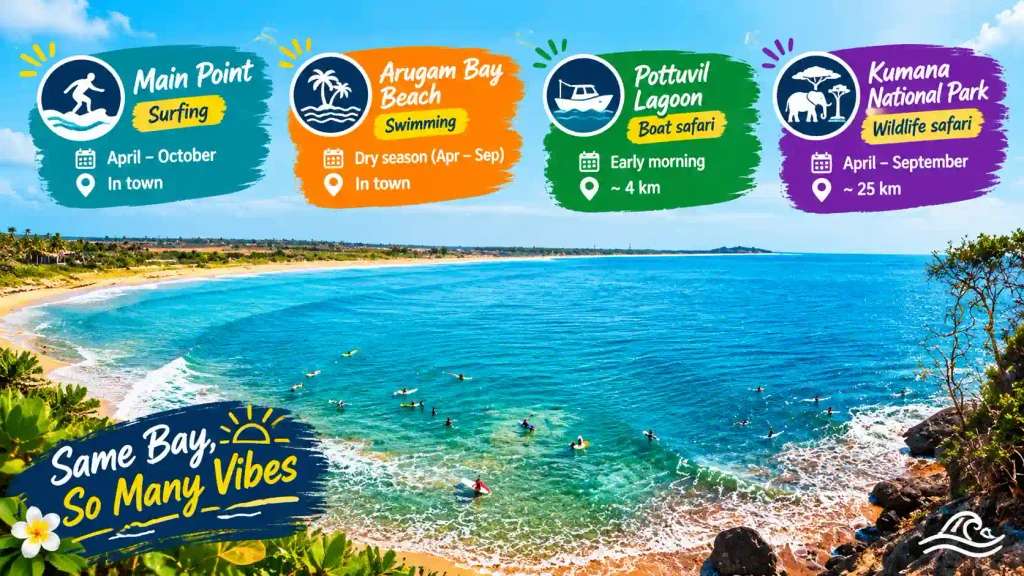
| Attraction | Type | Best Time | Distance from Town |
| Main Point | Surfing | April–October | In town |
| Arugam Bay Beach | Swimming | Dry season (Apr–Sep) | In town |
| Pottuvil Lagoon | Boat safari | Early morning | ~4 km |
| Kumana National Park | Wildlife safari | April–September | ~25 km |
| Muhudu Maha Viharaya | Ancient temple | Year-round | ~5 km |
| Elephant Rock | Sunset/sunrise view | Dawn or dusk | ~4 km |
| Magul Maha Viharaya | Ancient temple | Year-round | ~11 km |
What Are the Top Things to Do in Arugam Bay?
Surfing at Main Point and Whiskey Point, swimming in the calmer stretch of the main beach, a boat safari on Pottuvil Lagoon, a morning game drive through Kumana National Park, and sunset from Elephant Rock cover the essentials, with two ancient temples for a spare afternoon.
Arugam Bay Surfing
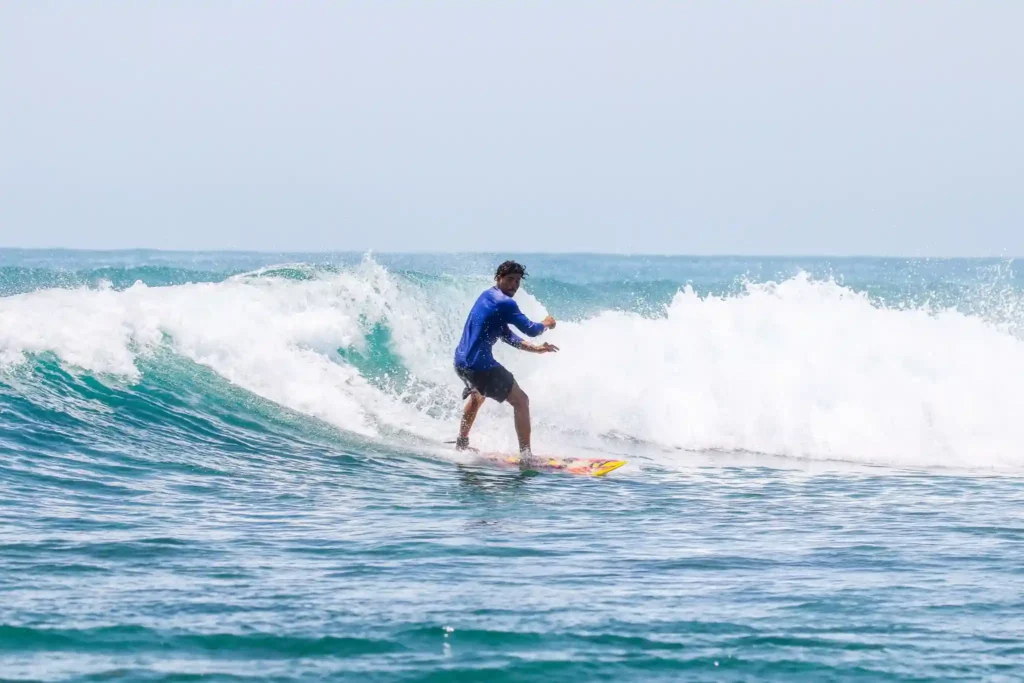
Arugam Bay earned its reputation from a string of right-hand point breaks strung along roughly 10 kilometres of coastline. Southwest swells arrive consistently between April and October, and confident intermediates can expect chest-high to overhead waves in the July and August peak. Beginners are not left out, since several breaks soften into forgiving whitewash closer to shore.
The table compares the five named breaks that make up the core surf circuit, so a first-time visitor can match a spot to their skill level before heading out.
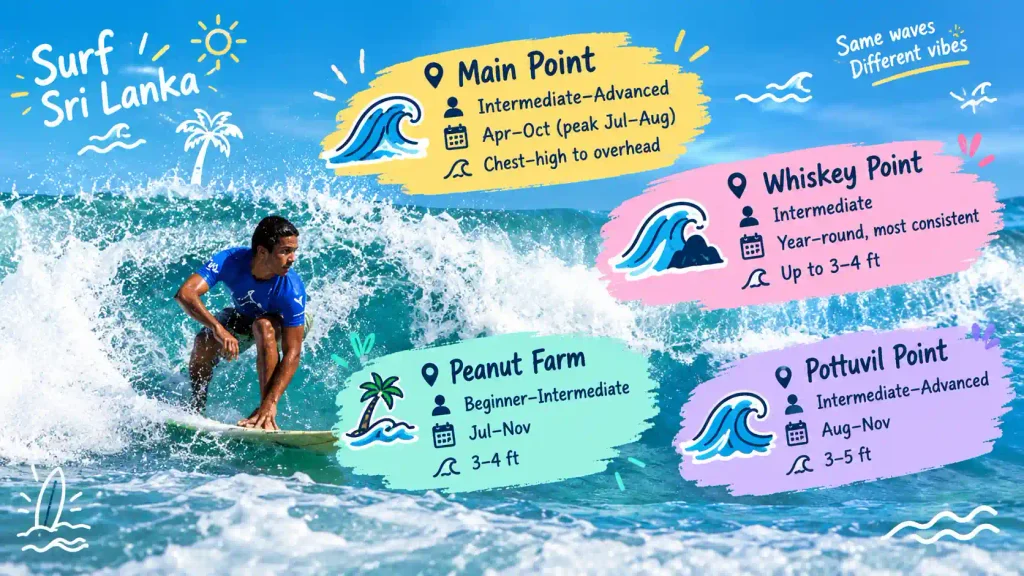
| Surf Spot | Skill Level | Best Season | Wave Height |
| Main Point | Intermediate–Advanced | Apr–Oct (peak Jul–Aug) | Chest-high to overhead |
| Whiskey Point | Intermediate | Year-round, most consistent | Up to 3–4 ft |
| Peanut Farm | Beginner–Intermediate | Jul–Nov | 3–4 ft |
| Pottuvil Point | Intermediate–Advanced | Aug–Nov | 3–5 ft |
| Elephant Rock | Beginner | Dawn/dusk sessions | Small, forgiving |
Main Point Arugam Bay
Main Point holds the title of Sri Lanka’s most famous wave, a long right-hander that can run several hundred metres on a clean day. It works over sand and rock, and draws the biggest crowds in the bay during July and August. Beginners usually start at the gentler inside section known as Baby Point.
Peanut Farm Arugam Bay
Peanut Farm sits about 7 kilometres south of town, named after an old peanut plantation that once stood behind the beach. Two distinct peaks break over a sandy bottom, friendlier for improving surfers than Main Point. The beach stretches roughly 2 kilometres and stays mostly undeveloped, with one small café and board rentals nearby.
Whiskey Point Arugam Bay
Whiskey Point lies a short tuk-tuk ride north of town and tends to produce the most consistent waves in the area, catching swell even when other breaks go flat. Wind exposure makes it popular with longboarders and kitesurfers. Crowds thin out compared with Main Point, suiting anyone wanting a workable wave without the scrum.
Pottuvil Point Arugam Bay
Pottuvil Point delivers one of the longest rides on this coast, a right-hander that can carry a surfer several hundred metres on the right swell. Boulders and a sand shelf shape the wave, and it performs best from August through November. Lagoon runoff during the wet season can cloud the water, so this spot works mainly in season.
Elephant Rock Arugam Bay
Elephant Rock combines a mellow beginner-friendly wave with one of the best viewpoints on the coast. It sits about 4 kilometres south of town, reachable by crossing a shallow lagoon channel that occasionally hosts resting crocodiles on the far bank. Surfers use it for gentle sessions, while non-surfers climb the short trail up top for the view.
What Is the Best Time to Surf in Arugam Bay?
The main surf season runs from April to October, with the biggest swells arriving in July and August. May, June, September and October still deliver solid waves with smaller crowds. Most guesthouses and surf camps close between November and March, when the monsoon flattens the swell.
Arugam Bay Swimming
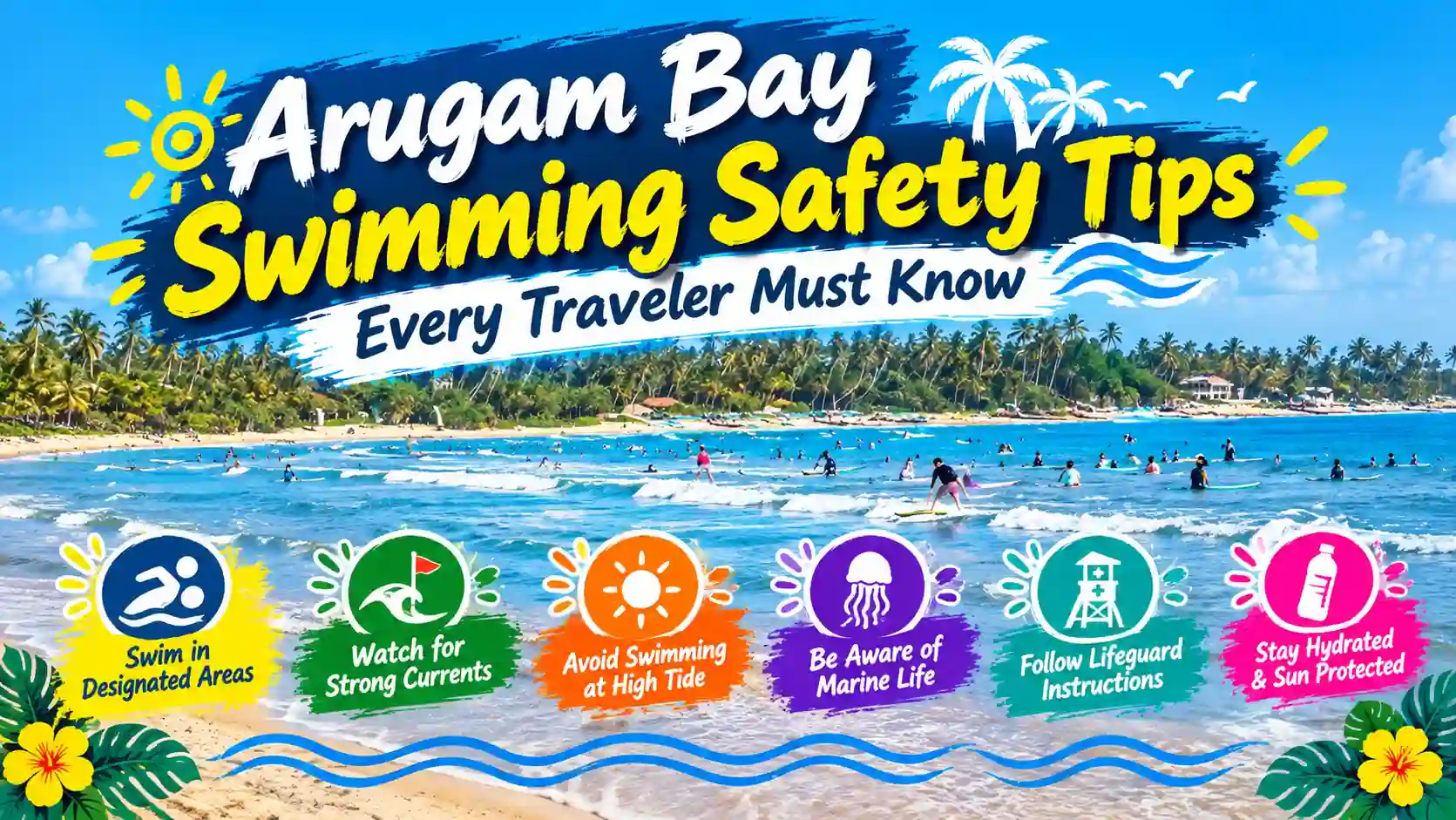
Swimming conditions change block by block along the beach, since the same swell that draws surfers also stirs up currents in places. The stretch of sand directly in front of town, away from the main surf break, stays calm enough for a relaxed swim most mornings. Local fishing boats dock here too, and children wade in the shallows nearby.
Rip currents form occasionally, particularly during the peak swell months of July and August. Swimmers caught in one should move parallel to the shore rather than fighting straight back in, then angle back once free of the pull. Asking a guesthouse owner about the day’s conditions first is worth two minutes.
- Swim at the calmer stretch of the main town beach, away from the surf break.
- Check with local surf shops or guesthouses each morning, since conditions shift daily.
- Avoid the lagoon channel near Elephant Rock, where crocodiles are occasionally seen.
Pottuvil Lagoon
Pottuvil Lagoon spreads across roughly 200 hectares of brackish water just north of Arugam Bay, wrapped in close to 200 acres of mangrove forest. The lagoon separates the ocean from the mainland, and its calm channels contrast sharply with the surf a few minutes’ drive away. Fishing communities still work these waters using traditional methods.
Sea eagles, kingfishers, herons, egrets, cormorants and painted storks work the banks, while mugger crocodiles bask on the mud a comfortable distance from the boats. Sri Lankan elephants occasionally swim across open stretches, a sight reported at very few other spots on the island.
Pottuvil Lagoon Safari
Boat safaris typically run two to three hours, either in a small motorised boat or a quieter paddle boat that glides through the mangrove channels without disturbing the wildlife. Early morning and late afternoon departures give the best chance of spotting elephants and active birdlife. Operators supply binoculars and a guide who can identify the birds.
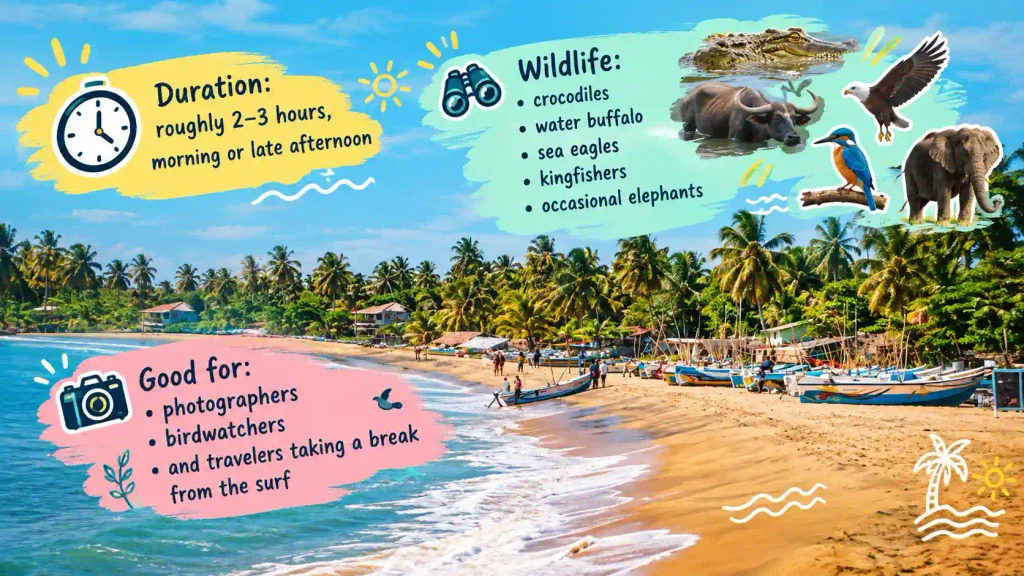
- Duration: roughly 2–3 hours, morning or late afternoon
- Wildlife: crocodiles, water buffalo, sea eagles, kingfishers, and occasional elephants
- Good for: photographers, birdwatchers, and travelers taking a break from the surf
Kumana National Park
Kumana National Park covers close to 35,700 hectares of lagoons, mangrove swamp and dry tropical forest, connected to the larger Yala National Park by the Kumbukkan Oya River. Formerly known as Yala East, it shares much of Yala’s wildlife without the crowds. Entry runs through the Okanda gate, roughly 25 kilometres south of Arugam Bay, and the final stretch needs a 4WD.
Birdlife defines Kumana more than anything else. The Kumana Villu, a 200-hectare swamp lake, hosts nesting colonies of painted storks, pelicans, egrets and the rare black-necked stork between April and July, overlapping with peak surf months. Leopards, elephants, sloth bears, wild boar and mugger crocodiles also live within the park, though sightings depend on the day and the guide’s skill.
The table sums up the practical details worth knowing before booking a jeep.
| Feature | Detail |
| Governing body | Department of Wildlife Conservation |
| Size | ~35,700 hectares |
| Main entrance | Okanda Gate, ~25 km from Arugam Bay |
| Best season | April–September (dry season) |
| Key wildlife | Elephants, leopards, crocodiles, painted storks, sloth bears |
Sri Lanka’s Department of Wildlife Conservation sets and periodically revises park entrance fees, safari permits, and vehicle charges for Kumana, much as it does at Yala and Udawalawe. Because these figures shift with government updates, checking the department’s official booking portal before the trip is the safest way to confirm today’s rate.
What Animals Can You See in Kumana National Park?
Kumana supports elephants, leopards, sloth bears, wild boar, golden jackals, water buffalo and mugger crocodiles, alongside more than half of Sri Lanka’s recorded bird species during migration season. Painted storks, pelicans, spoonbills and egrets nest in large colonies at Kumana Villu between April and July. Leopard sightings happen less often than at Yala, since the cats here are less used to vehicles.
Muhudu Maha Viharaya
Muhudu Maha Viharaya, whose name translates loosely to “temple of the sea,” sits on dunes in Pottuvil, about 5 kilometres from Arugam Bay. Tradition credits King Kavan Tissa of the ancient Ruhuna kingdom with building the site more than 2,000 years ago, tied by local legend to Princess Viharamahadevi, said to have washed ashore nearby before becoming his queen. The white stupa is visible from parts of Arugam Bay beach on a clear day.
Ruins across the grounds include ancient stupas, a chapter house, a monastic residence, and stone statues of the Buddha alongside two figures believed to represent kings or deities. Much of the original layout stays buried under shifting sand, so storms occasionally reveal new details. Sri Lanka’s Department of Archaeology listed the site as a protected archaeological reserve in 1965, keeping the ruins under formal conservation.
Magul Maha Viharaya
Magul Maha Viharaya stands roughly 11 kilometres from Pottuvil in the village of Lahugala, on the road toward Siyambalanduwa. According to the same royal chronicle, King Kavan Tissa built the temple in the 2nd century BC to mark his marriage to Princess Viharamahadevi, and the name comes from the Sinhala word for wedding. The circular Magul Maduwa, believed to mark the ceremony, still stands within the grounds.
The moonstone carving is the detail most guides point out first, since it shows a row of elephants carrying riders on their backs, a feature not repeated at any other moonstone in Sri Lanka. A preserved image shrine and a sacred Bodhi tree sit nearby, both still in active use. The site received protected-monument status on 26 March 1954, and the surrounding forest is known for elephant herds near the tank in the dry months.
Arugam Bay Sunset
Sunset works differently here than on Sri Lanka’s south coast, since the sun drops behind the mainland rather than over open water. Elephant Rock, also called Crocodile Rock locally, gives the clearest uninterrupted view, with the lagoon reflecting the colour below. A short ten-minute scramble gets visitors to the top, best done in trainers rather than flip-flops.
Sunrise tends to outshine sunset along this coast, since dawn breaks directly over the Indian Ocean with nothing blocking the view. Both golden hours draw a small, quiet crowd to Elephant Rock, and wild elephants occasionally wander into view on the flats below.
Day Trips from Arugam Bay
Arugam Bay works well as a base for exploring the wider Ampara District, since most standout sites sit within a one- to two-hour drive. A tuk-tuk covers the closer stops, while a hired car suits Lahugala or the road toward Ella.
The table below lists popular day trip options with rough travel times from town.
| Destination | Distance/Time | Highlights |
| Lahugala National Park | ~15 km / 25 min | Wild elephant herds near the tank, best Jul–Aug |
| Okanda & Kudumbigala | ~20–25 km / 40 min | Coastal shrine, forest hermitage, rock viewpoint |
| Panama Village | ~12 km / 20 min | Quiet dune-backed beach, fishing village life |
| Ella (hill country) | ~4–5 hrs | Waterfalls, tea country, mountain scenery |
| Yala National Park | ~2–2.5 hrs | Leopard safaris, larger and busier than Kumana |
Panama village, about 12 kilometres south, makes an easy half-day trip with a dune-backed beach and a slower pace than Arugam Bay itself. Lahugala National Park draws visitors mainly for elephants, with up to 150 gathering around the tank in July and August as nearby water dries up.
Travelers heading toward the hill country can combine a full transfer to Ella with temple stops en route. Since road conditions can shift, cross-checking travel plans against advisories from the Sri Lanka Tourism Development Authority before finalising a multi-day itinerary is a sensible extra step.
Final Thoughts
Arugam Bay earns its reputation the moment a right-hander peels down Main Point, but Things to Do in Arugam Bay stretch well beyond the surf. Whiskey Point, Peanut Farm, Pottuvil Point and Elephant Rock round out a surf circuit built for every skill level, while the calmer stretch of town beach handles the swimming. Pottuvil Lagoon and its boat safaris bring elephants and crocodiles within paddling distance, and Kumana National Park adds a genuine wildlife safari a short drive south.
Muhudu Maha Viharaya and Magul Maha Viharaya carry more than 2,000 years of history between them, and Elephant Rock closes the day with the coast’s best sunset. Day trips to Lahugala, Panama and Ella round out a stay that rarely feels rushed.
FAQs About Things to Do in Arugam Bay
Is Arugam Bay good for beginner surfers?
Yes. Baby Point inside Main Point, the inside section at Peanut Farm, and Elephant Rock all produce soft, forgiving waves suited to beginners. Surf schools operate throughout the main season.
What is the best time to visit Arugam Bay?
The dry season from April to October is best overall, with July and August offering the biggest surf and the busiest crowds. Travelers who prefer quieter beaches often choose May, June, September, or October instead.
Is it safe to swim in Arugam Bay?
Swimming is generally fine in the calmer section of the main town beach, though rip currents can form during peak swell months. Checking conditions with a local guesthouse first is the safest approach.
How far is Kumana National Park from Arugam Bay?
Kumana’s Okanda entrance sits roughly 25 kilometres south of Arugam Bay, about a 45-minute to one-hour drive. A 4WD vehicle is recommended for the final stretch.
Can you see elephants near Arugam Bay?
Yes. Elephants cross toward Kumana and Pottuvil at various times of year, appear regularly at Lahugala National Park in July and August, and are sometimes seen swimming across Pottuvil Lagoon.
How many days should I spend in Arugam Bay?
Four to five nights covers a couple of surf sessions, a lagoon safari, a Kumana half-day trip, and time to see the temples without feeling rushed.
Is Arugam Bay worth visiting if I don’t surf?
Yes. Pottuvil Lagoon, Kumana National Park, Elephant Rock’s sunset view, and two ancient temples give non-surfers plenty to fill several days.


One Response