

Arugam Bay swimming works best during the dry season, from May to September, when the sea stays calmer, and the strong currents ease off. Outside this window, big swells and rip currents make Arugam Bay swimming risky for anyone who is not a confident swimmer, so it is smart to check local conditions and ask at your guesthouse before you head into the water.
Even during the calmer months, the seabed can change from soft sand to rocky patches within a few steps, so it helps to wade in slowly and watch where the water pulls. Sticking close to areas where locals or lifeguards are present gives you a much safer and more enjoyable swim.
Arugam Bay Swimming Conditions
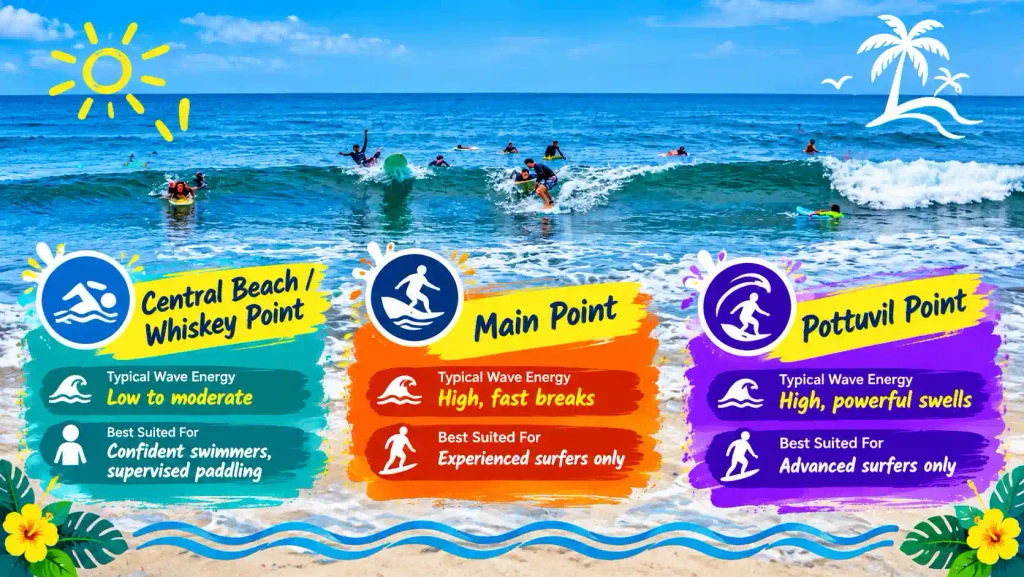
Water behavior at Arugam Bay changes depending on exactly where you stand on the beach. Main Point and Pottuvil Point produce fast, powerful waves suited to experienced surfers, and neither zone is friendly to casual swimmers even when the surface looks glassy from a distance.
Sheltered pockets near the central beach and Whiskey Point offer gentler shore breaks, though the sea can still push hard against anyone who isn’t paying attention. A sandy bottom in some stretches gives way to rock and reef patches elsewhere, raising the risk of cuts for anyone without footwear.
This snapshot shows how conditions typically shift across the bay, so save it before deciding where to head in.
| Zone | Typical Wave Energy | Best Suited For |
| Central beach / Whiskey Point | Low to moderate | Confident swimmers, supervised paddling |
| Main Point | High, fast breaks | Experienced surfers only |
| Pottuvil Point | High, powerful swells | Advanced surfers only |
| Peanut Farm | Moderate, playful | Beginner to intermediate surfers |
| Elephant Rock | Moderate, mellow | Beginner surfers, sightseeing |
Southwesterly swells reach this coast most consistently from May through September, the region’s core surf season. Outside that window, the water can flatten out somewhat, though local wind and swell direction still shift things day to day.
Is Arugam Bay Safe for Swimming?
Arugam Bay is reasonably safe for swimming in the calmer central zones during the dry season, particularly when locals or lifesavers are nearby, and sea conditions look settled. It is not safe near the main surf breaks, during large swell events, or for anyone unfamiliar with reading ocean conditions.
Best Time to Swim in Arugam Bay
Early morning tends to offer the calmest window, generally before wind picks up and before the beach fills with surfers heading out to the main breaks. The water often looks noticeably flatter than it does by midday.
Midday brings stronger sun and busier lineups near the popular points, so swimmers may prefer the central beach during these hours. Late afternoon can bring building wind and swell from the southwest, especially during peak surf months.
This table lines up common swim windows with what to expect at each one.
| Time of Day | General Conditions | Notes for Swimmers |
| Early morning (6:30–9:00 AM) | Calmest winds, smaller chop | Best general window |
| Midday (11 AM–2 PM) | Strong sun, busier lineups | Stick to central beach zone |
| Late afternoon (4–6 PM) | Wind and swell often build | Watch conditions closely |
Can You Swim in Arugam Bay?
Yes, swimming is possible at Arugam Bay, though conditions vary a lot by location and season. The calmer, sandier sections near the central beach and Whiskey Point work reasonably well for a supervised swim during the dry season, while areas closer to the surf breaks carry stronger currents and suit surfers far better than casual swimmers.
Arugam Bay’s Swimming Season
Sri Lanka’s east coast runs on a different monsoon cycle than the south and west of the island. According to the Department of Meteorology, Sri Lanka, the country experiences a southwest monsoon roughly from May to September and a northeast monsoon from around December to February, with inter-monsoon transitions in between. For the east coast, the calmest stretch generally runs from April or May through September, while October through January brings rougher seas and heavier rain.
May and June often bring the most settled conditions, with lower humidity than the crowded peak months of July and August. The wet season doesn’t rule out a visit, but swell and rainfall both climb, and casual swimming loses most of its appeal.
Here’s a quick reference for planning a trip around this seasonal pattern.
| Season | Approximate Months | Swimming Outlook |
| Dry season | April/May – September | Best overall conditions |
| Inter-monsoon | March, October | Mixed, check forecasts |
| Northeast monsoon | November – February | Rougher seas, caution advised |

Best Beaches in Arugam Bay for Swimming
Not every stretch of coastline works the same way for a swimmer. The central beach fronting the main guesthouse strip tends to be the most practical choice, since it avoids the fastest breaks while staying close to town.
Whiskey Point, further north near Pottuvil, has a reputation as moderately swimmable, though waves there stay strong enough to suit confident swimmers more than beginners. Elephant Rock, south of town, offers a quieter setting with mellower surf, friendlier for a paddle despite being better known as a beginner surf spot.
This comparison makes it easier to match a beach to your comfort level.
| Beach / Point | Swimming Suitability | Distance from Town |
| Central Arugam Bay beach | Moderate, manageable in calm conditions | In town |
| Whiskey Point | Moderate, powerful waves | ~12 km north |
| Elephant Rock | Better for wading and scenery | ~4 km south |
| Main Point / Pottuvil Point | Not recommended for swimming | In town / ~6 km north |
Where to Swim in Arugam Bay
For anyone prioritising a swim over a surf session, the central beach area near town remains the sensible default, keeping swimmers away from the fastest breaks while staying close to guesthouses and other people who can help if something goes wrong.
A few practical pointers make a real difference:
- Choose sandy sections over rocky or reef-heavy patches wherever visible.
- Watch where surfers paddle out and avoid crossing directly through that channel.
- Enter the water slowly and observe wave patterns for a few minutes first.
- Ask at a nearby guesthouse or surf shop about current conditions before swimming.
Avoid the lagoon areas near Elephant Rock and Pottuvil entirely, since these host crocodiles and were never intended for swimming.
Swimming in Arugam Bay for Beginners
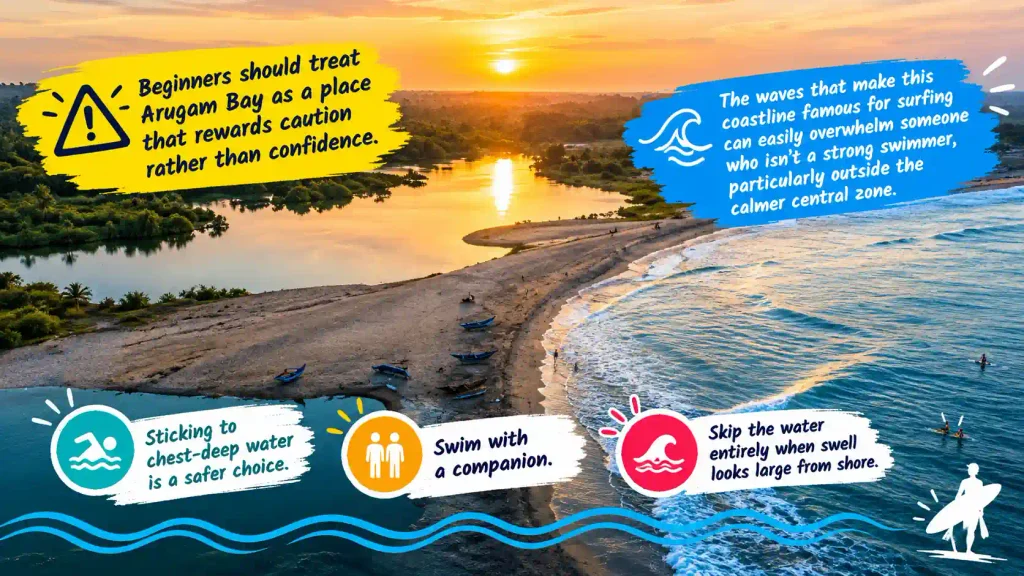
Beginners should treat Arugam Bay as a place that rewards caution rather than confidence. The waves that make this coastline famous for surfing can easily overwhelm someone who isn’t a strong swimmer, particularly outside the calmer central zone.
Sticking to chest-deep water, swimming with a companion, and skipping the water entirely when swell looks large from shore are sensible starting points. Local surf instructors who work this coast daily are usually glad to give a straightforward read on the day’s conditions.
Arugam Bay Swimming Tips for First-Timers
Enter the water gradually rather than diving straight in, and keep within sight of shore at all times. Never assume a calm-looking surface means the current underneath is weak, since currents here don’t always announce themselves visually.
Arugam Bay Water Safety Tips
Basic precautions make a bigger difference here than they might at a more sheltered beach. These points cover the essentials worth remembering before wading in:
- Check conditions locally. Ask at your guesthouse or a surf shop before swimming, since staff usually know the day’s swell and current situation.
- Never swim alone. Have someone watching from the beach, even if you’re a confident swimmer.
- Avoid swimming near surf breaks. Stay well clear of Main Point and Pottuvil Point when boards are in the water.
- Watch for rip current signs. Choppy, discoloured water moving seaward signals a need to stay out or move to another spot.
- Respect the wet season. Rougher seas from around November through February call for extra caution or skipping the swim altogether.
- Wear reef shoes where the bottom is rocky. Cuts from coral or rock can take a while to heal in a tropical climate.
- Check official travel advisories. The Sri Lanka Tourism Development Authority (SLTDA) and your embassy are useful sources for current safety notices before a trip.
Families and Children at Arugam Bay
Families traveling with kids often use Arugam Bay for the scenery, wildlife-watching boat trips, and relaxed guesthouses, then head to a calmer beach nearby for the actual swimming. That split keeps the trip enjoyable without pushing children into water better suited to adult surfers.
Can Children Swim in Arugam Bay?
Young children can wade in shallow water near the central beach under close adult supervision, but Arugam Bay isn’t built the way family beaches like Nilaveli or Pasikuda are. Currents here generally run stronger than what suits unsupervised young swimmers, so deeper water and visible swell are best avoided with kids.
Final Thoughts on Swimming at Arugam Bay
Arugam Bay swimming works best when treated as a conditional yes rather than a guaranteed calm dip. Location, dry season timing, and the specific stretch of beach all matter more here than at a typical resort beach, and skipping that homework is how casual swimmers end up in trouble. The central beach and spots like Whiskey Point offer a reasonable middle ground for confident swimmers during calmer months, while the main breaks stay firmly in surfer territory.
Rip currents deserve real respect rather than a passing glance, and checking with locals before entering the water remains one of the smartest habits any visitor can build. Families and beginners are generally better served pairing a scenic stay here with a swim at a calmer nearby beach such as Pasikuda or Nilaveli. None of this takes away from why people keep returning: surf culture, fresh seafood, wildlife trips through the lagoon, and sunsets over the water make the journey worth it, water conditions included.
FAQs About Swimming in Arugam Bay
Is Arugam Bay safe for swimming?
Arugam Bay is reasonably safe for swimming in the calmer central beach zone during the dry season, especially when conditions look settled, and other people are nearby. It is not recommended near the main surf breaks or during periods of large swell.
What is the best time to swim in Arugam Bay?
Early morning, generally between 6:30 and 9:00 AM during the dry season from around April through September, tends to offer the calmest water and lightest winds for swimming.
Can beginners swim in Arugam Bay?
Beginners can swim in the calmer central beach area under supervised, low-swell conditions, but should avoid the main surf breaks entirely. Arugam Bay overall is not considered a beginner-friendly swimming destination compared with calmer east coast beaches.
Are there rip currents at Arugam Bay?
Yes, rip currents occur at Arugam Bay, particularly near the surf breaks and reef-influenced sections of the coast. Swimmers should watch for channels of choppy, discoloured water and swim parallel to shore if caught in one.
Can children swim in Arugam Bay?
Children can wade in shallow water near the central beach with close adult supervision during calm conditions, but Arugam Bay is not a typical family swimming beach. Nearby options like Pasikuda or Nilaveli suit young children better.
Which beach in Arugam Bay is best for swimming?
The central beach near the main guesthouse area generally offers the most manageable conditions, followed by Whiskey Point for confident swimmers. Main Point and Pottuvil Point are best left to surfers.
What is the water temperature at Arugam Bay?
Sea temperatures at Arugam Bay typically stay between 27°C and 30°C (81–86°F) year-round, reflecting Sri Lanka’s tropical, equatorial location.







One Response