
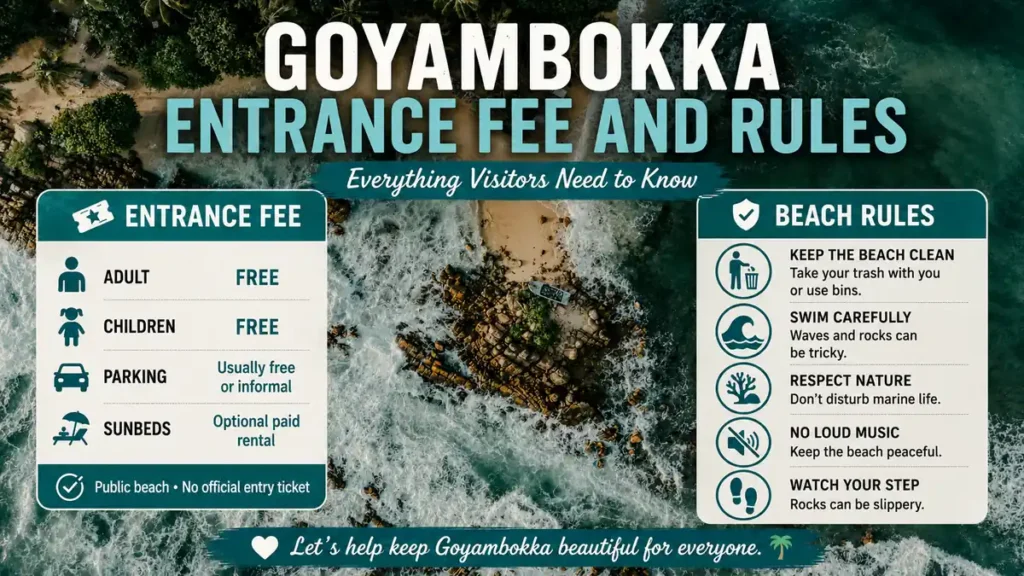
Let me be honest with you. The first time I heard about Goyambokka Beach, I almost skipped it. It sounded like one of those spots where you pay to sit on a strip of sand surrounded by plastic chairs and vendors shouting at you. The current Goyambokka entrance fee for foreign tourists is around LKR 200 per person, with extra small costs for parking, chairs, or umbrellas.
I was completely wrong. Goyambokka is genuinely one of the calmest, most beautiful beaches on Sri Lanka’s southern coast, and understanding the Goyambokka entrance fee and rules before you arrive makes the whole experience smoother and way less stressful.
Because yes, there are fees, there are rules, and a few things that will catch you off guard if no one tells you first. This guide covers everything, honestly and practically, so you know exactly what to expect when you turn up at this stunning corner of Tangalle.
We’re talking real numbers, actual dos and don’ts, and a few things I noticed on the ground that the tourist pamphlets tend to leave out. You don’t need to worry about complicated entrance fees or rules at Goyambokka Beach, but you should know them before you visit
Where Is Goyambokka Beach Located?
Goyambokka Beach sits along the southern coastline of Sri Lanka, within the Tangalle area of the Southern Province. It’s about 5 kilometers west of Tangalle town itself, which places it roughly 230 kilometers south of Colombo. The Southern Expressway makes the drive from the capital more manageable now; you can reach the Tangalle area in about three and a half hours on a good day.
Nature has tucked the beach into a sheltered bay, which makes it so attractive. The Sri Lanka Tourism Development Authority (SLTDA) recognizes Tangalle and its surrounding beaches as a priority destination for sustainable coastal tourism. Goyambokka benefits from that framework in terms of basic facilities and some environmental protections that more isolated beaches lack.
If you’re coming from Mirissa or Unawatuna, this is an easy extension of a southern coast circuit. Locals in the Tangalle area refer to this stretch as one of the quietest swimming beaches on the south coast, which says a lot given the competition.
Before you pick your beach for the day, here’s a quick look at how Goyambokka compares with other beaches around Tangalle, especially if you’re wondering whether the small entrance fee is actually worth it.
| Beach near Tangalle | Best For | Entrance Fee | Swimming Safety | Facilities | Overall Vibe |
| Goyambokka Beach | Calm swimming, families, relaxed beach day | Around LKR 200 for foreign tourists | Generally good from December to April | Parking, food stalls, chairs, and basic changing areas | Quiet, clean, and easy to enjoy |
| Silent Beach | Secluded scenery and peaceful photos | Usually free, but access can vary | Can be rough depending on the season | Limited facilities nearby | More hidden and less commercial |
| Tangalle Beach | Long walks, local atmosphere, sunset views | Free | Not always ideal for swimming due to the waves | Restaurants, hotels, and shops nearby | Open, wide, and local |
| Medilla Beach | Budget stays, backpackers, beach cafés | Free | Mixed conditions, check before swimming | Guesthouses, cafés, restaurants | Casual and slightly busier |
| Marakolliya Beach | Nature, quiet stays, turtle-watching nearby | Free | Often rough, better for walking than swimming | Limited but peaceful | Wild, natural, and less developed |
Thinking about visiting Goyambokka Beach? Read more in Goyambokka Beach Sri Lanka Travel Guide: This Beach Feels Like a Secret for tips, costs, and local insights.
Is There an Entrance Fee for Goyambokka Beach?
Yes, there is. Goyambokka Beach does charge a small entrance fee for visitors, administered through the local government and the Tangalle Pradeshiya Sabha (local municipal authority).Local authorities introduced the fee as part of a broader coastal management initiative to fund upkeep, waste management, and basic lifeguard services at public beaches in the region.
Importantly, staff collect the fee at the main access point near the parking area. There is usually a small booth or a designated person handling collections during peak hours. If you arrive very early in the morning, before 6:30 AM or so, you might find the booth unstaffed, though locals say the fee is still technically applicable and collection usually resumes by mid-morning.
The money collected does stay locally according to guidelines from the Southern Provincial Council, which manages a portion of coastal tourism revenues for infrastructure and environmental upkeep. That’s a positive sign compared to beaches where authorities do not clearly account for how they use collected fees.
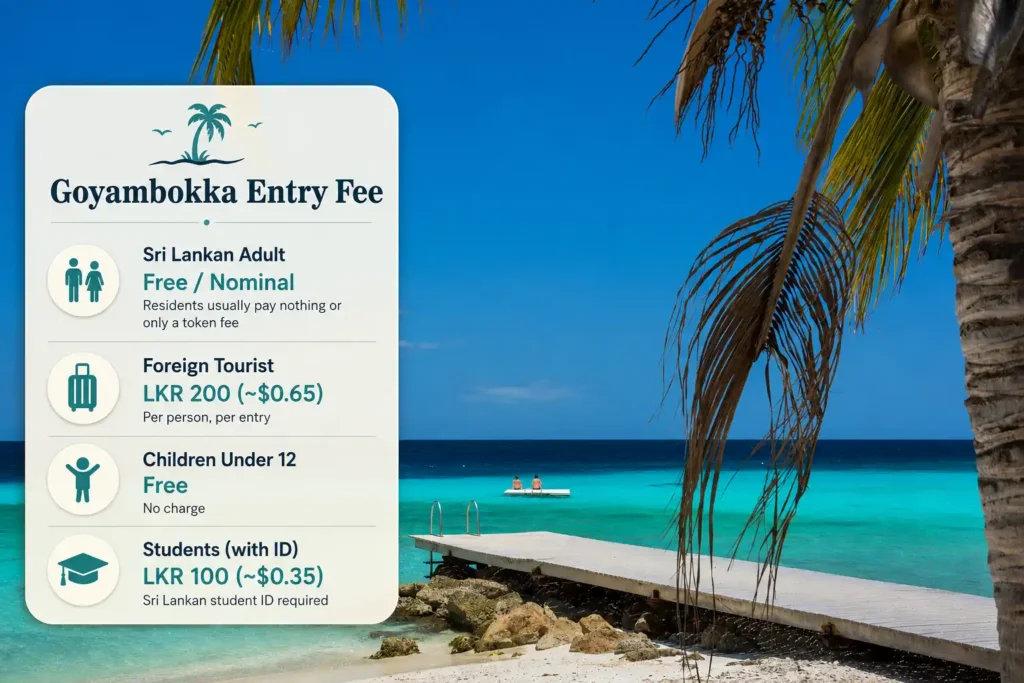
Current Goyambokka Beach Entry Costs at a Glance
Here’s a straightforward breakdown of what you’ll actually pay at the entrance:
| Visitor Type | Entrance Fee (LKR) | Approximate USD | Notes |
| Sri Lankan Adult | Free / Nominal | — | Residents are typically exempt or pay a token fee. |
| Foreign Tourist (Adult) | LKR 200 | ~$0.65 | Per person, per entry |
| Children under 12 | Free | — | No charge for young children |
| Students (with ID) | LKR 100 | ~$0.35 | Sri Lankan student ID required |
These figures are based on the 2024–2025 fee structure confirmed with the Tangalle area tourism office. It’s worth knowing that Sri Lanka’s beach entrance fees are among the lowest in South Asia, which says something about how accessible this coastline genuinely is.
Do Foreign Tourists Pay Different Fees?
Yes, they do, and this is common practice at many managed beaches and national sites across Sri Lanka. The dual pricing system (known locally as differential pricing) reflects a model used across the region, similar to how India and Thailand handle popular tourist sites. Foreign tourists pay slightly more than locals, which in this case is still a very small amount.
The Sri Lanka Tourism Development Authority supports this model as part of sustainable tourism funding. The rationale is straightforward: tourist footfall puts more pressure on facilities, and a marginal fee contribution helps offset that impact without creating a financial barrier.
From a practical standpoint, no one is checking your residency in great detail. The difference in fees is small enough that it’s not worth trying to navigate around it. Just pay it, enjoy the beach, and consider the LKR 200 an investment in keeping this place as clean and functional as it is.
Parking Charges and Other Small Costs to Expect
Beyond the entrance fee, there are a couple of small costs that catch people off guard because they’re not always mentioned upfront.
| Cost Type | Approximate Amount | Notes |
| Car Parking | LKR 100–200 | Collected by a local attendant |
| Motorbike / Tuk-tuk | LKR 50–100 | Informal but consistent |
| Beach Chair Rental | LKR 300–500 | Optional, not mandatory |
| Sunshade / Umbrella | LKR 200–400 | Varies by vendor |
| Locker / Changing Room | LKR 100–150 | If facilities are available |
None of these are officially mandatory, but beach chair and umbrella rentals are often informally encouraged by the vendors on site. You can absolutely bring your own mat and setup. Just be aware that the vendors are locals earning their livelihood from the beach, so a polite decline is always better than an argument.
Goyambokka Beach Opening Hours
Goyambokka Beach is a public coastal area, meaning technically it doesn’t “close” in the way a park does. However, the staffed entrance and managed facilities operate within specific hours:
- Main entrance staffed hours: 6:00 AM to 6:30 PM
- Lifeguard service (when present): 8:00 AM to 5:00 PM
- Parking attendants: 7:00 AM to 7:00 PM approximately
- Food stalls and vendors: Typically 8:00 AM to sunset
Local authorities and the beach safety guidelines published by the National Aquatic Resources Research and Development Agency strongly discourage swimming after dark. The ocean conditions here can shift significantly after sunset, and there’s no lighting on the beach itself.
The best practical window is 7:00 AM to 5:00 PM, which captures the full morning calm and avoids the post-sunset risks. Arriving at 7 AM also means the beach is at its quietest and most photogenic.
What Are the Official Opening Hours at Goyambokka Beach?
The managed entrance at Goyambokka Beach operates from 6:00 AM to 6:30 PM daily. Lifeguard coverage runs 8:00 AM to 5:00 PM during the main season. The beach itself is accessible beyond these hours, but swimming after dark is officially discouraged by Sri Lanka’s coastal safety guidelines.
Beach Rules Every Visitor Should Know
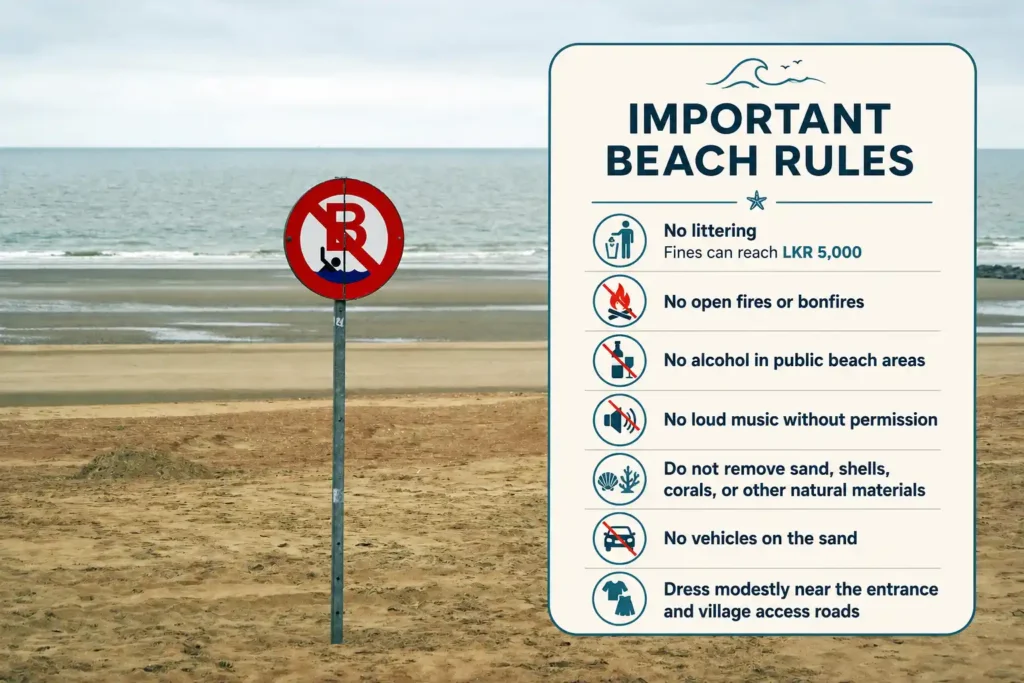
These rules aren’t arbitrary. They’re a combination of national environmental regulations, local authority guidelines, and plain common sense that’s been formalized because people kept ignoring it.
- No littering: The beach is covered by the National Environmental Act (NEA) of Sri Lanka. Fines for littering in protected coastal zones can reach LKR 5,000 for individuals.
- No open fires or bonfires: Strictly prohibited under coastal zone management regulations overseen by the Coast Conservation Department (CCD) of Sri Lanka.
- No alcohol consumption in public beach areas: Public intoxication and visible alcohol are prohibited. Resorts have private beach areas with different rules.
- No playing loud music without permission: This applies particularly to amplified audio equipment.
- No removing sand, shells, corals, or any natural material: Covered under the Fauna and Flora Protection Ordinance (FFPO).
- No vehicles on the sand: Motorcycles and tuk-tuks must remain in the designated parking area.
- Dress modestly in non-swimming areas: Sri Lanka’s cultural norms apply near the beach entrance and village access roads.
I’ll be honest, a few of these rules are enforced inconsistently on any given day. But the littering rule and the fire rule are taken seriously, and the consequences of ignoring them aren’t worth it.
What Are the Main Rules at Goyambokka Beach?
Key rules at Goyambokka Beach include: no littering (fines up to LKR 5,000), no open fires, no alcohol in public beach zones, no removal of natural materials, and no vehicles on the sand. These are enforced under Sri Lanka’s National Environmental Act and the Coast Conservation Department regulations.
Swimming Safety Tips Before You Get in the Water
This is worth taking seriously. Goyambokka has a relatively sheltered bay compared to the open beaches nearby, but the Indian Ocean doesn’t play around even in calm conditions. The National Aquatic Resources Research and Development Agency (NARA) and the Sri Lanka Coast Guard have both issued seasonal advisories for southern coast beaches.
| Season | Ocean Conditions | Swimming Safety Level | Recommended Action |
| Dec – Mar (Northeast Monsoon) | Generally calm | Good | Safe for swimming in calm areas |
| Apr – May (Inter-monsoon) | Moderate waves | Caution | Check daily conditions |
| Jun – Sep (Southwest Monsoon) | Rough, strong currents | High Risk | Avoid swimming; rip currents are possible |
| Oct – Nov (Inter-monsoon) | Variable | Moderate | Follow the lifeguard’s advice |
- Always swim in areas flagged by the lifeguard on duty.
- If there’s no lifeguard present, treat that as a caution signal.
- Don’t swim alone, especially outside of main visitor hours.
- Watch for rip currents: swim parallel to shore to escape one, never fight it directly.
- Children should stay in the shallows regardless of conditions.
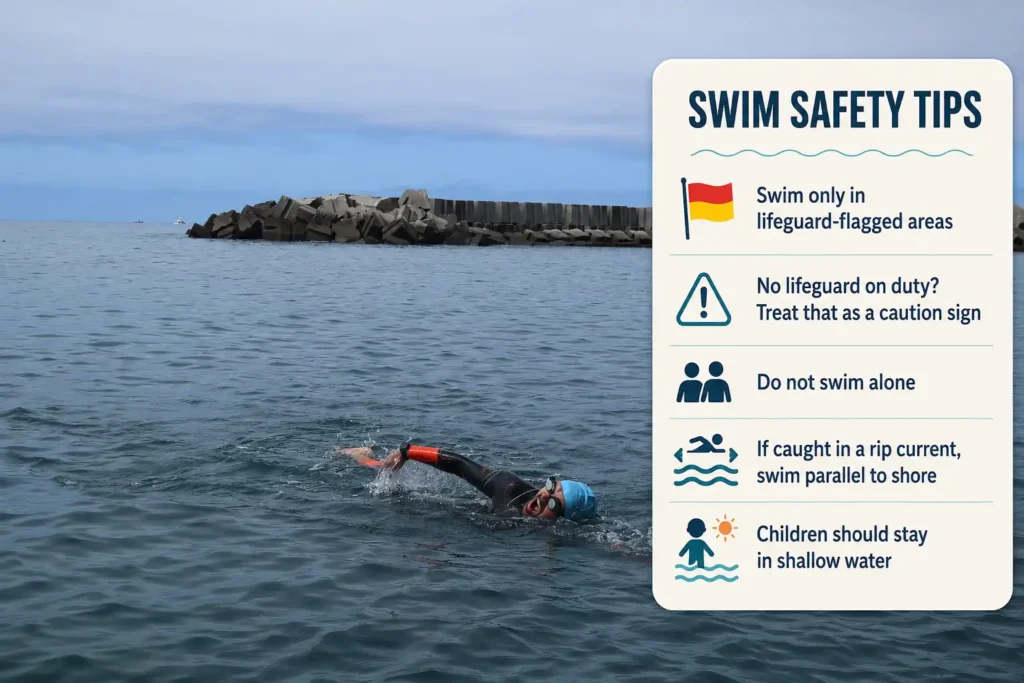
Locals near the Tangalle fishing harbor told me that the undertow picks up unexpectedly even in December, especially toward the western end of the bay. That’s not in any official brochure, but it’s the kind of thing worth knowing.
Is Goyambokka Beach Safe for Swimming?
Goyambokka Beach is generally safe for swimming between December and April when conditions are calmer. During the southwest monsoon season (June to September), swimming is strongly discouraged due to strong currents and rough surf. Always follow the advice of the lifeguard on duty and avoid swimming alone.
Is it really safe to swim at Goyambokka Beach? Read more in Is Goyambokka Beach Safe to Swim? Read This First to find out what you should know.
Photography and Drone Rules at Goyambokka
Photography for personal use is completely fine. The beach is stunning, the light in the morning is exceptional, and no one will bother you with a camera or phone. However, there are a few specific restrictions worth knowing about, especially for content creators.
- Commercial photography and videography: Requires a permit from the Sri Lanka Tourism Development Authority (SLTDA). This applies to professional shoots, brand content, and anything intended for broadcast or paid distribution.
- Drone flights: Subject to the Civil Aviation Authority of Sri Lanka (CAASL) regulations. You need prior approval to fly drones over the coastline. Flying without approval can result in equipment confiscation and fines up to LKR 500,000.
- Photographing residents: Always ask permission first. This is both a cultural and legal consideration under Sri Lanka’s privacy norms.
- Photography near resort properties: Some private beach-adjacent properties restrict photography from certain angles. Look for posted signs.
For most visitors taking personal travel photos, none of this is relevant. Just be respectful with your lens, especially around local families.
Can You Fly a Drone at Goyambokka Beach?
Drone flights at Goyambokka Beach require prior approval from the Civil Aviation Authority of Sri Lanka (CAASL). Flying without authorization is illegal and carries fines of up to LKR 500,000 plus possible equipment confiscation. Personal photography without drones is unrestricted for visitors.
What You Can and Can’t Bring to the Beach
This is one of those practical sections that most travel blogs skip. It matters.
- Bring: Reef-safe sunscreen (the Coral Triangle Initiative, which Sri Lanka participates in, encourages this), reusable water bottles, light snacks in sealed containers, beach mats or towels, and a small bag for your trash.
- Bring: Cash in LKR. There are no card payment options at the entrance or from vendors on the beach itself.
- Don’t bring: Single-use plastic bags (increasingly restricted under Sri Lanka’s plastic ban regulations rolled out since 2023), glass bottles near the waterline, pets without advance checking with local authority rules, and large portable speakers.
- Don’t bring: Surfboards or water sports equipment without checking the day’s conditions and any local sporting zone designations first.
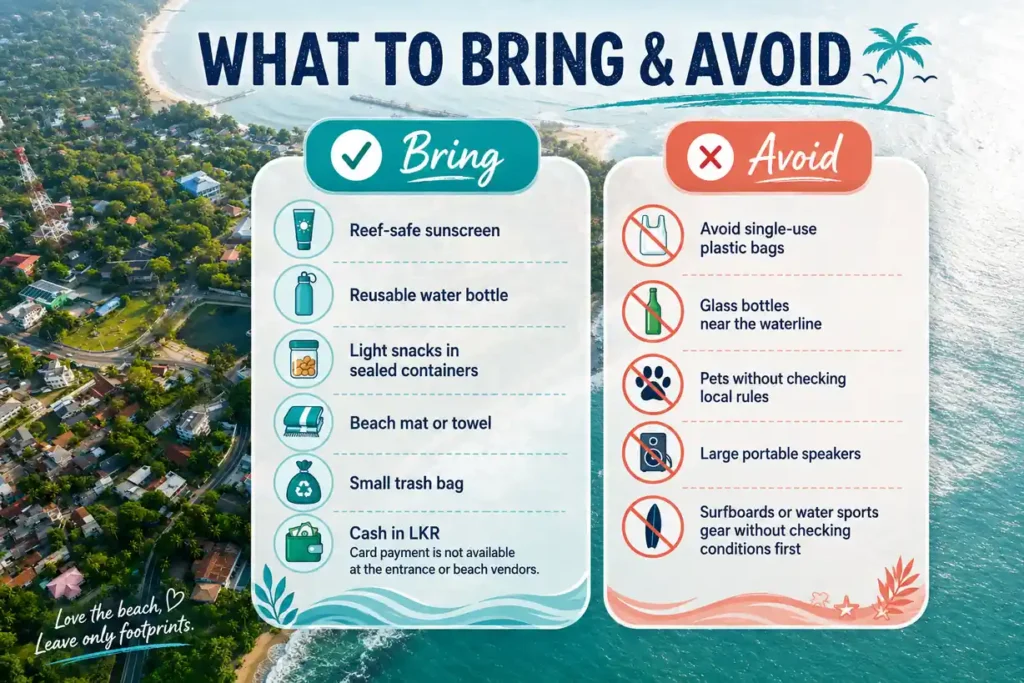
I once watched someone lose a glass bottle to a wave and spend 20 minutes trying to collect the shards before a child walked nearby. Bring plastic-free alternatives and save everyone the stress.
Local Etiquette Visitors Should Respect
Goyambokka isn’t a resort bubble. The surrounding community of Tangalle is a working fishing town with its own culture and daily rhythms. Being a considerate visitor matters here more than at a fully commercialized resort beach.
- Dress appropriately when walking to and from the beach through village paths. A sarong over swimwear is considered respectful.
- Greet local vendors and staff with basic Sinhala: ‘Ayubowan’ (meaning ‘may you live long’) is always received warmly.
- Don’t negotiate aggressively over beach chairs or small food items. The margins here are tiny.
- Keep music at a considerate volume. Families and elderly visitors use this beach regularly.
- If you see someone in difficulty in the water, alert the lifeguard immediately rather than entering the water yourself unless you’re a trained rescuer.
The Sri Lanka Tourism Promotion Bureau emphasizes community-based tourism ethics in the Southern Province, and Tangalle is specifically highlighted as a destination where visitor behavior significantly impacts local livelihoods and community relationships.
Best Time to Visit for a Hassle-Free Experience
The honest answer is December through March. This is when the southern coast of Sri Lanka sits in its calmest and most visually spectacular window. The water is clear, the waves are manageable, the humidity is lower, and the light in the early morning is something you genuinely have to see to believe.
April and May are a transitional period. You can have perfectly beautiful days, but you need to check conditions daily. The southwest monsoon season from June through September brings rough seas and a lot of overcast sky. It’s not unpleasant on land, but the beach experience is significantly different.
For day-of timing, arriving between 7 and 9 AM gives you the beach at its best. The crowds (such as they are, this is not a crowded beach by any standard) build from mid-morning. By 3 PM on a popular day, the beach starts to fill up, especially on weekends when domestic tourists from Colombo make the drive down.
What Is the Best Time to Visit Goyambokka Beach?
The best time to visit Goyambokka Beach is from December to March, during the northeast monsoon season, when conditions are calm, visibility is excellent, and swimming is safe. Within a single day, arriving between 7:00 AM and 9:00 AM offers the quietest, most pleasant experience with softer light for photography.
Looking for a smooth, hassle-free experience? Read more in Best Time to Visit Goyambokka Beach (And Why Timing Changes Everything) to pick the perfect time to go.
Facilities Available Near the Beach
Goyambokka isn’t completely barren in terms of amenities, though it’s not heavily developed either. Here’s what you can actually count on:
- Parking area with attendant (paid, as noted above)
- Small food stalls and drink vendors near the entrance, coconut water, short eats, rice, and curry
- Basic changing facilities, though these vary in quality and cleanliness by season
- Lifeguard presence during peak visitor hours (not guaranteed year-round)
- Waste bins at the main access points
- A small number of guesthouses and family-run hotels within walking distance
There’s no first aid post on the beach itself. The nearest hospital is the Tangalle General Hospital, which is about 7 kilometers away. It’s a fully functional regional hospital, but getting there takes time, which reinforces why swimming safety isn’t something to take casually.
What Should You Know Before Visiting Goyambokka for the First Time?
First-time visitors should bring cash in LKR for the entrance fee (LKR 200 for foreign tourists), parking, and vendors. Arrive before 9 AM for the best experience, use reef-safe sunscreen, avoid swimming during the southwest monsoon (June–September), and take all rubbish with you. Drone flights require prior approval from Sri Lankan aviation authorities.
Common Mistakes First-Time Visitors Make
I’ve talked to enough travelers who’ve done this trip to compile what actually goes wrong. Most of it is avoidable.
- Arriving without cash: There are no ATMs at the beach. The nearest ones are in Tangalle town.
- Underestimating the sun: The southern Sri Lanka sun is intense even in the morning. Reef-safe SPF 50+ is not optional.
- Ignoring monsoon season warnings: Some visitors assume a beach is a beach regardless of season. This one genuinely isn’t safe to swim at during the southwest monsoon.
- Not checking drone regulations in advance: Several travel content creators have had equipment confiscated at southern Sri Lanka beaches. Learn from that.
- Expecting resort-level facilities: Goyambokka is a public community beach. Plan accordingly.
- Leaving without taking your rubbish: The beach relies on visitors doing the right thing. Bags are cheap, and conscience is cheaper.
A Quick Recap of Goyambokka Entrance Fee and Rules
The Goyambokka entrance fee for foreign tourists is LKR 200 (approximately USD 0.65) per person, collected at the managed entrance near the parking area. Key rules include no littering (fines up to LKR 5,000), no open fires, no public alcohol consumption, no drones without CAASL approval, and no removal of natural materials. The beach operates under guidelines from Sri Lanka’s Coast Conservation Department and the National Environmental Act.
Goyambokka is one of those rare beaches that hasn’t been turned into a product yet. The goyambokka entrance fee and rules are genuinely light; a small payment, a few common-sense guidelines, and a bit of cultural awareness are all it takes to have a completely immersive experience on one of Sri Lanka’s most beautiful southern shores. Go early, bring cash, respect the ocean, and take your rubbish home with you. It’s not complicated. And the beach will reward you for it in ways that a hundred Instagram photos can’t quite capture.
Frequently Asked Questions About Goyambokka Entrance Fees and Rules
Q1: What is the current entrance fee at Goyambokka Beach for foreign tourists?
The entrance fee for foreign tourists is LKR 200 per person (approximately USD 0.65). Sri Lankan residents typically pay a nominal or no fee. This fee is collected at the managed entrance booth near the main parking area.
Q2: Is Goyambokka Beach free for Sri Lankan citizens?
Sri Lankan residents generally pay a nominal fee or no entrance fee at Goyambokka Beach. The dual pricing structure reflects national tourism policy and is common at managed beaches and protected sites across the country.
Q3: What are the rules about alcohol at Goyambokka Beach?
Alcohol consumption in open public beach areas is not permitted under Sri Lanka’s public spaces regulations. Some nearby hotels and resorts have private beach areas with different rules. Bringing alcohol to the public beach and consuming it openly can attract fines from local police.
Q4: Can I bring my pet to Goyambokka Beach?
There is no blanket ban on pets at all Sri Lankan public beaches, but local authority guidelines and community norms at Goyambokka generally discourage bringing dogs to the main swimming areas. It’s worth checking the current local rules before you arrive with a pet.
Q5: Is there a lifeguard at Goyambokka Beach?
A lifeguard is typically present during peak visitor hours, roughly 8:00 AM to 5:00 PM, during the main tourist season. This is not guaranteed year-round. The National Aquatic Resources Research and Development Agency (NARA) coordinates beach safety services across Sri Lanka’s southern coast.
Q6: What is the fine for littering at Goyambokka Beach?
Under Sri Lanka’s National Environmental Act, fines for littering in coastal zones can reach LKR 5,000 for individuals. Enforcement varies, but the regulation exists and has been applied at popular southern beaches, including those around Tangalle.
Q7: How do I get to Goyambokka Beach from Colombo?
Take the Southern Expressway from Colombo toward Matara and exit toward Tangalle. From Tangalle town, Goyambokka Beach is approximately 5 kilometers west. The total journey from Colombo is roughly 230 kilometers and takes about three to four hours, depending on traffic. Private taxis, intercity buses, and hired drivers are all practical options.
2 Responses
I really appreciated the detailed breakdown of entrance fees and extra costs—it’s reassuring to know exactly what to expect before visiting Goyambokka. The tips on local etiquette and rules also make it easier to enjoy the beach without accidentally stepping on toes.
Thank you! I’m glad the cost breakdown and local tips helped make your trip planning easier. Hope you have an amazing time at Goyambokka Beach and enjoy everything it has to offer!