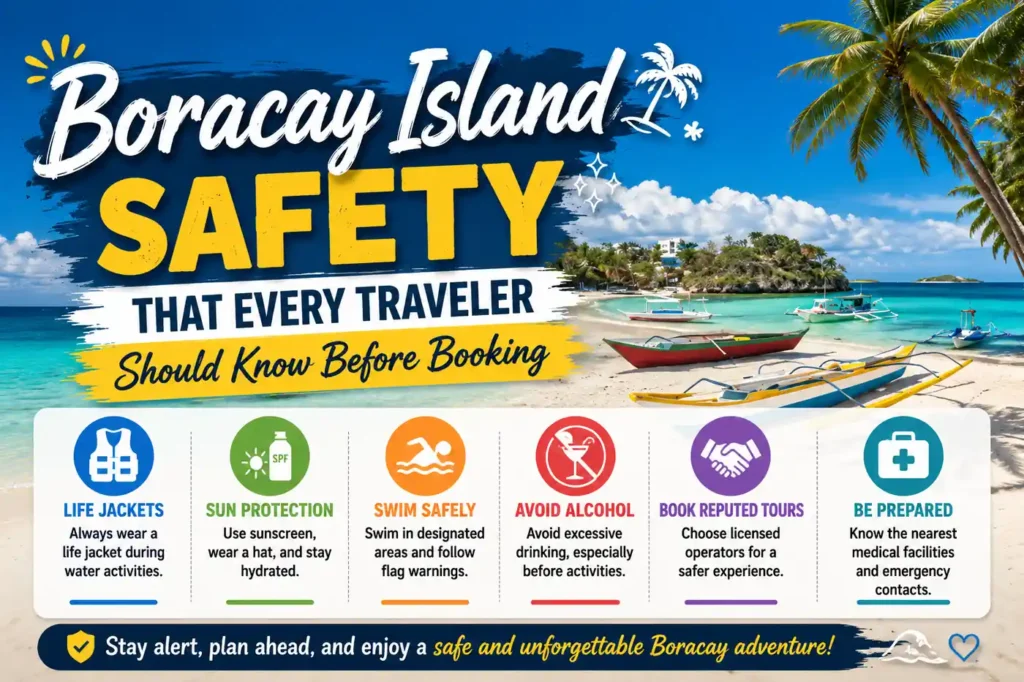
Yes, Boracay is generally safe for tourists in 2026. The biggest risks are usually weather, strong currents, sun exposure, petty theft, and transport issues, not violent crime. Boracay Island safety depends mostly on nature, not crime. Violent incidents against tourists are rare, but rip currents at Bulabog Beach, jellyfish during certain months, and typhoon-season ferry delays (July to October) cause the most problems. Petty theft and overcharging by unlicensed tricycles or tour operators are also common complaints. Local police and tourist assistance desks are active along White Beach and Stations 1 to 3, and swimming is safest only in flagged zones.
Night walks along the beach are generally fine, but isolated paths away from the main strip should be avoided after dark. Solo travelers should also keep valuables in hotel safes and use only registered dive shops or boat operators for water activities. In short, Boracay Island safety comes down to smart choices: licensed transport, checked weather updates, and awareness of local scam patterns.
Boracay Island Safety: Is it Safe for Tourists?
Yes, generally speaking, and the numbers back that up. Nationwide, the Department of the Interior and Local Government reported an 80 percent decline in crime rates since 2014, helped along by a newer “Safer Cities” push that cut focus crimes like theft by roughly 20 percent in a recent quarter. Boracay itself operates as a tightly managed tourism zone under the Boracay Inter-Agency Task Force (BIATF), with a hard cap of 19,215 people allowed on the island at any given time.
Petty theft on crowded beach paths remains the most common complaint, alongside inflated tricycle fares near the ports. Genuinely violent incidents involving foreign tourists stay rare enough that local news treats them as notable events, not a pattern. Situational awareness still matters more than blind confidence, especially after dark or after a few drinks.
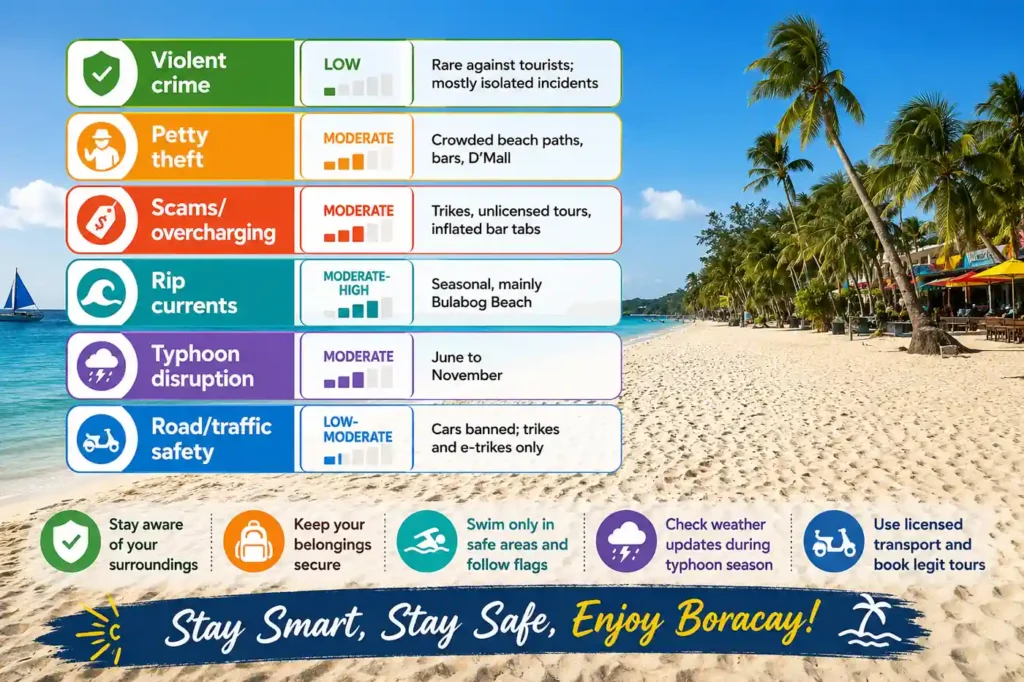
Here’s a quick snapshot most travelers search for before booking; save it for later.
| Risk Factor | Level | Notes |
| Violent crime | Low | Rare against tourists; mostly isolated incidents |
| Petty theft | Moderate | Crowded beach paths, bars, D’Mall |
| Scams/overcharging | Moderate | Trikes, unlicensed tours, inflated bar tabs |
| Rip currents | Moderate-High | Seasonal, mainly Bulabog Beach |
| Typhoon disruption | Moderate | June to November |
| Road/traffic safety | Low-Moderate | Cars banned; trikes and e-trikes only |
Is Boracay Island Safety a Real Concern in 2026?
Short answer: Boracay remains one of the safer beach destinations in the Philippines. Violent crime against tourists stays rare, according to local tourism officials and repeated traveler reports, and the bigger threats come from the sea, the sun, and the occasional overpriced trike ride rather than street crime.
Worried About Safety in Boracay? Get the Facts Before You Go. Read more in 9 Reasons Boracay Island Is Famous but Not for Everyone.
Beach and Swimming Safety in Boracay
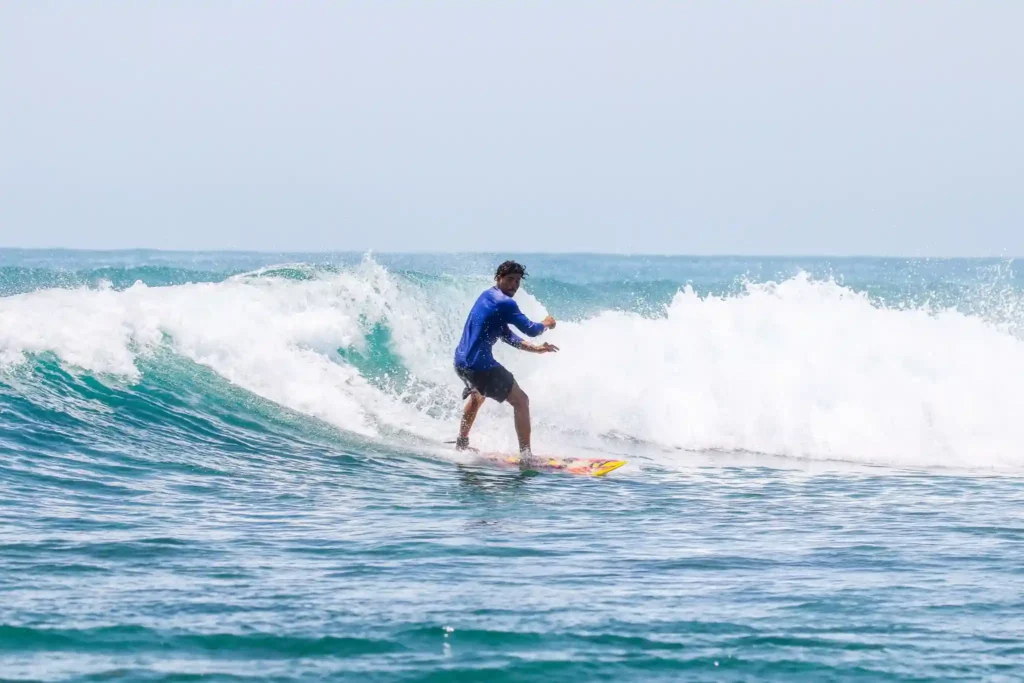
White Beach earns its reputation honestly. Calm, shallow water and lifeguard patrols make the main strip suitable for most swimmers during the Amihan dry season from November through May. Bulabog Beach, on the eastern side, tells a different story, since it faces the open sea and hosts most of the island’s kitesurfing activity. Strong lateral currents build up there, particularly during Habagat season from June to October, and swimming isn’t recommended when flag warnings go up.
Jellyfish season occasionally overlaps with the wetter months, so a quick check with lifeguards before wading in never hurts. Water quality has stayed within Philippine standards since the 2018 rehabilitation removed illegal wastewater outflows, according to repeated post-reopening testing.
A few habits keep swimming trouble-free:
- Swim only at designated, patrolled sections of White Beach, Stations 1 to 3.
- Check flag warnings before entering the water at Bulabog Beach.
- Avoid alcohol before or during ocean swimming, no matter how calm it looks.
- Keep young children within arm’s reach; the sandbar drop-off surprises first-timers.
Is Boracay Safe at Night?
Nightlife in Boracay centers on Station 2, and honestly, it’s louder and busier than dangerous. Beachfront bars, fire dancers, and live music pull huge crowds every evening, and most nights pass without incident. Trouble tends to follow alcohol rather than criminals lurking in the dark, with arguments, lost belongings, and the occasional bar-tab dispute topping the list of complaints.
Poorly lit side streets and quiet interior lanes away from the main strip are where caution genuinely pays off, particularly for anyone walking home alone after midnight. Drink spiking gets mentioned in traveler safety guides mostly as a general precaution, but keeping a drink in view is still smart practice anywhere. Sticking to the main beachfront and busy roads keeps most nights uneventful.
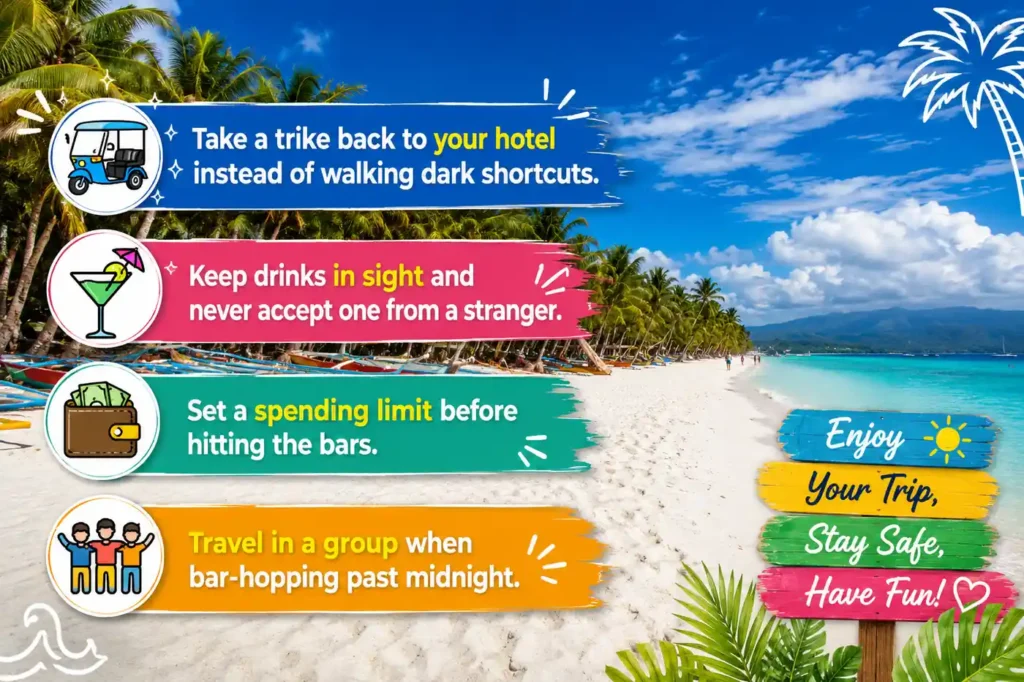
For safer nights out:
- Take a trike back to your hotel instead of walking dark shortcuts.
- Keep drinks in sight and never accept one from a stranger.
- Set a spending limit before hitting the bars.
- Travel in a group when bar-hopping past midnight.
Common Safety Risks in Boracay
Most problems tourists actually run into have nothing to do with crime statistics. Sunburn and heat exhaustion send more visitors to local clinics than any other single cause, given the island’s near-equatorial UV exposure. Coral cuts and marine stings during snorkeling trips rank close behind, especially for guests who skip reef shoes. Tap water isn’t recommended for drinking anywhere in the Philippines, Boracay included, so food and water safety deserve attention too.
Unlicensed tour operators occasionally oversell island-hopping boats or skip safety briefings, which becomes a real problem if weather shifts mid-trip. A rare but widely reported saltwater crocodile sighting near Bulabog in 2024 also prompted the Department of Tourism to roll out heightened monitoring near mangrove and estuary zones.
What Is the Biggest Safety Risk for Tourists in Boracay?
Sun exposure and dehydration cause more medical visits among tourists than any crime or accident combined. Reef-safe sunscreen, regular water breaks, and shade during midday hours prevent the vast majority of these cases.
- Sunburn and heatstroke from underestimating tropical UV levels
- Coral cuts from swimming or wading without reef shoes
- Contaminated tap water and unwashed street food
- Overloaded or under-briefed island-hopping boats
Boracay Weather and Natural Hazards
Weather shapes safety on this island more than almost anything else on this list. The island runs on two monsoon patterns: Amihan, the cool, dry northeast wind from roughly November to May, and Habagat, the warmer, wetter southwest monsoon from June to October. Typhoon season stretches from June through November, occasionally bringing ferry suspensions that strand travelers on the island for a few days at a stretch.
PAGASA, the national weather service, issues storm tracking that most resorts and tour operators follow closely, so checking bulletins before finalizing plans genuinely matters during wetter months. Resorts generally keep backup power and food supplies on hand for exactly these scenarios. Green algae blooms sometimes appear on White Beach between February and May, which looks alarming but poses little more than mild skin irritation for sensitive visitors.
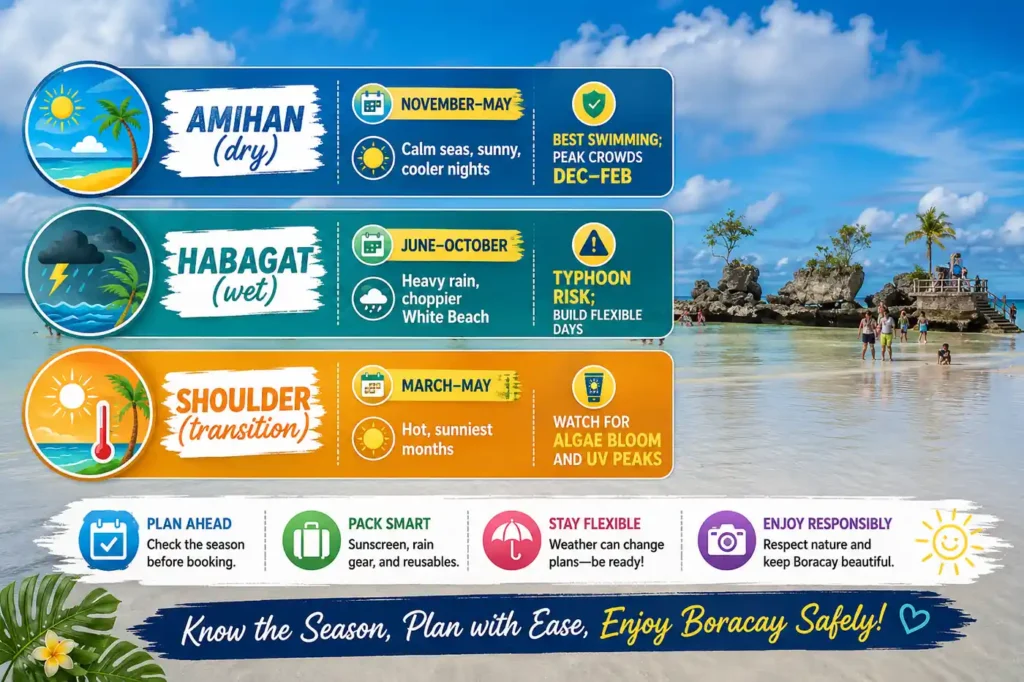
Here’s how the two seasons actually compare for anyone planning around the weather.
| Season | Months | Conditions | Safety Notes |
| Amihan (dry) | November–May | Calm seas, sunny, cooler nights | Best swimming; peak crowds Dec–Feb |
| Habagat (wet) | June–October | Heavy rain, choppier White Beach | Typhoon risk; build flexible days |
| Shoulder | March–May | Hot, sunniest months | Watch for algae bloom and UV peaks |
What Should You Do If a Typhoon Hits During Your Boracay Trip?
Riding it out on the island is standard practice, since ferries and flights get suspended rather than the island itself being unsafe. Resorts with sturdy construction and backup power handle short storms without major issues, though trip delays of a few days are common.
Transportation Safety in Boracay
Getting around Boracay looks nothing like a typical tourist island, and that’s mostly a safety upgrade. Private cars and taxis are banned from the main beachfront road, leaving tricycles and increasingly electric e-trikes as the primary way to move between stations. Shared rides run about PHP 15 to 30 per person, while private hires cost roughly PHP 100 to 150 for a single trip, all cash-only.
Traffic congestion barely exists compared to mainland Philippine cities, keeping pedestrian risk relatively low along the main strip. Overcharging remains the bigger headache, particularly for first-time visitors arriving at Cagban Port with luggage. Boat transfers from Caticlan involve a short, well-practiced 15-minute crossing, though rough seas during Habagat season can delay departures.
Smart moves for getting around:
- Agree on a trike fare before getting in, especially near ports.
- Use official transfer counters at Caticlan or Kalibo airports rather than freelance touts.
- Wear a life vest during every boat crossing, no exceptions.
- Avoid overloaded boats; a genuinely safe operator won’t rush you aboard.
Health and Medical Safety
Medical care on Boracay handles everyday issues well but has real limits for serious emergencies. Clinics like the Boracay Medical Clinic and private facilities offer general consultations, first aid, and minor procedures in the tourist zones, often with English-speaking staff. Serious cases typically require transfer to the Malay Municipal Health Office near Caticlan Jetty Port or further to Kalibo, since the island lacks a full trauma hospital.
Comprehensive travel health insurance isn’t optional here; medical evacuations by helicopter have reportedly cost tens of thousands of dollars, and that bill lands on uninsured travelers directly. Dengue fever appears occasionally during wetter months, so mosquito repellent and covering up at dawn and dusk are worth the minor hassle. Pharmacies along the main road stock most common medications, though bringing prescription drugs in original packaging avoids awkward questions at customs.
- Buy travel insurance that explicitly covers medical evacuation, not just trip cancellation.
- Use reef-safe SPF 50+ sunscreen daily; sunburn is the top reason tourists seek a clinic.
- Drink bottled or filtered water exclusively, including for brushing teeth.
- Bring repellent for dengue-carrying mosquitoes, especially June through October.
Safety Tips for Solo Travelers and Families
Solo travelers, including women traveling alone, generally report feeling comfortable in Boracay’s main tourist zones, where staff and fellow visitors tend to be helpful rather than intrusive. Sticking to well-lit, populated areas after dark and sharing a daily location update with someone back home costs nothing and adds real peace of mind. Families face a different set of concerns, mostly crowd separation at busy spots like White Beach and D’Mall during peak season.
Younger children do well in the calmer central sections of White Beach, while Bulabog’s currents and kitesurfing traffic suit older kids and adults better. Booking DOT-accredited accommodation adds a layer of protection too, since these properties answer to local tourism authorities. Either way, blending a little local awareness into the trip beats over-planning every single hour.
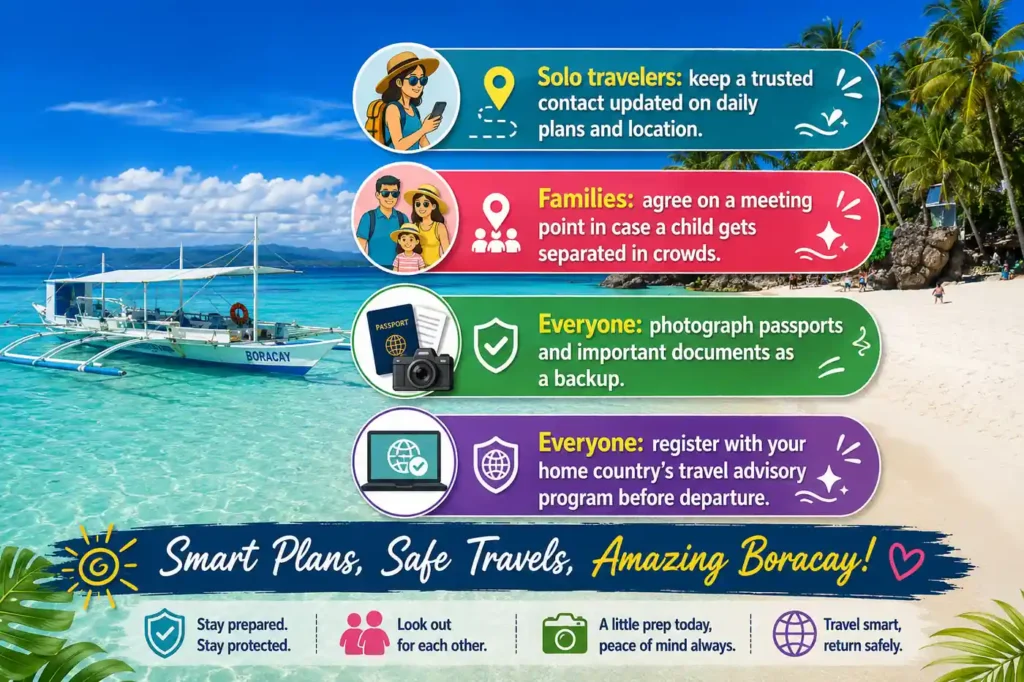
- Solo travelers: keep a trusted contact updated on daily plans and location.
- Families: agree on a meeting point in case a child gets separated in crowds.
- Everyone: photograph passports and important documents as a backup.
- Everyone: register with your home country’s travel advisory program before departure.
What to Do in an Emergency in Boracay
Fast action matters more than perfect action when something actually goes wrong. Dialing 911 connects to police, fire, and medical dispatch anywhere in the Philippines, Boracay included, and it’s worth memorizing before landing. Tourist-specific help is also available through the dedicated tourist police line, which tends to move faster for visitor issues like theft reports or lost documents.
Hotel and resort staff usually know the fastest route to the nearest clinic and can help translate or coordinate transport in a pinch. For anything beyond minor injuries, contacting a travel insurance provider immediately helps set evacuation logistics in motion. Keeping a printed copy of key documents and policy numbers saves precious time when phone batteries or signal fail.
This table covers the numbers worth saving to your phone before you land.
| Service | Number | When to Use |
| Police / Fire / Medical (national) | 911 | Any life-threatening emergency |
| Tourist Police hotline | 151-TOUR | Theft, scams, visitor-specific issues |
| Boracay medical/ambulance hotline | (036) 288-2068 | Non-911 medical dispatch on-island |
| U.S. Embassy Manila | +(63)(2) 5301-2000 | U.S. citizens needing consular help |
Boracay Island Safety Tips to Remember
Staying safe here, at the end of the day, comes down to preparation rather than paranoia. Booking accredited accommodation, checking PAGASA bulletins during Habagat season, and keeping travel insurance active covers most of the serious risks in one move. Petty theft and overcharging respond well to basic vigilance: agree on prices upfront and use official counters instead of freelance touts.
Swimming smart means respecting flag warnings and never underestimating Bulabog’s currents just because the water looks calm from shore. None of this requires constant worry once the habits become second nature. Most travelers settle into a relaxed rhythm within a day or two of arriving.
A short checklist worth keeping in mind: save 911 and the tourist police hotline before you land, buy travel insurance with medical evacuation coverage, check ferry and weather status during typhoon season, stay in the central, patrolled sections of White Beach, and always agree on trike and tour prices before committing. Keeping these few habits in place takes away most of the guesswork and lets you enjoy the island without second-guessing every decision.
FAQs About Boracay Island Safety
Is it safe to go to Boracay now?
Yes, Boracay remains open and welcoming to tourists in 2026, with standard safety measures, a visitor cap of 19,215 people, and active monitoring from local tourism authorities. Checking current weather advisories before travel during typhoon season (June–November) is still a smart move.
What is the crime rate in Boracay?
Island-specific crime statistics aren’t published in detail, but nationwide Philippine crime rates fell sharply, with an 80 percent decline since 2014 reported by interior officials. Boracay’s tourism-dependent economy and heavy local monitoring generally keep serious crime against visitors rare.
Which part of the Philippines is safest?
Dumaguete City, Davao City, and Baguio City consistently rank among the country’s safest urban destinations based on recent safety indices, while Batanes province stands out as the safest rural area. Major tourist zones like Boracay, Palawan, and Cebu also benefit from strong tourism-focused policing.
How safe is Boracay for tourists?
Boracay ranks among the Philippines’ safer beach destinations, with rare violent crime and manageable risks limited mostly to petty theft, overcharging, and seasonal water hazards. Following basic precautions around swimming, transport, and nightlife covers nearly every realistic scenario.
What are the problems facing Boracay Island?
Overtourism pressure on infrastructure, seasonal algae blooms, waste management, and balancing visitor caps against local livelihoods remain the island’s biggest ongoing challenges. The 2018 closure addressed the worst environmental damage, though authorities keep enforcing strict rules to prevent a repeat.