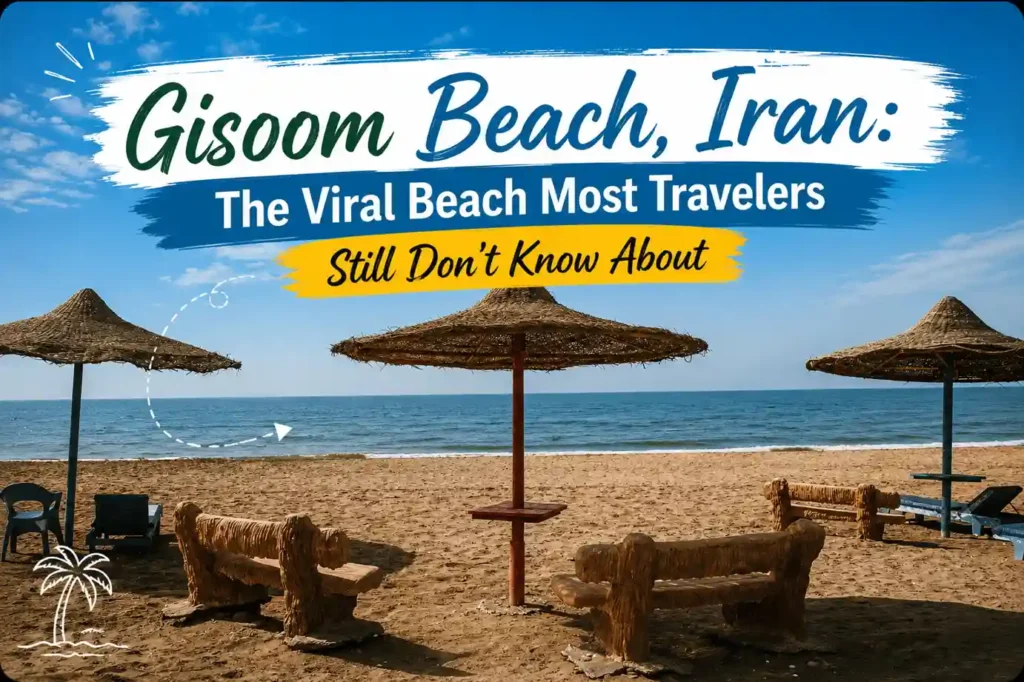
Gisoom Beach lies on the Caspian Sea coast in Iran’s Gilan province, close to the town of Talesh in the north of the country. What makes Gisoom Beach different from other coastal spots is the short forest road you walk or drive through before the trees suddenly open up onto the sand and sea.
This road cuts through the Gisoom Forest, part of the ancient Hyrcanian forest region, and the shift from thick green woodland to open beach happens in just a few steps. The Caspian Sea here is calm and shallow, with separate swimming areas for men and women, making Gisoom Beach a comfortable spot for a relaxed swim or a quiet walk by the water.
Where Is Gisoom Beach Located in Iran?
Gisoom Beach is located in Gilan Province in northern Iran, near the city of Rasht. Specifically, it sits along the Caspian Sea coastline, roughly 55 kilometers northwest of Rasht near the small town of Rezvanshahr. The area is part of the Hyrcanian forests, which UNESCO added to the World Heritage List in 2019, recognizing them as one of the oldest and most ecologically important forest zones on Earth.
Getting there from Rasht takes about 1.5 to 2 hours by car, depending on traffic and road conditions. From Tehran, the drive is around 5 to 6 hours, though many travelers prefer to take the overnight train to Rasht and then hire a car locally. The road into the area is scenic and well-paved for most of the journey, though the last stretch narrows considerably as you approach the forest zone.
| Detail | Info |
| Province | Gilan, Northern Iran |
| Nearest City | Rasht (~55 km) |
| Drive from Tehran | ~5 to 6 hours |
| Drive from Rasht | ~1.5 to 2 hours |
| Caspian Coastline | Yes, direct beach access |
| UNESCO Recognition | Hyrcanian Forests (2019) |
Why Gisoom Beach Feels Different From Other Iranian Beaches
There are a few beaches along the Caspian coast in Iran, but none of them quite look like this. Most beaches in the region are open, sandy stretches backed by flat land or low dunes. Gisoom Beach is different because the forest comes right up to the shoreline. Tall trees, dense undergrowth, and a cool green canopy frame the beach on one side, while the grey-green Caspian stretches endlessly on the other.
When I first arrived there in early October, the contrast was genuinely striking. The air smells different too: a mix of sea salt and damp earth that you won’t find anywhere else in Iran. Locals from Rasht often describe it as the cleanest air in the province, and after spending a morning there, you believe them.
Furthermore, the beach itself is relatively less crowded compared to more commercially developed spots like Ramsar or Anzali. That gives it a quieter, more personal atmosphere that most coastal destinations in the region have long since lost.
Northern Iran has Gisoom, but the south hides even more surprises. Discover the best hidden beaches in Iran for adventurous travelers.
The Beautiful Forest Road Leading to Gisoom Beach
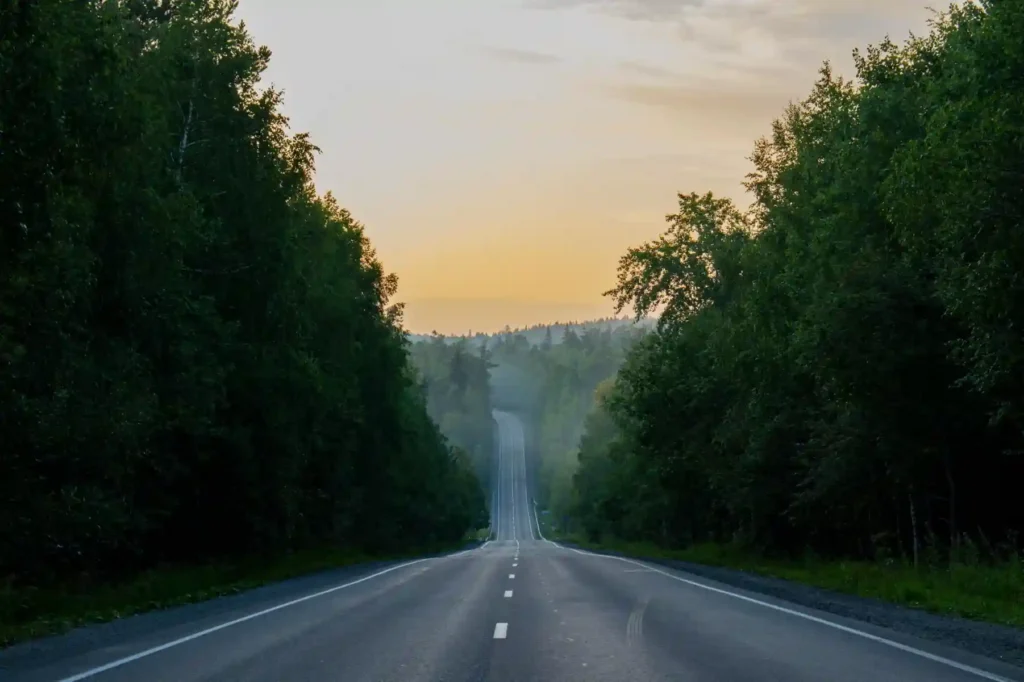
One thing most travel guides skip is the road itself. The drive through the Gisoom forest to reach the beach is genuinely one of the best parts of the whole experience. Trees arch over the road from both sides, forming a green tunnel effect that filters light into shifting patterns on the asphalt. In spring and early summer, the green is almost electric. In autumn, golds and reds take over.
Locals from the area say this road alone draws photographers from across Iran every year. That’s no exaggeration. In fact, according to the Iran Cultural Heritage, Handicrafts and Tourism Organization (ICHTO), the Hyrcanian forests of Gilan receive hundreds of thousands of domestic visitors annually, with forest road drives listed as one of the primary draws. So even if the beach weren’t there, this stretch of road would be worth the trip.
Practically speaking, drive slowly and stop whenever something catches your eye. There are small pull-offs where you can park safely. Keep your eyes open for birds and, occasionally, wildlife near the tree line.
Best Things to Do at Gisoom Beach
The beach isn’t set up for tourist activities in the traditional sense. That’s actually part of its appeal. Still, there’s plenty to keep you busy.
- Walking the shoreline: The beach stretches for a considerable length, and a morning walk along the water’s edge with forest on one side is genuinely calming.
- Photography: The combination of forest and sea creates endlessly interesting compositions. Early morning light filtering through the trees and hitting the water is particularly spectacular.
- Forest walks: Trails lead into the surrounding Hyrcanian forest, offering a cool, shaded escape from the sun during midday hours.
- Birdwatching: The forested coastline is home to a wide range of migratory and resident bird species, making it a quiet favorite among Iranian birdwatchers.
- Picnicking: Many local families bring their own food and spend an entire day here. There are open grassy areas near the tree line, ideal for this.
- Sunrise and sunset viewing: The Caspian sunrises here are genuinely worth waking up early for.
Is swimming allowed at Gisoom Beach?
Swimming is possible at Gisoom Beach, though the Caspian Sea here can have strong currents depending on the season. There are no formal lifeguard services, so caution is essential. Calm summer months offer the safest conditions. Women should be aware that Iran’s public beach regulations apply here.
Water Sports and Activities at Gisoom Beach
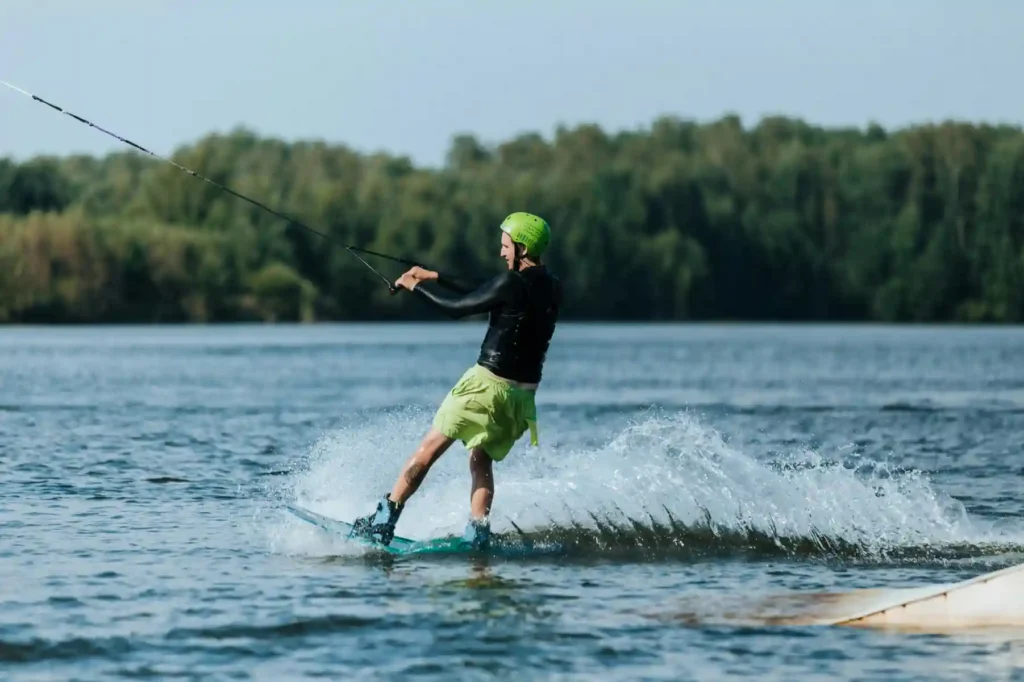
The beach doesn’t have formal water sports rental facilities, unlike the way more commercialized resorts do. However, some local operators near the entrance area occasionally offer small boat rides and basic equipment rentals during peak summer months. These aren’t guaranteed year-round, so it’s better not to plan your trip around them.
For most visitors, the appeal is simpler: wading in the water, watching the waves, and being present in a beautiful and unusual setting. That said, the Caspian Sea here is calmer than most open-ocean beaches, which makes it reasonably pleasant for casual swimming when conditions allow.
| Activity | Availability | Best Season | Notes |
| Swimming | Yes | Summer (Jun–Aug) | No lifeguards on duty |
| Forest walks | Year-round | Spring & Autumn | Wear comfortable shoes |
| Photography | Year-round | Spring & Autumn | Best light early morning |
| Birdwatching | Year-round | Autumn migration | Bring binoculars |
| Boat rides | Seasonal | Summer only | Local operators are not guaranteed |
| Picnicking | Year-round | Any | Bring your own food |
Best Time to Visit Gisoom Beach in Iran
Gilan Province is one of the wettest regions in Iran. The Hyrcanian forests receive substantial rainfall throughout the year, which is precisely why they’re so lush. For a beach visit specifically, the best months are June through September, when rainfall decreases, and temperatures are warm enough to enjoy the water.
That said, spring (April and May) is arguably the most visually stunning time to visit, even if it’s rainier. The forest is at its most intensely green, wildflowers appear along the trails, and the light has a softness that summer loses. Autumn, particularly October, brings the forest’s color change, which is genuinely beautiful and draws significant domestic tourism.
Winter visits are possible, but the beach itself is less enjoyable in cold, wet conditions. The forest walk is still worthwhile, though.
What is the best month to visit Gisoom Beach?
The best months are June, July, and August for beach weather. For scenic beauty without the peak crowds, early October is excellent. Avoid December through February if you’re primarily visiting for the beach experience.
| Season | Months | Beach Weather | Forest Scenery | Crowds |
| Spring | Apr–May | Mild, some rain | Excellent (peak green) | Moderate |
| Summer | Jun–Aug | Warm and sunny | Good | High (domestic) |
| Autumn | Sep–Nov | Cooling, some rain | Excellent (color change) | Moderate |
| Winter | Dec–Mar | Cold and wet | Atmospheric | Low |
How to Reach Gisoom Beach From Tehran or Rasht
From Tehran, the most common route is to take the Chalus Road or the Haraz Road north through the Alborz mountains, eventually connecting to the Caspian coastal highway and heading west toward Rasht and then Rezvanshahr. This drive is one of the most scenic in Iran, passing through mountain tunnels, high-altitude villages, and dramatic valley landscapes before dropping into the lush green north.
Alternatively, Iran Railways operates a regular service between Tehran and Rasht, and the journey takes approximately 6 hours overnight. From Rasht, hiring a private car or taxi for the day is the most practical approach, as public transport to the Gisoom area is very limited.
- From Tehran by car: ~5 to 6 hours via Haraz or Chalus Road
- From Rasht by car: ~1.5 to 2 hours
- From Tehran by train: ~6 hours to Rasht, then hire a car
- Recommended: Hire a local driver in Rasht for the day (~500,000 to 800,000 IRR approximately)
Can I visit Gisoom Beach as a day trip from Tehran?
Technically, yes, but it’s very long. The drive alone is 5 to 6 hours each way, making for an exhausting 14+ hour day. A much better approach is to spend at least one night in Rasht, which also gives you time to explore Gilan’s excellent food scene.
Hotels and Places to Stay Near Gisoom Beach
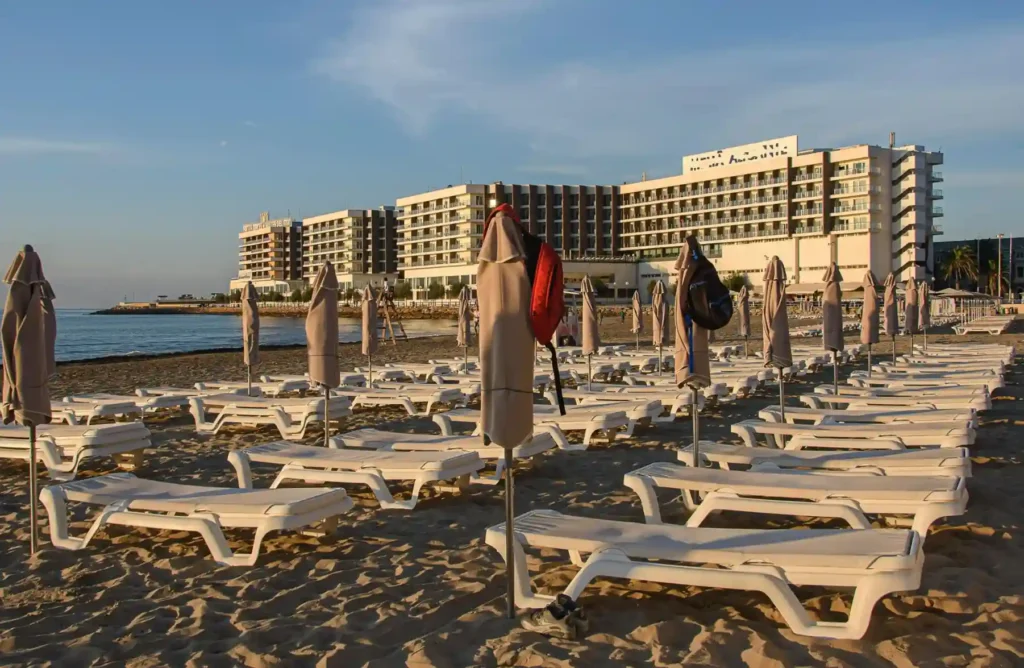
There are no hotels directly at the beach. The nearest accommodation options are in Rezvanshahr, about 20 to 30 minutes away, or in Rasht, which has a much wider range of hotels and guesthouses to suit different budgets.
Rasht is actually worth staying in for its own reasons. It’s widely considered the food capital of Iran, known for its rich, herb-heavy Gilani cuisine. Staying there gives you the best of both worlds: a comfortable base and easy access to the Gisoom forest and beach area for a full-day trip.
For travelers who prefer to be closer to nature, a few eco-lodges and rural guesthouses operate within the forest zone, some within 30 to 40 minutes of Gisoom Beach. These are typically simpler in facilities but offer an immersive experience that urban hotels can’t replicate.
| Option | Distance to Beach | Price Range | Best For |
| Rasht city hotels | ~55 km | Budget to mid-range | Comfort & food access |
| Rezvanshahr guesthouses | ~20–30 km | Budget | Proximity & simplicity |
| Forest eco-lodges | ~30–40 km | Varies | Nature immersion |
| Anzali accommodation | ~60 km | Mid-range | Beach + port town |
Local Food and Seafood to Try at Gisoom Beach
Gilan province has some of the most distinct and celebrated cuisine in all of Iran. If you’re making the trip to Gisoom, eating well is a significant part of the experience and shouldn’t be rushed.
Near the beach and in the surrounding villages, small local restaurants and roadside stalls serve fresh Caspian fish, most notably Kutum (a prized local fish), as well as Mahi Shekampor (stuffed fish), which is marinated with herbs, pomegranate paste, and walnuts. It’s one of the most distinctive dishes in Iranian cuisine and something you genuinely can’t find with the same quality anywhere else.
Also try Mirza Ghasemi, a smoky eggplant dish cooked with tomatoes, garlic, and eggs, and Baghali Ghatogh, a broad bean stew that locals eat year-round. Most small roadside places don’t have English menus, so it helps to know what you want before you go in.
Is there food available at Gisoom Beach itself?
There are no permanent restaurants at the beach. Occasionally, small vendors sell snacks and drinks near the entrance during the summer months. Always carry your own food and water for the day. The nearest restaurants are along the main road leading to the beach area.
Travel Tips Before Visiting Gisoom Beach
A few practical points that make a real difference:
- Dress code: Iran’s public regulations apply at mixed-gender beaches. Women are required to wear appropriate covering in public areas. Seek guidance from your accommodation on current local norms.
- Cash: Card payment infrastructure outside major cities is limited. Bring Iranian Rials in cash for fuel, food, and entrance fees.
- Connectivity: Mobile data coverage is decent along the main road, but can drop near the beach and forest interior. Download offline maps before you go.
- Water: Bring at least 2 liters per person. The forest humidity combined with walking can be dehydrating.
- Footwear: If you plan to walk forest trails, proper closed shoes are strongly recommended over sandals.
- Timing: Arrive early morning to enjoy the beach before midday heat and any afternoon crowds.
- Fuel: Fill up in Rasht or Rezvanshahr. Small villages may not have reliable fuel stations.
Is Gisoom Beach Safe for Tourists in 2026? (Iran War-Related)
This is understandably a question many international visitors are asking. As of 2026, Gilan Province and the northern coastal region of Iran, including the Gisoom area, remain far removed from any conflict zones. The regional tensions that have affected parts of Iran’s western and southwestern borders have not extended to the Caspian coast.
That said, travelers should always consult their national government’s official travel advisory before visiting Iran. The UK Foreign Commonwealth & Development Office (FCDO), the US State Department, and equivalent bodies in other countries publish regularly updated advisories that reflect current conditions on the ground. These should be your primary reference.
From a general safety standpoint, Gilan Province is considered one of Iran’s most visited domestic tourism regions and is generally regarded as calm and welcoming to both domestic and foreign visitors. Local hospitality in the north is genuinely warm. Numerous travelers who have visited the area in 2025 and early 2026 have reported no safety concerns specific to tourism activity.
How the Iran Conflict Is Affecting Tourism at Gisoom Beach

Broader geopolitical tensions involving Iran have affected international tourism numbers across the country over the past several years. According to data from the Iran Tourism and Cultural Heritage Organization, international visitor numbers to Iran have fluctuated significantly since 2019, with domestic tourism filling much of the gap.
For Gisoom Beach specifically, the primary visitor base is domestic. Families from Tehran, Rasht, and other northern cities form the overwhelming majority of visitors, particularly in summer. The beach and forest area have seen growing domestic visitor numbers as awareness increases, partly through social media coverage.
International travelers willing to do their research and follow their government’s guidelines generally find that northern Iran, and the Gisoom area in particular, offers a travel experience that is both accessible and richly rewarding. The lack of heavy international tourist infrastructure, which some see as a barrier, actually helps preserve exactly the authenticity that makes Gisoom worth visiting.
Is northern Iran safe to visit for tourists in 2026?
Northern Iran, including Gilan Province and the Gisoom forest-beach area, is geographically distant from conflict-affected regions. Most current travel advisories do not specifically warn against travel to this part of Iran, though Iran-wide advisories vary by country. Always check your government’s official advisory before travel and register with your embassy if recommended.
Final Thoughts on Visiting Gisoom Beach, Iran
Gisoom Beach is one of those places that rewards people who make the effort. It doesn’t hand you a curated experience or try to package itself for tourists. What it gives you instead is genuine: a coastline where a UNESCO-recognized ancient forest meets a quiet inland sea, in a part of the world that most travelers have never thought to visit.
I’ve been to a lot of so-called hidden beaches. Most of them are only hidden in the marketing. Gisoom Beach is actually quiet. The forest is actually ancient. The food nearby is actually worth traveling across a country for.
If you’re building an Iran itinerary and want one day that genuinely surprises you, the Gisoom Beach experience delivers that and more. Plan, bring cash, travel early, and give yourself the full day. You won’t regret it.
Frequently Asked Questions
Q1: Do I need a visa to visit Gisoom Beach as a foreign tourist?
Most international visitors need a visa to enter Iran. Some nationalities can obtain a visa on arrival at major Iranian airports, while others require pre-arranged visas through Iranian embassies. Always check current requirements through your country’s Iranian consulate or embassy well in advance of travel.
Q2: Is Gisoom Beach suitable for families with children?
Yes, Gisoom Beach is family-friendly, particularly during calm summer months. The relatively shallow and calm sections of the Caspian Sea near the beach make it manageable for families. The forested surroundings also provide shade and space for children to explore safely.
Q3: What language is spoken near Gisoom Beach?
The local language in Gilan Province is Gilaki, a distinct Iranian language. Persian (Farsi) is also widely spoken and understood. English is not commonly spoken in rural areas, so having a translation app or basic Persian phrases will help considerably.
Q4: Are there entrance fees for Gisoom Beach?
There is typically a small parking or conservation fee when entering the Gisoom area, though this varies seasonally. The amount is modest, typically a few hundred thousand Rials. As of recent local reports, no formal beach entrance fee is charged beyond parking.
Q5: What is the water temperature in the Caspian Sea at Gisoom Beach?
Water temperature at the Caspian Sea near Gisoom varies significantly by season. In summer (June to August), surface temperatures typically reach 24 to 28°C, making swimming comfortable. In winter, temperatures can drop to 8 to 12°C, which is cold for recreational swimming.
Q6: Can I camp at or near Gisoom Beach?
Informal camping is practiced by some domestic visitors, particularly in designated areas near the forest edge. However, there are no formal campsite facilities with infrastructure. Check with local authorities or your accommodation host for current rules, as these can change seasonally.