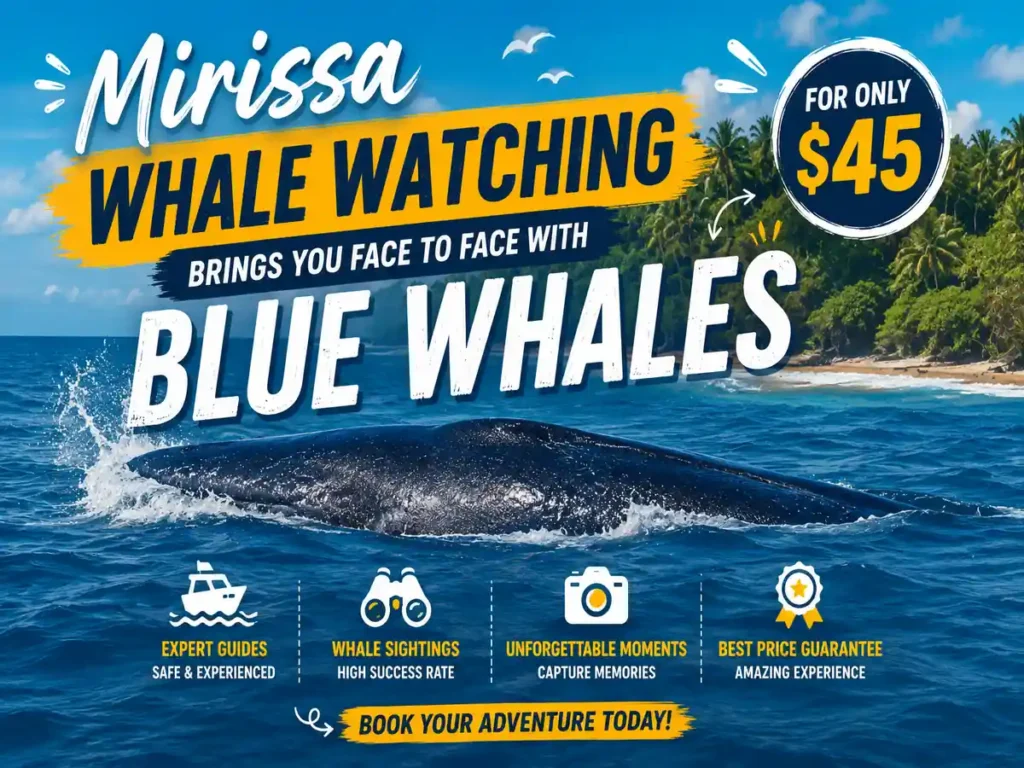
Mirissa whale watching is one of the best ways to see wild blue whales in the world. Boats leave every morning between December and April, and most trips find whales within the first two hours. Tour tickets start at around $45 per person, and sighting rates during peak season go above 90%.
This guide covers everything you need to know before you book a Mirissa whale watching tour, including the best months to go, real 2026 prices, and tips to pick a safe, responsible operator.
What Makes Mirissa Whale Watching So Special?
Mirissa sits right where the continental shelf drops off sharply, so boats reach deep water in under an hour instead of half a day. That is unusually convenient. Blue whales, the largest animals known to have ever existed, follow a migratory route between the Bay of Bengal and the Arabian Sea, and Mirissa happens to sit almost directly in their path. Combine that with calm seas from December to April and a well-developed harbor, and you get one of the most reliable spots on Earth to see a blue whale in the wild.
Best Time to Go Whale Watching in Mirissa
The season runs from November through April, with December to April considered peak. Blue whale sightings tend to spike between late February and mid-March, when whales gather offshore to feed on krill. Outside this window, from May to October, the southwest monsoon churns up the sea, so most operators pause trips altogether or shift their focus to Trincomalee on the east coast instead.
When Is the Best Time for Mirissa Whale Watching?
The best time for Mirissa whale watching is December through April, when the ocean is calmest and sighting rates pass 90%. Late February to mid-March is the sweet spot specifically for blue whales.
Best Season to See Whales in Mirissa: Read more in Best Time to Visit Mirissa So You Don’t Miss the Whales.
Which Whales and Dolphins Can You See?
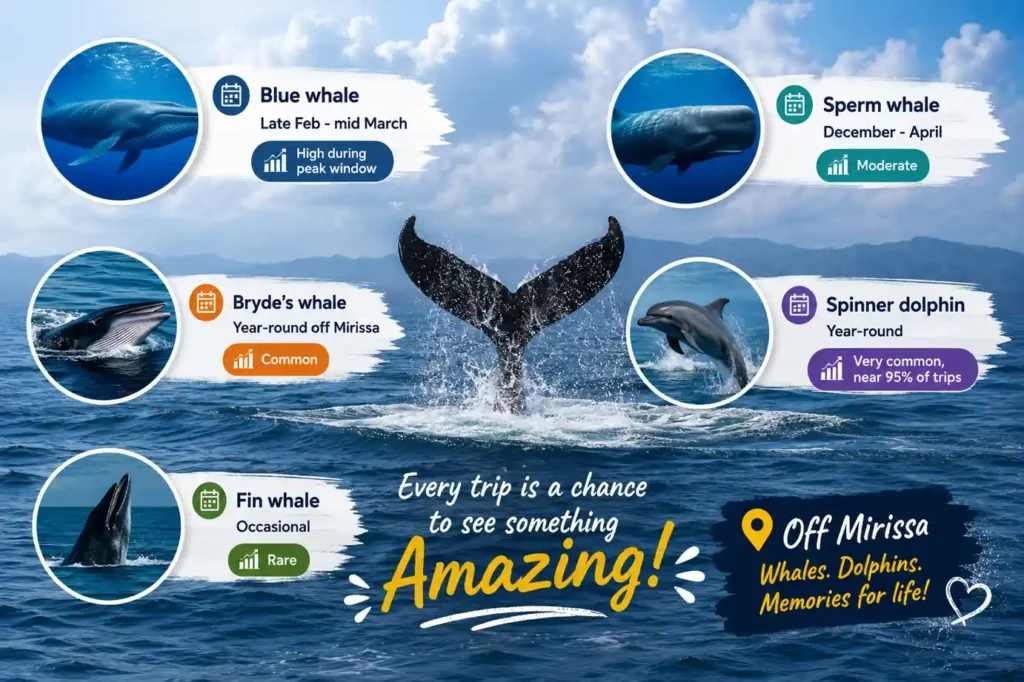
Here is a quick breakdown of what you might spot and roughly when, based on operator and research data.
| Species | Best Months | Sighting Frequency |
| Blue whale | Late Feb – mid March | High during peak window |
| Sperm whale | December – April | Moderate |
| Bryde’s whale | Year-round off Mirissa | Common |
| Spinner dolphin | Year-round | Very common, near 95% of trips |
| Fin whale | Occasional | Rare |
How Whale Watching Tours Work
Most operators run one trip a day, leaving early to catch calmer water and better light. Crews use binoculars, radio updates from nearby boats, and knowledge of feeding patterns to track whales. Once a whale is spotted, boats are supposed to slow down and approach carefully rather than crowding the animal, though this depends heavily on the operator.
Morning vs Afternoon Tours: Which Is Better?
Morning wins, and it is not close. Nearly every operator runs only morning departures because the sea is calmer before 10 AM and whales tend to be more active near the surface early in the day. Afternoon tours are rare in Mirissa and usually only happen when a morning trip gets cancelled due to weather.
How Much Does a Mirissa Whale Watching Tour Cost?
Prices vary depending on boat type and group size, so here is roughly what to expect in 2026.
| Tour Type | Price (2026) | What’s Included |
| Shared boat | $45 – $60 per person | Breakfast, water, life jacket |
| Private speedboat | $150 – $300 per boat | Faster access, smaller group |
| Family/luxury charter | $70 – $90 per person | Extra space, added comfort |
How Much Does Whale Watching Cost in Mirissa?
A standard shared-boat ticket for Mirissa whale watching costs between $45 and $60 per person in 2026, while private charters run higher depending on boat size and how many people are in your group.
Where Do Whale Watching Boats Leave From?
Nearly all tours depart from Mirissa Harbour on the south coast, a short walk or tuk-tuk ride from most guesthouses in town. Some operators also offer pickup from Weligama, Matara, or Galle if you are staying a little further out.
How Long Does the Tour Take?
Expect roughly three to five hours total, though this depends entirely on how quickly whales are found and how the sea behaves that morning. Some lucky trips wrap up in under two hours; others push toward the five-hour mark before the crew calls it a day.
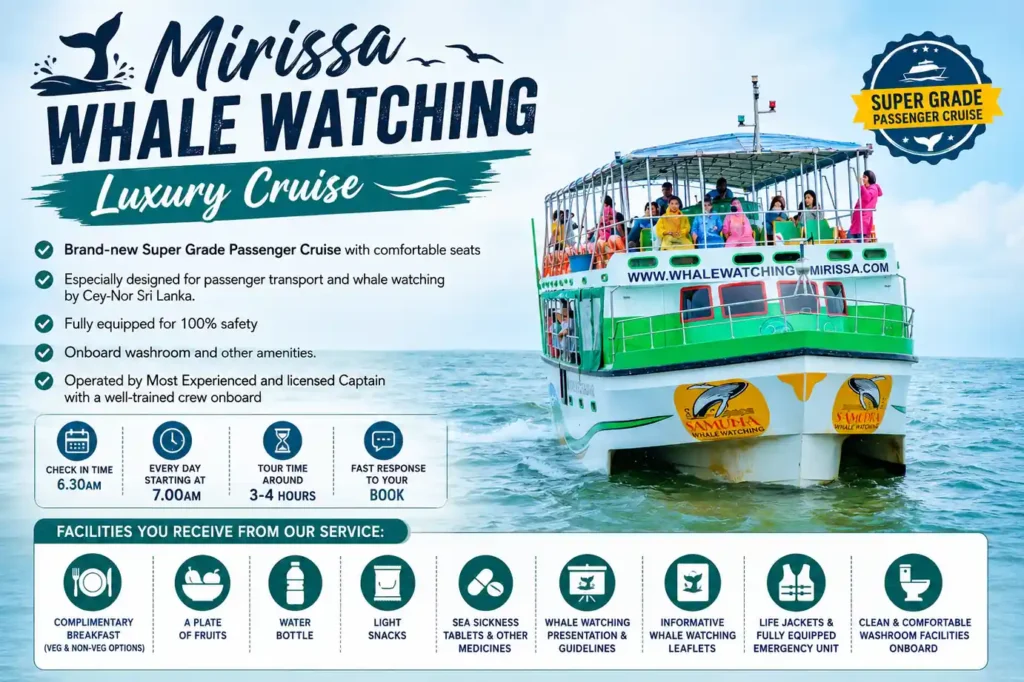
I’d suggest this activity if you want to enjoy whale watching in comfort, with breakfast, hotel pickup, and a professional crew included.
What to Wear and What to Bring
Layers work best, since mornings on the water are breezy but the sun gets strong fast once you are offshore. A few essentials go a long way:
- Sunscreen, a hat, and sunglasses
- A light jacket or windbreaker for the ride out
- Motion sickness tablets, just in case
- A waterproof pouch or dry bag for your phone or camera
- Closed shoes with grip rather than flip-flops
Tips to Avoid Seasickness
Take motion-sickness medication at least 30 minutes before boarding, not after you start feeling queasy. Eat something light beforehand instead of going in on an empty stomach, and skip alcohol the night before. Sitting toward the middle of the boat, where the rocking is less intense, helps more than most people expect.
How to Choose a Responsible Whale Watching Operator
Not every boat follows the rules. Look for operators who keep their distance, avoid chasing or cutting across a whale’s path, and cap group sizes. In Sri Lanka, the Department of Wildlife Conservation enforces a 100-meter minimum approach distance, though on-water enforcement is inconsistent, so choosing your operator carefully matters just as much as the rules themselves. Guidance from the International Whaling Commission also outlines best practices for responsible whale watching worldwide, and it is worth a look if you want to understand what ethical boat behavior actually looks like.
Safety Rules to Follow During the Tour
Always wear the life jacket provided, even once the water feels calm. Stay seated while the boat is moving at speed, and follow crew instructions immediately if conditions turn rough. Reputable operators are registered, often through the local tourism board, so it is worth asking about safety certification before you board if you are unsure.
What Happens if You Don’t See Any Whales?
Sightings are never guaranteed, and honest operators will tell you that upfront. Some companies offer a free repeat trip or a partial refund if nothing is spotted, though this is not standard across the industry. Given the 90%-plus success rate in peak season, most trips do see something, even if it ends up being dolphins rather than whales.
Is Mirissa Whale Watching Worth It?
Yes, Mirissa whale watching is generally worth it during peak season, when calm seas and a narrow continental shelf combine to create one of the highest blue whale sighting rates anywhere in the world. Outside December to April, though, rough seas make it much more of a gamble.
Discover the Best of Mirissa: Read more in Stop! Don’t Book Mirissa Beach Before Reading This.
Common Mistakes First-Time Visitors Make
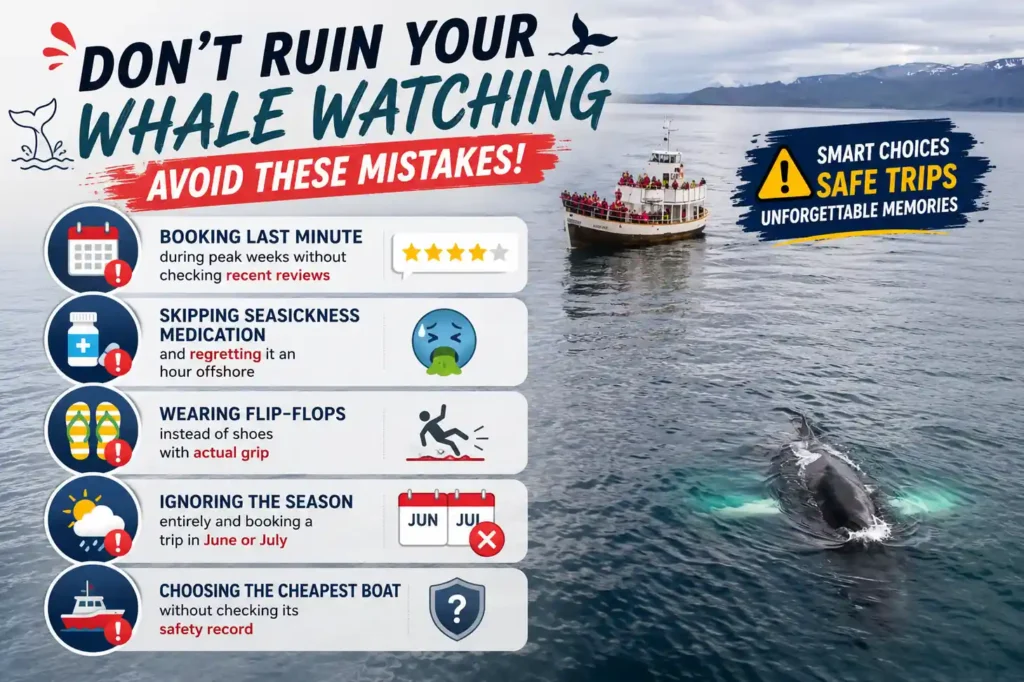
- Booking last minute during peak weeks without checking recent reviews
- Skipping seasickness medication and regretting it an hour offshore
- Wearing flip-flops instead of shoes with actual grip
- Ignoring the season entirely and booking a trip in June or July
- Choosing the cheapest boat without checking its safety record
Should You Book a Mirissa Whale Watching Tour? Here’s the Final Word
For a wildlife experience this rare, Mirissa whale watching is about as good as it gets. A blue whale sighting within your first hour at sea, a 90%+ success rate during peak season, and tickets starting at just $45 make it one of the best value wildlife encounters anywhere in the world, not just in Sri Lanka.
The trade-off is narrow timing: stick to December through April, ideally late February to mid-March for blue whales, and book with a licensed, responsible operator who respects distance guidelines. Get the season and the operator right, and Mirissa whale watching delivers a genuinely unforgettable morning on the water, one most travelers say is worth building their entire south coast itinerary around.
Frequently Asked Questions About Mirissa Whale Watching
Is Mirissa the best place in the world for whale watching?
It is widely regarded as one of the best, mainly because of its unusually high sighting rate and easy access to deep water close to shore.
What time do whale watching boats leave Mirissa Harbour?
Most tours depart between 6:30 AM and 7:00 AM, with a briefing about 30 minutes before departure.
Can children go whale watching in Mirissa?
Yes, most operators welcome families, though very young children can struggle with the length of the trip and choppier stretches of sea.
Is whale watching in Mirissa cruel to the whales?
It can be, if operators approach too fast or too close. Choosing a licensed, distance-respecting operator makes a real difference.
What is the alternative if I miss the Mirissa season?
Trincomalee on the east coast runs its own whale watching season roughly from May to September, giving you another window.