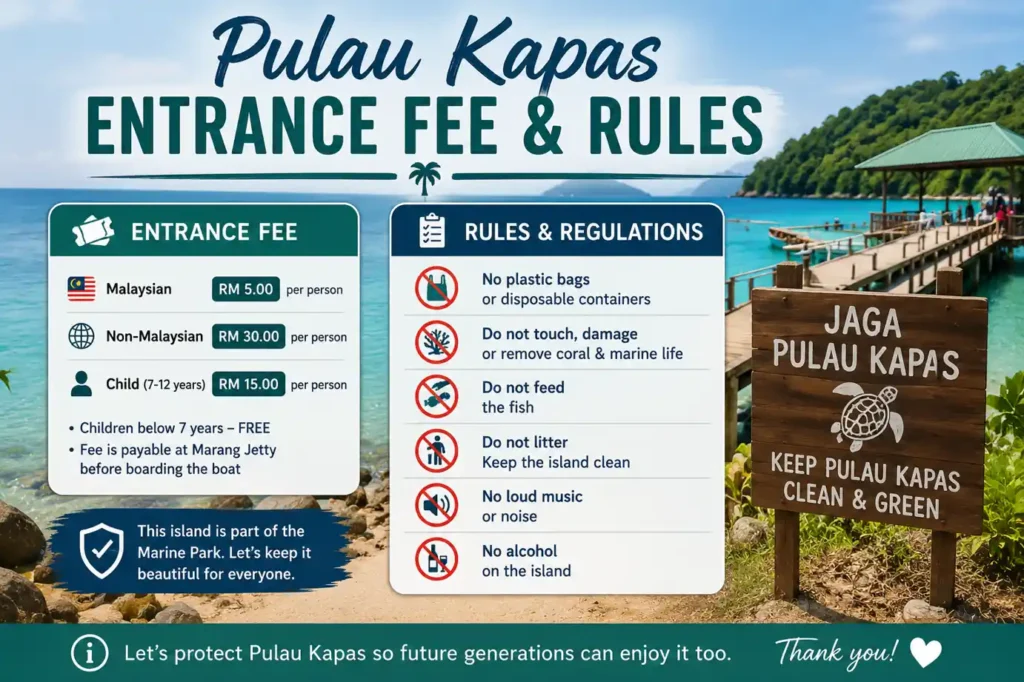
Pulau Kapas entrance fee and rules exist because the island sits inside a protected marine park, so every visitor must pay before boarding the boat. Locals pay RM5 and foreign tourists pay RM30 per person, and this covers coral reef protection and conservation work on the island. The fee is charged once per visit, not per day, so if you’re staying overnight, you don’t need to pay it again the next day.
Looking for a peaceful Malaysian island? This Pulau Kapas travel guide covers beaches, snorkeling, costs, and why travelers are falling in love with it.
Along with the Pulau Kapas entrance fee, there are simple rules too: no touching or standing on coral, no littering, no removing shells or marine life, and no bringing single-use plastics onto some parts of the beach. Knowing the Pulau Kapas entrance fee and rules ahead of time saves you from awkward moments at Marang Jetty, especially since most boat operators only accept cash.
Is There Really an Entrance Fee for Pulau Kapas?
Yes, there is Pulau Kapas entrance fee. Malaysia’s Department of Marine Parks (DMPM), a government body responsible for protecting marine biodiversity along the peninsula’s east coast, manages the Pulau Kapas Marine Park, and the island sits inside it. So when you arrive, you’re technically entering a protected conservation zone, not just any beach.
The Pulau Kapas entrance fee is collected as a marine park conservation charge. It’s not a huge amount, but it’s mandatory. Some visitors assume it’s optional or that small islands don’t bother enforcing it. That’s a mistake. Boat operators and resort staff are well aware of who’s paid and who hasn’t.
Is there an entrance fee for Pulau Kapas?
Yes. Pulau Kapas charges a marine park conservation fee of RM5 for foreigners and RM1 for Malaysian citizens. This is collected separately from your boat ticket and goes toward protecting the island’s coral reefs and marine ecosystem.
Pulau Kapas Marine Park Fee Explained
Malaysia’s Department of Marine Parks, which operates under the Ministry of Natural Resources, Environment, and Climate Change, sets the marine park fee. The fee structure hasn’t changed dramatically in recent years, but you should double-check at Marang Jetty since policies can change seasonally.
What does the fee actually fund? According to DMPM’s conservation framework, charges collected from marine park visitors go directly toward coral reef monitoring, turtle nesting protection programs, and enforcement of no-take zones around the island. So paying it genuinely matters for the ecosystem you’re there to enjoy.
| Visitor Type | Marine Park Fee | Who Collects It | Payment Method |
| Foreign adult | RM5 per person | Marang Jetty/boat operator | Cash (RM only) |
| Malaysian citizen (adult) | RM1 per person | Marang Jetty/boat operator | Cash (RM only) |
| Children under 12 | Free | N/A | N/A |
| Researchers/academics | Waived (permit required) | DMPM office | Official permit |
One thing to note: the marine park fee is per visit, not per day. If you’re staying overnight and leaving the next day, you pay once. Some visitors get confused and think it’s a daily charge. It isn’t.
Boat Ticket Costs From Marang Jetty
The only way to reach Pulau Kapas is by boat from Marang Jetty, which is about 18 km south of Kuala Terengganu. The boat ride takes roughly 15 to 20 minutes, depending on sea conditions. There’s no ferry service; you board a small fibreglass speedboat operated by one of the licensed operators registered with the Terengganu State Fisheries Department.
Return boat tickets typically cost between RM35 and RM45 per person for the round trip. One-way tickets are sometimes available at around RM20 to RM25, but most operators prefer to sell return tickets to manage capacity. Prices can go slightly higher during school holidays and the peak season between March and August.
| Cost Item | Approximate Price (RM) | Notes |
| Return boat ticket (adult) | RM35 – RM45 | Licensed operators at Marang Jetty |
| One-way ticket | RM20 – RM25 | Not always available |
| Marine park fee (foreigner) | RM5 | Separate from the boat ticket |
| Marine park fee (Malaysian) | RM1 | Separate from the boat ticket |
| Life jacket rental (if needed) | RM5 – RM10 | Rare; most operators provide one |
Honestly, the boat ride itself is one of the better parts of the experience. The water turns a different shade of blue once you clear the estuary, and on a clear day, you can see the island before you’re halfway there. Bring a dry bag for your phone and valuables, as waves can splash into the open boat.
Extra Charges Tourists Often Forget About
Beyond the marine park fee and the boat ticket, there are a few other costs that catch first-timers off guard. None of them is huge, but running out of cash on a small island with no ATM is genuinely inconvenient.
- Snorkeling gear rental: RM10 to RM20 per set per day at most resorts and chalets
- Life jacket hire: occasionally charged separately if you didn’t come with one
- Rubbish disposal fee: Some operators charge a small token fee for waste removal from the island
- Accommodation taxes: small chalets sometimes add a 6% service charge that isn’t shown upfront
- Drinking water: No tap water is safe to drink on the island; bottled water is available but priced higher than on the mainland
Bring at least RM200 in cash per person for a day trip, more if you’re staying overnight. There is no ATM on Pulau Kapas. The nearest one is back in Marang town.
Pulau Kapas Rules Every Visitor Should Know

Because Pulau Kapas is a gazetted marine park under Malaysia’s Fisheries Act 1985, specific rules apply that differ from those of a regular beach destination. The Department of Marine Parks Malaysia enforces these regulations, and violators may face fines or a ban from the island.
Most tourists are respectful without being told; the island’s natural beauty makes that easy. But a few rules are less obvious, especially around what you can bring and what you can’t do in the water.
What are the main rules at Pulau Kapas Marine Park?
The key rules cover no coral touching, no fishing without a license, no single-use plastics on the beach, no loud music after 10 PM, no collection of marine organisms, and strict waste management. These are enforced under the Fisheries Act 1985 by DMPM rangers.
Pulau Kapas entrance fee and rules: What You Can’t Bring to the Island
The island operates under a zero-waste-to-sea policy, which means anything you carry in, you carry out. Boat operators registered with the Terengganu Marine Park office are instructed not to bring certain items, and some actively check bags at departure.
- Single-use plastic bags are strictly discouraged and increasingly refused by boat operators
- Styrofoam containers, banned island-wide
- Fishing equipment (spear guns, fish traps, nets) is illegal without a special research permit from DMPM
- Alcohol in large quantities, the island has a soft restriction; no hard rule, but local cultural norms apply
- Spearguns or underwater hunting equipment are absolutely prohibited
- Pets are not permitted on most parts of the island
If you’re wondering about sunscreen, choose a biodegradable, reef-safe formula. Skip standard sunscreens that contain oxybenzone and octinoxate, since these chemicals damage coral reefs. The Reef Check Malaysia organization, which conducts coral health surveys in the region, has specifically flagged chemical sunscreen as a concern in Terengganu’s marine parks.
Beach Rules That Tourists Usually Ignore
Pulau Kapas vs Perhentian Islands one is peaceful and underrated, the other lively and adventure-filled. Find out which fits your travel style better.
There are a few behavioural rules that are posted at Marang Jetty and again at the main beach landing point on the island, but not everyone reads them. Worth knowing before you get there.
- No campfires on the open beach, only at designated fire pits if camping is arranged through a licensed operator
- No loud music after 10 PM, the island is home to sea turtle nesting areas, and artificial noise and light disturb nesting behaviour
- No collection of shells, coral, or sand, even a handful of sand, technically falls under marine park protected material
- No littering, rangers do patrol the island, and fines under the Fisheries Act can be significant
- No feeding of fish or other marine life with outside food, as this disrupts natural feeding behaviour and attracts fish away from reef zones
The Terengganu State Fisheries Department coordinates the sea turtle nesting program on Pulau Kapas alongside volunteer conservation groups. During nesting season, which typically runs from May through August, officials restrict beach access near nesting zones after dark. Respect these restrictions; they exist for good reason.
Are there snorkeling rules at Pulau Kapas?
Yes. No touching or standing on coral, no chasing or harassing marine life, no spearfishing, no anchoring boats on reef zones, and always wear a life jacket if you’re not a confident swimmer. These rules apply throughout the marine park area.
Snorkeling and Swimming Safety Rules

The snorkeling here is genuinely good. The reef around the island is healthier than many of Malaysia’s more popular dive destinations, partly because visitor numbers are still manageable. The Marine Conservation Society Malaysia has noted Pulau Kapas in regional reef health assessments as one of the better-preserved nearshore reef systems in Terengganu.
- Never touch, stand on, or collect coral, even dead coral forms part of the reef structure
- Keep a safe distance from sea turtles, DMPM guidelines recommend at least two metres
- Snorkel within designated swimming zones marked by buoys
- Don’t use gloves, it encourages touching; this is banned in many marine parks across Southeast Asia
- Always snorkel with a buddy; there are no lifeguards stationed on the island
Can You Camp on Pulau Kapas?

Yes, you can camp on Pulau Kapas, but you must arrange it through a licensed resort or chalet operator; you can’t simply pitch a tent wherever you like. The island doesn’t have designated public campgrounds in the way some national parks do. Instead, campers usually book a camping package through one of the established operators like Kapas Island Resort or Primula Kapas Island, which provide tent space, basic toilet access, and sometimes meals.
| Camping Detail | Information |
| Is free camping allowed? | No, must book through a licensed operator. |
| Average camping package cost | RM30 – RM60 per person per night |
| Facilities included | Basic toilet, water access, fire pit (some operators) |
| Season availability | March to October (island closes roughly Nov–Feb) |
| Reservation required? | Yes, contact the operator before travelling to Marang Jetty. |
The island effectively closes to visitors between November and February due to the monsoon season. The Department of Marine Parks Malaysia officially advises against visiting during this period, and most boat operators suspend services. If you’re planning around the monsoon window, confirm the exact dates with Marang Jetty operators directly; the opening date can shift by a week or two depending on sea conditions.
Drone Rules and Photography Restrictions
Drones are a sensitive topic at Pulau Kapas. Malaysia’s Civil Aviation Authority (CAAM) requires drone operators to obtain a permit for commercial use, and flying over a marine park adds another layer of restriction. In practice, drone flying over the island is not recommended without prior authorisation from both CAAM and the Department of Marine Parks Malaysia. Enforcement isn’t constant, but rangers have the authority to confiscate equipment.
- Personal photography: fully allowed and encouraged, no restrictions
- Drone flying (recreational): technically requires CAAM notification even for hobbyists
- Commercial drone/video work: full permit from CAAM and DMPM required
- Underwater photography: allowed, but no flash photography near turtle or ray resting zones
If you’re a photographer and you want to do any kind of drone work legally, apply through CAAM’s online permit system at least two to three weeks before your trip. The permit is not guaranteed and can take time to process.
Rules for Foreign Tourists vs Locals

The basic rules of the marine park apply to everyone equally. However, there are a few practical differences worth knowing.
| Aspect | Foreign Tourists | Malaysian Citizens |
| Marine park fee | RM5 per visit | RM1 per visit |
| Language of signage | English and Malay in the main areas | Full Malay signage throughout |
| Permit applications | Via DMPM Kuala Terengganu office or online | Same process |
| Access restrictions | Same as locals except research zones | Same |
| Fishing | Not permitted without a permit (same rule) | The same rule applies |
When is the best time to visit Pulau Kapas?
March to June is the sweet spot. The weather is stable, the water is calm, visibility for snorkeling is at its best (often 10 to 15 metres), and visitor numbers are lower than the July–September peak. Avoid November through February due to the monsoon season.
Best Time to Visit Pulau Kapas Without the Crowds

The best window is March through early July. By August and September, school holiday crowds from Kuala Lumpur and other cities start picking up, and the island feels noticeably busier. Malaysian school holidays in particular bring larger groups of domestic tourists, which affects the otherwise quiet atmosphere.
Early mornings on any day are also significantly quieter. If you’re on the island, getting in the water by 7:30 or 8 AM means you’re snorkeling before most day-trippers even board the boats at Marang. That window of about two hours is genuinely the best the island offers.
Things to Pack Before Heading to Pulau Kapas
- Reef-safe sunscreen (SPF 50+, biodegradable formula)
- Cash in Malaysian Ringgit, RM200 minimum for a day trip
- Dry bag or waterproof phone case, the boat ride can get splashy
- Snorkeling gear (optional), can rent on the island, but bringing your own is more hygienic)
- At least 1.5 litres of water per person, more in peak heat
- Light rash guard or long-sleeved swim top, sun exposure on the water is intense
- Insect repellent, sandflies are active near the treeline at dusk
- Small reusable bag for rubbish, pack-in, pack-out is expected
- Printed or downloaded confirmation if you’ve pre-booked accommodation
- Basic first-aid kit; nearest hospital is in Marang or Kuala Terengganu
Common Mistakes First-Time Visitors Make
The biggest one is arriving at Marang Jetty without enough cash. There’s no ATM at the jetty and no card payment option for most boat operators. Sort your Ringgit before you leave wherever you’re staying.
Second is underestimating the sun. Pulau Kapas has limited shade on most of its beaches, and the reflection off the water makes UV exposure significantly stronger than people expect. People who’ve been to Bali or Thailand often assume they know how to handle tropical sun. Kapas will humble you if you’re not careful.
Third, and this one’s for the snorkeling fans, is not checking tides before getting in the water. The reef at low tide in some areas can be very shallow. Standing on coral, even accidentally, is not just against the rules; it causes real damage that takes years to heal. The World Wildlife Fund Malaysia and local marine NGOs have both flagged reef damage from uninformed snorkelers as a growing concern in Terengganu’s marine parks.
Quick Travel Tips for a Smooth Pulau Kapas Trip
- Book your boat ticket in advance during school holidays; seats fill up, and operators sometimes run fixed departure times
- Arrive at Marang Jetty by 8 AM to catch the first boats and get the most time on the island
- Confirm boat return times before you disembark; missing the last boat is a real possibility
- Tell your accommodation if you’re staying overnight; the island is small, but communication between operators and the jetty matters
- Register with your resort or chalet before camping. Ranger patrols sometimes ask unregistered campers to leave.
- Don’t book unofficial operators outside the jetty area; only use operators registered with the Terengganu Marine Park office
Before You Book Your Trip
Pulau Kapas is one of those islands that rewards people who show up prepared. Knowing the Pulau Kapas entrance fee and rules ahead of time isn’t just about avoiding fines; it’s about actually understanding the place you’re visiting. The marine park fee, the conservation rules, and the waste management expectations all exist because someone decided this reef was worth protecting. And honestly, once you’re in that water and you see what’s underneath, you’ll agree.
The island isn’t trying to be Perhentian or Redang. It’s smaller, quieter, and in some ways more honest. With the right preparation, cash, reef-safe sunscreen, a sense of respect for the rules, a trip to Pulau Kapas can be one of the genuinely memorable things you do in Malaysia. Plan well, follow the Pulau Kapas entrance fee and rules guidelines above, and the island will absolutely deliver.
Frequently Asked Questions
Q1: How much is the Pulau Kapas entrance fee for foreigners?
Foreign visitors pay a marine park conservation fee of RM5 per person per visit. This is separate from your boat ticket and is collected at Marang Jetty or by the boat operator. Malaysian citizens pay RM1, and children under 12 are usually exempt.
Q2: What is the boat ticket price from Marang Jetty to Pulau Kapas?
Return boat tickets cost approximately RM35 to RM45 per adult. One-way tickets are sometimes available at RM20 to RM25, but not all operators offer them. Prices may be slightly higher during school holidays and peak season.
Q3: Can I bring food and drinks to Pulau Kapas?
Yes, you can bring your own food. However, avoid styrofoam containers and single-use plastics, since the island prohibits them. You must carry your rubbish back off the island, and park authorities enforce this rule.
Q4: Is it safe to swim and snorkel at Pulau Kapas?
Generally, yes, especially during the dry season (March to October). Always snorkel within designated zones, wear a life jacket if you’re not a strong swimmer, and never touch coral. There are no lifeguards on the island.
Q5: When is Pulau Kapas closed to visitors?
The Northeast Monsoon effectively closes the island roughly from November to February. Most boat operators suspend services during this period. The exact dates vary by year; confirm with Marang Jetty operators before travelling.
Q6: Can I fly a drone over Pulau Kapas?
Not without the proper permits. Recreational drone use requires notification to Malaysia’s Civil Aviation Authority (CAAM), and commercial drone work additionally requires clearance from the Department of Marine Parks Malaysia. Flying without permits risks equipment confiscation.
Q7: Is camping allowed on Pulau Kapas?
Yes, but only through licensed operators. The park bans free camping without operator arrangements. Camping packages typically cost RM30 to RM60 per person per night and include basic toilet access. Always book before arriving at Marang Jetty.