
The Pulau Kapas Ferry leaves from Marang Jetty in Terengganu and takes you across 6 kilometres of open sea to reach the island. The trip is short, usually around 15 to 20 minutes, and boats run daily from about 9am until 5pm, depending on the operator and the weather.
A standard return ticket for the Pulau Kapas Ferry costs around RM35 for adults, with a lower price for children, and you pay a separate marine park fee when you arrive. Boats leave when they have enough passengers rather than on a fixed timetable, so it helps to reach the jetty early, especially on weekends and public holidays when demand is higher.
Where Is the Pulau Kapas Ferry Departure Point?
All ferries to Pulau Kapas depart from Marang Jetty, which sits right in Marang town on the Terengganu coast. The jetty is operated under the oversight of the Terengganu State Forestry Department and the Marine Park authority, which adds a layer of official structure to what might otherwise feel like a casual fishing boat operation.
Marang itself is a small, quiet coastal town, with nothing glamorous about it. But that’s fine. You’re not there for Marang. The jetty is the functional gateway, and it does that job well. There are ticketing counters, a few food stalls nearby, and basic waiting space. Don’t expect an airport-style terminal. It’s simple, a little noisy in the morning rush, and very much a working fishing jetty.
How to Reach Marang Jetty Without the Confusion
This is where a lot of visitors lose time. Marang Jetty isn’t always obvious on Google Maps, and directions can take you to the wrong end of town if you’re not careful.
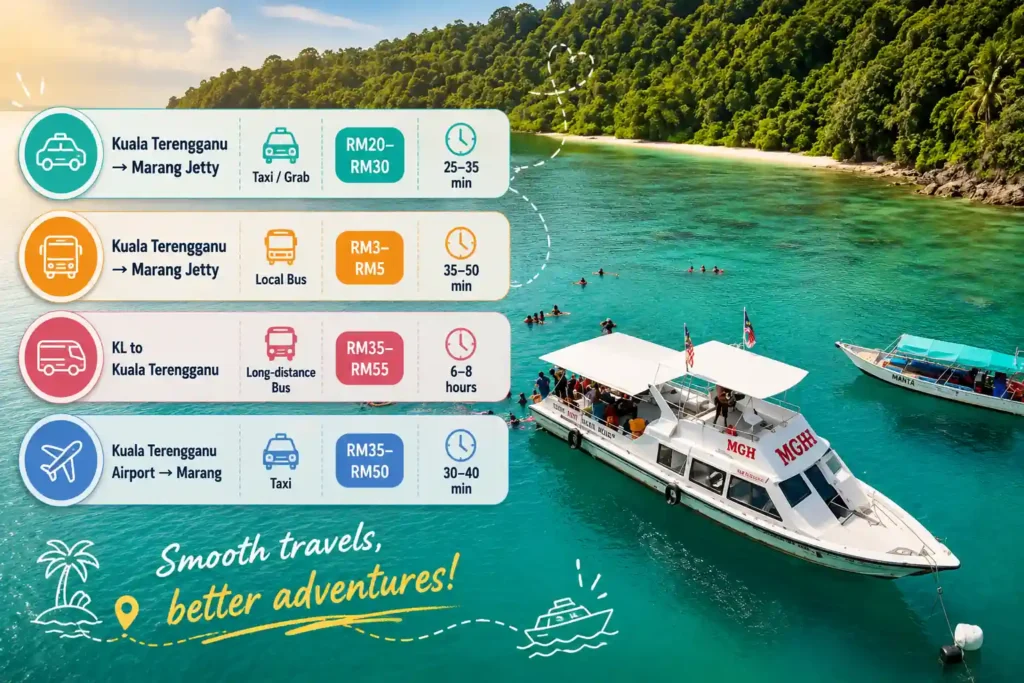
From Kuala Terengganu, the most straightforward option is a taxi or Grab, which typically costs around RM20 to RM30 and takes 25 to 35 minutes depending on traffic. Bus options also exist; the Kuala Terengganu to Marang route runs regularly and costs roughly RM3 to RM5, dropping you in central Marang from where the jetty is a short walk or short ride.
If you’re coming from Kuala Lumpur by bus, the KLIA2 to Terengganu route is popular, and several operators like Transnasional and Sri Maju connect major cities to Kuala Terengganu. From there, you continue to Marang separately.
Read more about Pulau Kapas vs Langkawi and discover which Malaysian island actually matches the kind of trip you want.
| Route | Mode | Approx. Cost | Travel Time |
| Kuala Terengganu → Marang Jetty | Taxi / Grab | RM20–RM30 | 25–35 min |
| Kuala Terengganu → Marang Jetty | Local Bus | RM3–RM5 | 35–50 min |
| KL to Kuala Terengganu | Long-distance Bus | RM35–RM55 | 6–8 hours |
| Kuala Terengganu Airport → Marang | Taxi | RM35–RM50 | 30–40 min |
Pulau Kapas Ferry Timings: Most Travelers Miss
Here’s something most articles won’t tell you: ferry timings are not fixed in the way flight schedules are. Boats run when there are enough passengers, and the official window is generally between 8:00 AM and 5:30 PM daily. In practice, you’ll see the busiest departures between 9:00 AM and 11:00 AM, with another cluster around 2:00 PM to 3:00 PM.
The Marang Jetty operators follow guidelines set partly by the Terengganu Marine Park regulations, which restrict access during the annual monsoon closure, typically from November 1 to March 1. This is enforced seriously. The island effectively shuts down for tourism during that period, and no ferry operators will make the crossing.
Morning vs Afternoon Departures
Morning departures are genuinely preferable. You get the calmer seas, better light for photography, and more time on the island if you’re doing a day trip. Afternoon crossings are fine, but leave you with fewer daylight hours and sometimes rougher water.
I made the mistake on my first visit of arriving at the jetty at 11:30 AM, thinking I’d hop on a boat immediately. There was a wait of nearly an hour because the morning rush had just cleared, and the next organised group wasn’t assembling until 12:30 PM. Lesson learned: Arrive before 9:30 AM if you can.
Ferry Ticket Prices in 2026
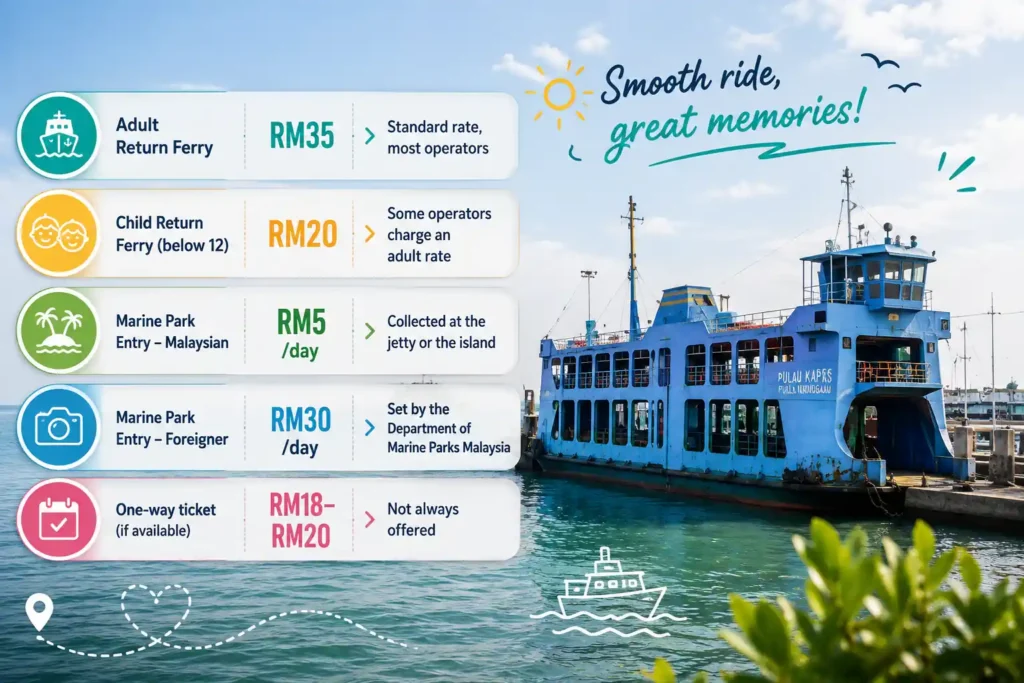
As of 2026, the standard return ferry ticket from Marang Jetty to Pulau Kapas costs approximately RM35 per adult and RM20 per child. Some operators bundle the return trip into a single payment upfront, while others collect each way separately.
Marine Park entrance fees are charged separately at RM5 per person per day for Malaysian residents and RM30 for international visitors, as set by the Department of Marine Parks Malaysia.
| Ticket Type | 2026 Price (RM) | Notes |
| Adult Return Ferry | RM35 | Standard rate, most operators |
| Child Return Ferry (below 12) | RM20 | Some operators charge an adult rate |
| Marine Park Entry – Malaysian | RM5/day | Collected at the jetty or the island |
| Marine Park Entry – Foreigner | RM30/day | Set by the Department of Marine Parks Malaysia |
| One-way ticket (if available) | RM18–RM20 | Not always offered |
Prices can shift slightly by operator and season, so it’s worth confirming on arrival. That said, RM35 return is the most consistent number I’ve seen across multiple visits and has been confirmed by local operators at the jetty as of early 2026.
How much does the Pulau Kapas ferry cost?
The standard return ferry ticket costs approximately RM35 per adult in 2026. Children under 12 typically pay RM20. Marine Park entrance fees are separate: RM5 for Malaysians and RM30 for international visitors, as required by the Department of Marine Parks Malaysia.
Read more to see why Pulau Kapas is becoming one of Malaysia’s most talked-about quiet island escapes.
How Long Does the Ferry Ride Actually Take?
The crossing from Marang Jetty to Pulau Kapas takes roughly 15 to 25 minutes under normal sea conditions. The distance is about 6 kilometres, and the speedboats used by most operators cover it quickly. In choppy conditions during the shoulder months (late September or early October), the crossing can feel longer and bumpier, but it’s never particularly dangerous for healthy adults.
How long is the ferry from Marang to Pulau Kapas?
The ferry ride from Marang Jetty to Pulau Kapas takes approximately 15 to 25 minutes, depending on sea conditions and the type of boat. Speedboats are used by most operators, and the distance is around 6 kilometres.
Best Time to Take the Ferry to Pulau Kapas
The island is open to visitors from approximately March through October, with peak season running from May to August. During this window, the sea is calm, visibility for snorkelling is at its best, and ferry departures are frequent and reliable.
July and August are the busiest months because of Malaysian school holidays. The Terengganu State Education Department typically sets holidays in waves, and local families flood the island during these windows. If you want the island at its quietest while it’s still open, aim for late March, April, or late September to October.
What is the best time to take the Pulau Kapas ferry?
The best time to take the ferry is between May and August for calm seas and clear water. For a quieter experience, visit in April or late September. The ferry does not operate between November and February due to the monsoon closure enforced by Malaysian Marine Park authorities.
What the Ferry Ride Feels Like
Honestly? It’s one of the better parts of the trip. The boats are open or semi-covered speedboats with bench seating for 10 to 20 passengers, typically. The sea air hits you immediately once you leave the jetty, and within minutes, you’re watching Marang disappear behind you while a small green island slowly grows on the horizon.
The water colour changes noticeably as you get further out, shifting from the murky brown near the river mouth to clear blue-green as you approach the island. On a sunny morning with calm conditions, this is genuinely beautiful. Even on overcast days, there’s something quietly exciting about it.
Do keep a light jacket or a dry bag for your electronics. Spray from the bow can surprise you, especially in the front seats. I got my phone wet once. Once was enough.
Things to Know Before Boarding the Ferry
A few practical things that make the experience smoother:
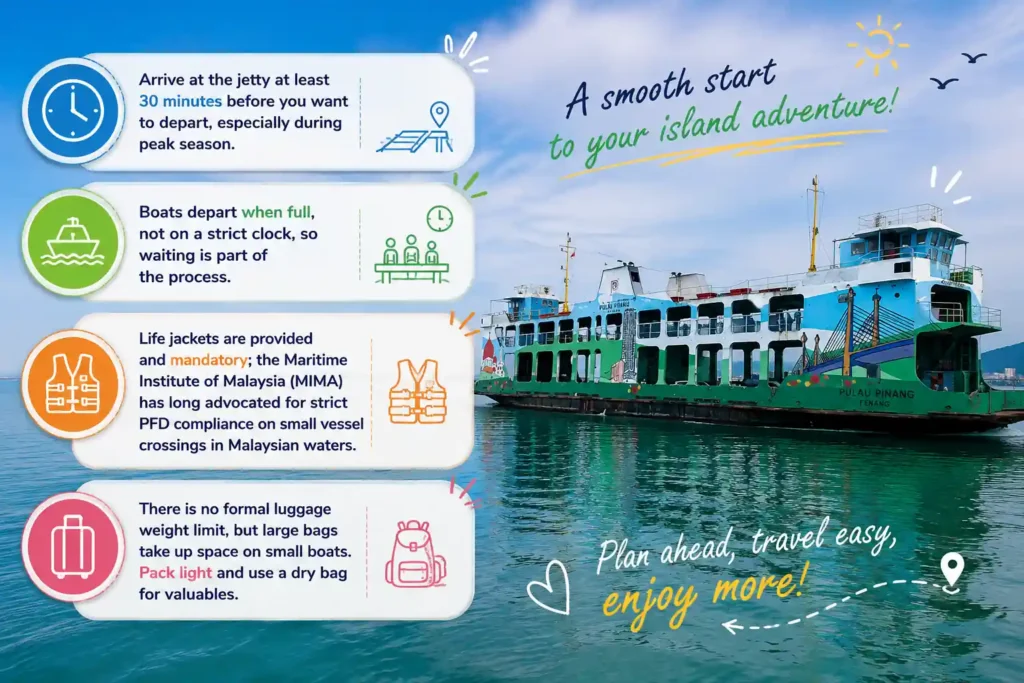
- Arrive at the jetty at least 30 minutes before you want to depart, especially during peak season.
- Boats depart when full, not on a strict clock, so waiting is part of the process.
- Life jackets are provided and mandatory; the Maritime Institute of Malaysia (MIMA) has long advocated for strict PFD compliance on small vessel crossings in Malaysian waters.
- There is no formal luggage weight limit, but large bags take up space on small boats. Pack light and use a dry bag for valuables.
- Cash is essential. The jetty ticketing counters are cash-based in most cases, and there are no ATMs at Pulau Kapas.
- Sunscreen is recommended before you board, not after. The open water crossing under a clear sky burns faster than you’d expect.
Can You Book Pulau Kapas Ferry Tickets Online?
Short answer: mostly no, not through any central booking platform. Most ferry operators at Marang Jetty are independent boat owners who sell tickets directly at the counter. There’s no equivalent of a Grab Taxi booking experience here.
Some island resorts, like Gem Island Resort & Spa or Kapas Island Chalet, bundle ferry transfers as part of accommodation packages. If you’re staying on the island, checking whether your resort offers this is the closest thing to online booking you’ll get.
A few unofficial third-party travel websites claim to book Pulau Kapas ferry seats, but results vary. The most reliable approach is simply showing up at Marang Jetty on the morning of your intended trip. This has worked smoothly across every visit I’m aware of, even during the busier school holiday windows.
Can I book the Pulau Kapas ferry online?
There is no centralised online booking system for the Pulau Kapas ferry. Tickets are sold directly at Marang Jetty on a first-come, first-served basis. Some island resorts bundle ferry transfers with accommodation bookings. Arriving early is the best strategy.
What Happens During Bad Weather?
This is genuinely important to know before you plan your trip. Ferry operators have full discretion to cancel or delay crossings based on sea conditions. The Malaysian Meteorological Department (MetMalaysia) provides marine weather bulletins that operators reference, and responsible captains take them seriously.
If conditions are rough, you will not get on a boat. There’s no compensation or automatic rebooking. Most operators are understanding about refunding tickets if conditions make crossing impossible, but this isn’t guaranteed, and it depends on the operator.
The safest practice is to check MetMalaysia’s marine forecast for the Terengganu coastal zone the night before you plan to travel. Build in a backup day if your trip is time-sensitive. Trying to pressure a boat operator into crossing in unsafe conditions is something no experienced traveller should attempt, and most won’t entertain it.
What happens to the Pulau Kapas ferry in bad weather?
Operators cancel crossings at their own discretion based on sea conditions. The Malaysian Meteorological Department (MetMalaysia) provides marine weather data for the Terengganu coast. No formal rebooking system exists. Always check the forecast the night before and build a flexible itinerary.
Ferry Tips for Families and First-Time Visitors
If you’re travelling with young children, a few things are worth thinking about ahead of time. The boats are small and open, and young kids can get nervous if the crossing is choppy. Sitting in the middle of the boat reduces movement significantly. Bring a light change of clothing for little ones in case of spray.
For first-timers, generally, the experience is rarely as dramatic as the lack of information online might make it seem. Thousands of visitors make this crossing every year without incident. According to the Terengganu Tourism Board, Pulau Kapas receives an average of over 20,000 visitors annually during the open season, and the ferry operation has a strong safety record.
One thing worth flagging: the return jetty on the island side is a simple floating pontoon. There’s no elaborate infrastructure. You flag down boats or coordinate with your resort, and departures back to Marang are arranged at the island rather than pre-booked.
What to Pack for the Boat Ride
| Item | Why It Matters |
| Dry bag or ziplock for electronics | Spray from the bow is common. |
| Cash (RM) | No card terminals at the jetty or island |
| Water bottle | Stay hydrated before and after the crossing. |
| Light jacket or windbreaker | Sea breeze can be cold in the mornings. |
| Sunscreen (apply before boarding) | Open water sun exposure is intense |
| Snacks | No food on the ferry; limited options on the island |
| Snorkel gear (optional) | Rentals are available on the island, but pricey. |

Returning From Pulau Kapas: Ferry Back to Marang
Getting back is broadly the same process in reverse, though the island side is even less formal. Most operators run the last return boat around 5:00 PM to 5:30 PM, and missing it means staying the night, which isn’t a disaster, but it’s an unplanned expense.
If you’re doing a day trip, aim to start heading to the island jetty by 4:00 PM at the latest. Coordinating with your resort or with the captain who dropped you off is the norm. Some day-trippers arrange a return time directly with their boat operator in the morning, which is genuinely the most reliable approach.
What time is the last ferry back from Pulau Kapas?
The last ferry from Pulau Kapas to Marang Jetty typically departs between 5:00 PM and 5:30 PM. Exact timings vary by operator and season. Day-trippers should start moving toward the island jetty no later than 4:00 PM to avoid missing the final boat.
Common Ferry Mistakes Tourists Make
- Arriving too late in the morning and missing the peak departure window.
- Not bringing enough cash, the island has no ATMs, and most vendors are cash-only.
- Visiting between November and February without knowing the monsoon closure applies.
- Underestimating the sun on the open crossing and getting burned before reaching the beach.
- Forgetting to arrange a return time with the ferry operator in the morning.
- Leaving valuables unsecured in bags that get wet from spray.
- Expecting strict timetables, this is a demand-based operation, not a scheduled service.
Is the Pulau Kapas Ferry Worth It?
Without question. The crossing itself is short and manageable, and what’s on the other side of it is one of the genuinely beautiful islands on Malaysia’s east coast. The Marine Park status, enforced by the Department of Marine Parks Malaysia, means the coral and marine life around Pulau Kapas are protected and remain in excellent condition compared to more commercial island destinations.
For context, Marine Park Malaysia data indicates that Pulau Kapas sits within a protected zone covering approximately 2,000 hectares of marine habitat. The visibility for snorkelling regularly hits 10 to 15 metres in the dry season, which is exceptional by regional standards.
The ferry ride is the first part of an experience that’s hard to replicate elsewhere on the peninsula. It’s genuinely one of those places that doesn’t disappoint when you’ve planned it well. And now, with a proper Pulau Kapas ferry guide in hand, you’re set up to do exactly that.
Frequently Asked Questions
Q1: Where does the Pulau Kapas ferry depart from?
All ferries to Pulau Kapas depart from Marang Jetty, located in Marang town on the Terengganu coast of Peninsular Malaysia. It’s approximately 15 kilometres south of Kuala Terengganu city centre.
Q2: How much is the ferry ticket to Pulau Kapas in 2026?
The standard return ferry ticket costs approximately RM35 per adult. Children under 12 typically pay around RM20. Marine Park entrance fees are additional: RM5 for Malaysians and RM30 for international visitors.
Q3: How long does the Pulau Kapas ferry ride take?
The crossing takes approximately 15 to 25 minutes under normal sea conditions. The distance from Marang Jetty to the island is about 6 kilometres.
Q4: Can I take the Pulau Kapas ferry during the rainy season?
No. The island is closed to tourism from approximately November 1 to March 1 each year due to the northeast monsoon. This closure is enforced by Malaysian Marine Park authorities, and no ferries operate during this period.
Q5: Is there an online booking system for the Pulau Kapas ferry?
There is no centralised online booking platform. Tickets are sold directly at Marang Jetty on the day of travel. Some island resorts include ferry transfers as part of accommodation packages, which is the closest to booking available.
Q6: What time does the last ferry leave Pulau Kapas?
The last ferry back to Marang typically departs between 5:00 PM and 5:30 PM. This varies by operator and season. Day-trippers should start heading to the island jetty by 4:00 PM at the latest.
Q7: Is the Pulau Kapas ferry safe?
Yes. Life jackets are mandatory on all crossings, in line with guidelines from the Maritime Institute of Malaysia (MIMA). Operators cancel trips in unsafe sea conditions. The route has a strong safety record, with over 20,000 visitors per year during the open season, according to the Terengganu Tourism Board.
Q8: Do I need to pay a Marine Park entrance fee separately?
A: Yes. The Marine Park entrance fee is charged separately from the ferry ticket. It is set by the Department of Marine Parks Malaysia at RM5 per day for Malaysian residents and RM30 per day for international visitors.