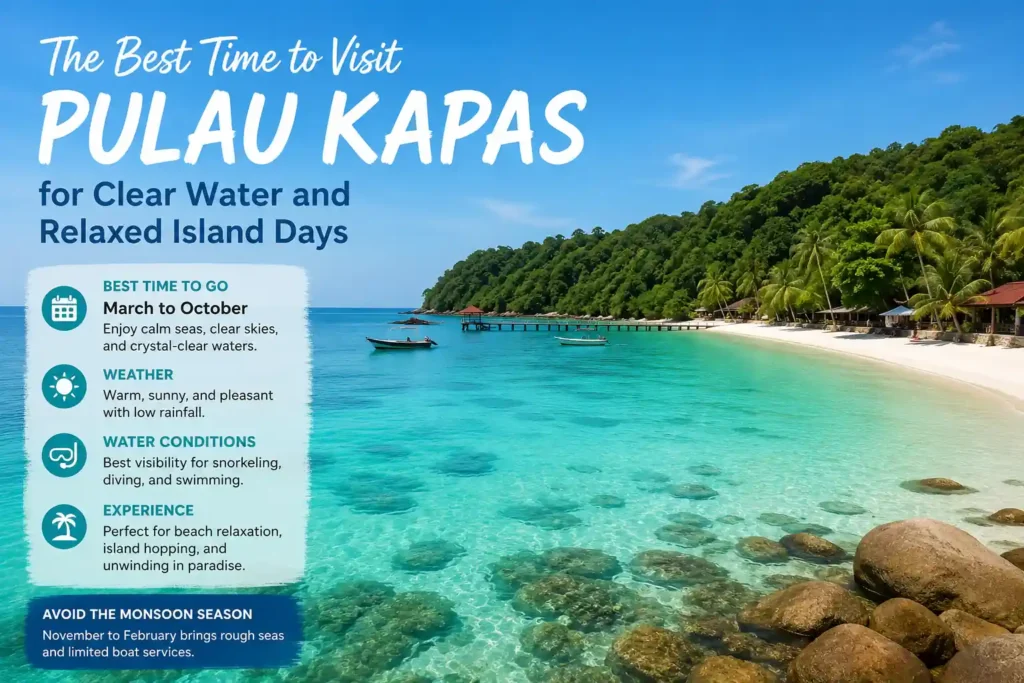
The best time to visit Pulau Kapas is between March and October, when the sea stays calm and the sky is mostly clear. June, July, and August offer the best conditions of all, with flat water, strong sunshine, and excellent visibility for snorkeling around the reefs. If you travel outside this window, you risk arriving when ferries stop running and resorts close for the season. This is why choosing the best time to visit Pulau Kapas matters more than picking a specific resort or itinerary.
Looking for a peaceful Malaysian island? This Pulau Kapas travel guide covers beaches, snorkeling, costs, and why travelers are falling in love with it.
From November to February, the northeast monsoon brings rough seas and heavy rain, cutting the island off from the mainland completely. Outside those months, Kapas stays calm, warm, and easy to reach, making it one of the most reliable island escapes on the Terengganu coast.
Where Is Pulau Kapas Located?

Pulau Kapas sits roughly 6 kilometers off the coast of Marang, a small fishing town in Terengganu on Malaysia’s east coast. The island covers about 25 hectares and is part of the Terengganu Marine Park, gazetted and managed under the Department of Marine Park Malaysia (DMPM), which actively protects its coral reefs and beach ecosystems.
The nearest major town is Kuala Terengganu, about 20 kilometers north of Marang. Access is by licensed speedboat only from Marang Jetty, and the crossing takes roughly 15 to 20 minutes depending on sea conditions.
Why Pulau Kapas Is Famous Among Travelers
The name “Kapas” literally means “cotton” in Malay, a nod to the brilliant white sand beaches that wrap around the island’s shoreline. The Terengganu Tourism Board consistently lists Pulau Kapas as one of the state’s top island destinations alongside Pulau Redang and the Perhentian Islands, though it sees far fewer visitors than either of those.
What makes it genuinely different is scale. No cars, no shopping strips, no crowds in any meaningful sense. A handful of budget chalets, a couple of mid-range resort properties, and water so clear you can see the sandy bottom from the boat before you’ve docked. The Department of Marine Park Malaysia prohibits fishing and anchoring on coral in the protected zone, which means marine life has genuinely recovered here over the past decade.
When is the best time to visit Pulau Kapas?
March to October. The sweet spot is June through August, when sea conditions are calmest, underwater visibility regularly exceeds 8 to 10 meters, and the island gets its most consistent sunshine. If you want fewer people and lower prices without sacrificing good weather, May is also an excellent choice.
Best Time to Visit Pulau Kapas for Good Weather

The Malaysian Meteorological Department (MetMalaysia) classifies Terengganu’s east coast as having two distinct seasons. The dry season runs from roughly March to October, and the northeast monsoon dominates from November to February. For Pulau Kapas specifically, this division is sharp because the island sits exposed to the South China Sea with very little landmass to buffer it.
The Dry Season: March to October
March and April mark the start of the dry season. Conditions are mostly good but can still have occasional downpours, particularly in the mornings. Think of these as early-season months: nice but not perfect.
By May, things genuinely settle. Swells reduce, skies clear, and the water picks up that turquoise color that makes East Coast Malaysia so photogenic. June through August is statistically the driest and calmest stretch according to historical records from MetMalaysia, with temperatures averaging a comfortable 28 to 32 degrees Celsius during the day.
September and October are still solid, but afternoon storms become more common as the season winds down. By late October, some accommodation operators start preparing for monsoon closure.
Pulau Kapas Weather by Month
| Month | Conditions | Avg Temp | Recommended? |
| January | Northeast monsoon, rough seas, most resorts closed | 26°C | No |
| February | Still monsoon, improving in the late months | 26°C | No |
| March | Transitional, some rain, mostly accessible | 28°C | Yes (early season) |
| April | Good weather building, mild swells | 29°C | Yes |
| May | Excellent conditions, noticeably quiet | 30°C | Yes |
| June | Peak dry season, very calm seas | 31°C | Best |
| July | Best conditions, school holiday month | 32°C | Best |
| August | Still peak, some Malaysian holiday crowds | 32°C | Best |
| September | Good, but afternoon storms are possible | 31°C | Yes |
| October | Transitional, some operators close late in the month | 29°C | Yes (early) |
| November | Monsoon begins, and ferries are unreliable | 27°C | Avoid |
| December | During the monsoon peak, the island is largely inaccessible | 26°C | No |
When is snorkeling best at Pulau Kapas?
May through August give you the best snorkeling conditions. Water clarity during these months regularly hits 8 to 10 meters or more, based on data reported by local dive operators certified under the Department of Marine Park Malaysia. Expect reef fish, sea turtles, and healthy hard coral coverage on the reefs surrounding both Kapas and the nearby Pulau Gemia.
Best Season for Snorkeling and Island Activities

During peak dry season, the water around Kapas takes on that particular shade of blue-green that you see in travel photos and assume has been heavily edited. Standing on the island jetty in late July, the seabed below is visible without needing to squint. According to coral monitoring data from WWF Malaysia, protected East Coast island sites within the Terengganu Marine Park zone have shown measurable coral recovery over the past decade, largely due to stricter regulations enforced by the DMPM.
Activities you can realistically enjoy during peak dry season:
- Snorkeling from the beach or on guided boat trips to the reef sites
- Kayaking between Kapas and Pulau Gemia, the smaller uninhabited island, roughly 400 meters away
- Swimming in the calm, shallow bays on the main beach side
- Scuba diving through small operators running PADI courses and fun dives
- Jungle walking on the short trail crossing to the quieter west-facing bay
Does Pulau Kapas close during the monsoon season?
Yes. Most accommodation on Pulau Kapas suspends operations between November and February. The licensed speedboat operators at Marang Jetty stop running when the seas become too rough, which happens regularly during this period. Attempting to visit outside the open season is both impractical and potentially dangerous.
Monsoon Season in Pulau Kapas: What to Expect

The northeast monsoon affecting Terengganu’s coastline is not a mild rainy season. Wave heights in exposed coastal areas can reach 2 to 4 meters according to Malaysian Meteorological Department forecasts, and the island’s small jetty simply cannot operate under those conditions.
A few practical things worth knowing before you plan:
- There is no fixed official reopening date each year. Most operators resume around late February or early March based on actual sea conditions.
- The Terengganu State Tourism Authority typically announces the island reopening through social media and the state tourism board website.
- If you’re targeting March, confirm directly with your chosen resort before purchasing flights or ferry tickets.
What is the cheapest time to visit Pulau Kapas?
April to May and September to early October. Budget chalets drop to RM80 to RM120 per night, compared to RM150 to RM200 in peak July-August. Ferry prices stay the same year-round, so accommodation is where you save the most.
Best Time to Visit Pulau Kapas for Budget Travelers
Shoulder season is where budget travelers find the most value. Budget chalets start from around RM80 to RM120 per night, compared to RM150 to RM200 during July-August peaks. During school holiday periods published by the Ministry of Education Malaysia, they book out weeks ahead.
Public holidays are also worth factoring in. When Hari Raya or Merdeka weekend falls within the open season, occupancy spikes. The Malaysia Association of Hotels reports near-full occupancy at Terengganu coastal properties during these windows, and Kapas feels that more than most.
Peak Season vs Off-Season in Pulau Kapas
| Category | Peak Season (Jun-Aug) | Shoulder Season (Apr-May, Sep-Oct) | Off-Season (Nov-Feb) |
| Budget chalet rate | RM150-200/night | RM80-130/night | Closed |
| Sea conditions | Excellent | Good | Too rough to operate |
| Underwater visibility | 8-10m or more | 5-8m | N/A |
| Crowd level | Moderate to High | Low to Moderate | N/A |
| Ferry frequency | Frequent (every 30-45 min) | Regular | Suspended |
| Booking needed | Yes | Walk-ins often possible | N/A |
Best Months for Swimming and Clear Water

Which month has the clearest water at Pulau Kapas? June, July, and August consistently offer the clearest water, with visibility of 8 to 10 meters possible in calm morning conditions. The shallow bays on the eastern side of the island are the calmest for swimming, and the water temperature stays around 27 to 29 degrees throughout the open season.
May is worth considering, too. It is earlier in the season, conditions are very good, the island is noticeably quieter, and accommodation costs less. If flexibility matters, May through early June can actually be the most balanced choice.
Is Pulau Kapas Worth Visiting During the Rainy Season?
Honestly, not if you have any alternative. Even in the borderline months of late October and early March, conditions can shift quickly. A sudden increase in swells can delay the ferry and strand you on the island for an extra day or two. No hospital, no ATM, limited food stock. That has happened to travelers before.
Late March and early April are a reasonably calculated risk if your schedule is flexible. Conditions improve fast once the monsoon lifts, rates drop noticeably, and you’ll likely have far more of the island to yourself. Just keep your return plans loose and confirm sea conditions before boarding.
Things to Do in Pulau Kapas Throughout the Year
During the open season from roughly March to October, the island keeps things refreshingly simple:
- Snorkeling at the marine park reef sites around Kapas and Gemia, best from May onwards
- Scuba diving through local operators registered with and approved by the DMPM
- Island hopping to Pulau Gemia, accessible by kayak or short boat taxi
- Beach relaxation along the main beach lined with coconut palms and low-rise chalets
- Nature walking on the jungle trail connecting the main beach to a quieter bay on the western side
- Photography during golden hour; the island looks exceptional in morning and late afternoon light
There is no large activity menu here. No jet ski rentals, no banana boats, no beach clubs. That is genuinely the point, and it attracts the kind of traveler who appreciates it.
What to Pack for Different Seasons in Pulau Kapas
| Season | What to Pack |
| Peak (Jun-Aug) | Reef-safe sunscreen, light clothing, snorkel gear (rentable on island), insect repellent, cash in RM, portable charger |
| Shoulder (Apr-May, Sep-Oct) | Light rain jacket, snorkel gear, quick-dry towel, insect repellent, cash |
| Transitional (March, early Oct) | Rain gear, flexible booking confirmation, extra cash buffer if ferries delay your return |
One thing almost no travel guide mentions clearly: there are no ATMs on Pulau Kapas. The nearest one is in Marang town. Some chalets accept cards; many still do not. Withdraw cash before you board the boat. Failing to do this causes real inconvenience.
Additionally, the Department of Marine Park Malaysia encourages the use of reef-safe, biodegradable sunscreen at all marine park sites. Standard chemical sunscreens containing oxybenzone are harmful to coral and are actively discouraged in the protected zone.
Travel Tips Before Visiting Pulau Kapas
- Book in advance for July and August. The island has limited beds. Quality options fill up weeks ahead around Malaysian school holidays.
- Confirm your return ferry time. Operators run on demand, not on a fixed timetable. The last boats leave before dark.
- Bring enough ringgit. No ATM. This cannot be overstated.
- Watch for leeches on the jungle trail after rain. Wear long socks. Nobody warns you.
- Check the Terengganu State Tourism Authority website for monsoon closure and reopening updates if visiting in March or late October.
How to Reach Pulau Kapas Easily

How do you get to Pulau Kapas from Kuala Lumpur? Fly from KL to Kuala Terengganu Airport (TGG), served by AirAsia and Malaysia Airlines with multiple daily departures. From TGG, take a Grab or taxi to Marang Jetty, roughly 20 kilometers south, about 20 to 25 minutes by road. At Marang Jetty, licensed operators run speedboat departures to Kapas throughout the day during open season. The crossing takes about 15 to 20 minutes and costs roughly RM35 to RM50 per person return, based on current rates listed by Terengganu Tourism Board and local operators.
Learn more about what a Pulau Kapas trip actually costs, from ferries and beach stays to snorkeling, food, and hidden island expenses.
Some accommodation packages on the island include ferry transfers in the overall rate. It is worth checking before buying your boat ticket separately at the jetty.
Best Places to Stay in Pulau Kapas
| Property Type | Price Range (per night) | Best For |
| Budget chalets | RM80-130 | Backpackers, solo travelers |
| Mid-range beach resorts | RM150-280 | Couples, small groups |
| Kapas Island Resort | RM200 and above | Divers and snorkelers want packages |
| Zara Beach Resort | RM120-180 | Relaxed stays, good beach location |
Booking via Booking.com or directly with resorts typically gives the most accurate availability. During peak season, direct booking is often more reliable because some smaller operators update third-party platforms inconsistently.
Final Thoughts on the Best Time to Visit Pulau Kapas
Ask any repeat visitor, and they will almost always say June or July. Clear skies, calm sea, 8 to 10 meters of visibility underwater, and the island at its most photogenic. The best time to visit Pulau Kapas for most travelers is June through August, with May as a strong alternative if you want fewer people and lower prices without meaningfully sacrificing conditions.
Kapas is not the Maldives or Bali. It is a quiet Malaysian island that rewards travelers who know when to show up and how to prepare. Plan around the monsoon. Book early if you are going during peak season. Bring enough cash. And if you can manage it, get on that boat before 9 AM on a clear morning in July. The water alone makes the trip worth it.
Frequently Asked Questions about Pulau Kapas
Q1: When exactly does Pulau Kapas open and close each year?
The island typically opens between late February and early March, depending on actual sea conditions that year. Most accommodation and ferry services suspend operations from November through February due to the northeast monsoon. Confirm directly with your resort before planning travel in either of those transitional months.
Q2: Can I visit Pulau Kapas in March?
Yes, March is generally accessible, though early March can still have rough seas. Late March is more reliable. Confirm sea conditions and ferry availability with your accommodation before booking flights.
Q3: Is Pulau Kapas suitable for families with children?
Yes, particularly during the calm months of May through August. The shallow, clear bays are well-suited for children, and the relaxed pace suits family travel. Note that there are no medical facilities on the island, so carry a basic first aid kit.
Q4: How much does a trip to Pulau Kapas cost in total?
Budget travelers can manage approximately RM150 to RM200 per day, covering accommodation (RM80-130), return ferry (RM35-50), meals, and basic activities. Mid-range travelers staying in resort accommodation or booking dive packages should budget around RM300 to RM500 per day.
Q5: Is snorkeling equipment available to rent on the island?
Yes. Most chalets and resorts on Pulau Kapas offer basic snorkel gear rental for around RM20 to RM30 per day. Quality varies, so serious snorkelers are better off bringing their own mask and fins.
Q6: Does Pulau Kapas have WiFi and electricity?
Most accommodation has electricity running from generators, typically during set evening hours. WiFi is available at some resorts, but tends to be slow and inconsistent. Mobile data on Maxis or Celcom networks usually works, but can be patchy. It is genuinely worth embracing the disconnect. It is part of what makes the island what it is.