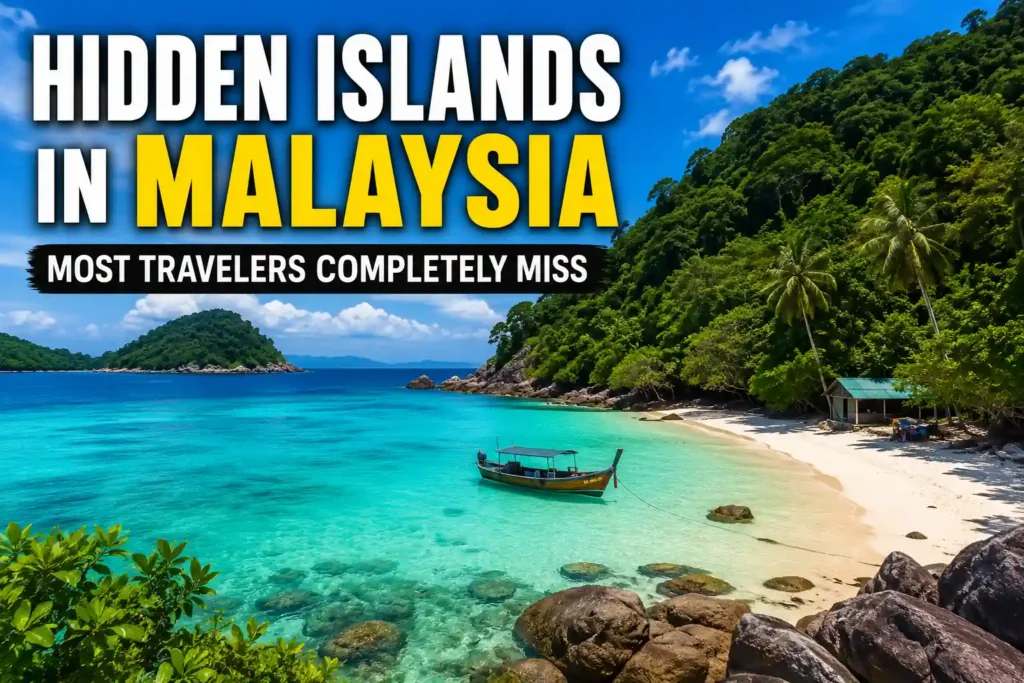
Most travelers visiting Malaysia end up on the same crowded islands. But the places that actually stayed with me were the ones almost nobody talks about. Everyone keeps recommending Langkawi. Or Perhentian. And look, those places are genuinely nice. But the islands in Malaysia that haven’t made it onto every travel influencer’s feed? Those are completely different experiences. I’ve spent time on both sides, the famous beaches and the genuinely quiet ones, and the hidden islands in Malaysia consistently win.
From snorkeling with turtles to empty beaches and sunset views, this Pulau Kapas travel guide explains why the island still feels untouched.
Less noise, cheaper ferry tickets, and actual peace. This guide covers five of them. Real ferry prices, real overnight costs, honest information about facilities (or the lack of them), and which type of traveler each island actually suits.
Why Malaysia Still Has Islands That Feel Undiscovered
Malaysia has 878 islands, according to the Department of Survey and Mapping Malaysia (JUPEM). Most tourists concentrate on about six or seven of them. That leaves a lot of coastline nobody’s fighting over.
Part of it is access. Getting to the lesser-known islands usually requires more effort, longer boat rides, connecting journeys, or simply knowing they exist. The Department of Marine Park Malaysia (DMPM) manages 42 designated marine parks across the country, and several of the quietest islands sit within these protected zones. Fewer resorts allowed means fewer people, which is exactly the point.
The other reason is timing. Tourism Malaysia, the national tourism authority under the Ministry of Tourism, Arts and Culture (MOTAC), reported over 26 million international arrivals before the pandemic. A meaningful portion of those visitors stayed concentrated in Kuala Lumpur, Penang, and the big-name islands. The quieter ones simply didn’t get the traffic, and a lot of them still haven’t.
Which Hidden Islands in Malaysia Are Worth Visiting in 2026?
The five best options right now are Pulau Rawa (Johor), Pulau Kapas (Terengganu), Pulau Gemia (Terengganu), Pulau Tengah (Johor), and Pulau Mantanani (Sabah). Budget travelers can manage from as little as RM 80 per night. Divers should head to Mantanani for visibility that sometimes reaches 20 to 30 meters. All five are still largely crowd-free in 2026.
Hidden Islands in Malaysia: Quick Comparison
| Island | State | Best For | Budget/Night (RM) | Crowd Level |
| Pulau Rawa | Johor | Snorkeling, relaxation | RM 200–450 | Very low |
| Pulau Kapas | Terengganu | Budget travel, snorkeling | RM 80–250 | Low to moderate |
| Pulau Gemia | Terengganu | Peace, sea turtles | RM 300–600 | Very low |
| Pulau Tengah | Johor | Diving, privacy | RM 600–900 | Extremely low |
| Pulau Mantanani | Sabah | Diving, dugong sightings | RM 150–350 | Low |
Not sure which island fits your travel style best?
• Want the cheapest beachfront escape? → Pulau Kapas
• Looking for luxury + privacy? → Pulau Tengah
• Best snorkeling without crowds? → Pulau Rawa
• Diving + marine life? → Pulau Mantanani
The biggest mistake travelers make is choosing the most famous island instead of the right one.
Pulau Rawa: The Tiny Island With Water You Won’t Believe Is Real

Pulau Rawa sits about 16 kilometers off the coast of Mersing in Johor. The ferry takes roughly 45 minutes and costs around RM 45 to 60 return, depending on the operator. It’s a small island, barely 1.5 kilometers across, but the water around it is some of the clearest I’ve personally encountered anywhere in Southeast Asia.
The Johor State Parks Corporation oversees environmental management in the surrounding area, which helps explain why the reefs here are in decent shape. Reef Check Malaysia, which conducts annual coral health surveys across Malaysian waters, has recorded relatively stable coral cover in the Mersing archipelago compared to heavily trafficked areas like Redang.
What’s Actually There
Accommodation runs from simple chalets to a reasonably good beach resort. Rawa Island Resort charges roughly RM 380 to 450 per night for a sea-facing chalet with breakfast included. Snorkeling gear rental is available on-site for around RM 20 per set. The island has no ATM and limited phone signal, so come prepared with cash.
The snorkeling is genuinely good. The marine park designation under the Sultan Abu Bakar Marine Park, one of Malaysia’s gazetted marine protected areas, limits fishing and development, which keeps the fish population healthy. You’ll see reef fish, the occasional blacktip reef shark passing in the distance, and solid coral formations on the sheltered northern side.
Which Hidden Island in Malaysia Should You Pick?
Choose Pulau Kapas for budget travel (RM 80–200/night). Choose Pulau Rawa for a comfortable mid-range stay with excellent snorkeling. Choose Pulau Mantanani for world-class diving and dugong sightings. Choose Pulau Gemia for sea turtles and near-total silence. Choose Pulau Tengah for complete privacy and a premium experience. All five count as genuinely hidden islands in Malaysia; none of them will feel overhyped.
Where to Stay on Malaysia’s Hidden Islands
Choosing the right island matters more than choosing the most famous one.
- Budget travelers: Pulau Kapas offers the best value with beachfront stays from RM 80–150 and great snorkeling straight from shore.
- Couples & honeymoon trips: Pulau Gemia and Pulau Tengah feel quieter, more private, and far less crowded than mainstream resorts.
- Divers: Pulau Mantanani is the strongest choice for dive packages and marine life encounters, including dugong sightings.
- Comfort + snorkeling: Pulau Rawa balances good facilities with some of the clearest water in Malaysia.
One important tip: book accommodation early during Malaysian school holidays and long weekends. These islands stay peaceful partly because room availability is very limited, and the best stays sell out surprisingly fast.
Pulau Kapas: What Bali Used to Look Like Before Instagram Found It

If Rawa feels polished and comfortable, Kapas feels slower, simpler, and far more backpacker-friendly. This one’s on the Terengganu coast, about 6 kilometers from the jetty in Marang. The ferry ride is short, around 15 to 20 minutes, and costs roughly RM 35 return. That’s one of the cheapest access points to any of Malaysia’s secret islands.
Wondering when Pulau Kapas looks its best? These are the months with clear water, sunny weather, and ideal snorkeling conditions.
The Terengganu State Tourism Department includes Pulau Kapas in its marine park circuit alongside the more famous Redang and Lang Tengah. But Kapas gets a fraction of the visitors. On a weekday in May, you can genuinely have a stretch of beach entirely to yourself.
Staying There Without Spending Much
Guesthouses and simple chalets run from RM 80 to 200 per night. Kapas Island Resort and Mak Cik Gemuk Beach Resort are the two most established options, both with PADI-certified dive operations on-site. Budget-conscious solo travelers can manage comfortably for RM 100 or less per night here.
There’s no nightlife. There’s barely mobile reception. The snorkeling around the rocky outcrops on either end of the beach is excellent, and the dive sites nearby are managed by local operators affiliated with GreenFins Malaysia, which promotes environmentally responsible diving practices across the region. The coral gardens in particular are worth at least two or three dives.
Estimated Cost for a 2-Night Island Stay (Per Person)
| Expense | Pulau Kapas (Budget) | Pulau Rawa (Mid) | Pulau Mantanani (Mid) |
| Ferry return | RM 35 | RM 55 | RM 60–80 |
| Accommodation (2 nights) | RM 180 | RM 820 | RM 400 |
| Meals (3x daily) | RM 90 | RM 150 | RM 130 |
| Snorkeling/diving | RM 40 | RM 20 | RM 180 (2 dives) |
| Total approx. | RM 345 | RM 1,045 | RM 770 |
When Is the Best Time to Visit These Islands?
For Johor islands (Rawa, Tengah), visit between February and November. For the Terengganu islands (Kapas, Gemia), May to September is the open season; they close fully from November through February due to the northeast monsoon. Sabah’s Mantanani is accessible year-round, with March to October offering the calmest seas and best underwater visibility, sometimes reaching 20 to 30 meters.
Pulau Gemia: Small, Quiet, and Honestly Almost Too Peaceful

But for travelers who want even fewer people around, there’s an island sitting quietly just beside Kapas that most tourists never notice. Gemia is tiny. It sits about 1 kilometer from Pulau Kapas, and most people visiting Kapas don’t even realize it’s there. That’s what makes it special.
The island has essentially one resort: Gem Island Resort & Spa, which manages the accommodation and coordinates environmental protection with the Fisheries Department of Malaysia. Sea turtle nesting programs operate here under the guidance of the Malaysian Fisheries Development Authority (LKIM), and guests can sometimes observe nest monitoring during nesting season, which is something genuinely rare to witness.
Rooms start around RM 320 per night. That’s not cheap. But you’re paying for something money usually can’t buy in Malaysia anymore: complete silence, a beach with fewer than 20 people on it, and an underwater ecosystem that WWF-Malaysia has noted as one of the more intact coastal habitats in Terengganu. If you want genuine quiet, Gemia delivers it without compromise.
Pulau Mantanani: Sabah’s Best-Kept Secret

The islands on Peninsular Malaysia’s east coast are beautiful, but Sabah offers a completely different kind of marine experience. Mantanani sits about 35 kilometers northwest of Kota Belud in Sabah.
The nearest major airport is Kota Kinabalu International Airport, managed by Malaysia Airports Holdings Berhad (MAHB), which connects to all major Malaysian cities and several international routes. From KK, you take a 45-minute van transfer to Kota Belud, then a 40-minute speedboat to the island.
It’s a bit of a journey. That’s exactly why it stays quiet.
What Makes Mantanani Different From Every Other Island
The underwater visibility here is extraordinary. The Sabah Tourism Board, the state’s official tourism authority, has specifically promoted Mantanani for its dugong sightings, large marine mammals related to manatees, classified as vulnerable on the IUCN Red List of Threatened Species. Sightings aren’t guaranteed, but Mantanani is one of only a handful of places in Malaysia where they still occur with any regularity.
PADI-certified dive operators on the island run two-dive packages starting around RM 180 to 220 per person. The Marine Research Institute Malaysia (MRIMI) has documented high fish species diversity around Mantanani, with over 200 species recorded in the surrounding reef systems. Guesthouses here are basic but clean, running RM 150 to 350 per night with meals sometimes included.
Best Season for Each Island
| Island | Open Season | Avoid | Notes |
| Pulau Rawa | Feb – Nov | Dec – Jan | The northeast monsoon affects access |
| Pulau Kapas | May – Sep | Nov – Feb | Fully closed off-season |
| Pulau Gemia | May – Sep | Nov – Feb | Same monsoon pattern |
| Pulau Tengah | Mar – Nov | Dec – Feb | Confirm with the resort directly |
| Pulau Mantanani | Year-round | Heavy rain Oct | Sabah monsoon differs from the Peninsula monsoon |
Quick tip before booking ferries:
Weather matters more than price on these islands. Monsoon closures in Terengganu are strict, and boats often stop operating completely between November and February.
Pulau Tengah: Malaysia Before Tourism Got There First
And if even Mantanani feels slightly adventurous, Pulau Tengah moves in the opposite direction entirely: quiet luxury and total privacy. This one’s back in Johor, about 10 kilometers from Mersing. It’s close to Rawa geographically, but a completely different atmosphere. Tengah is one of those rare islands where you might genuinely be one of only 20 or 30 guests on the entire island at any given time.
There’s one resort operating here, Japamala Resort, which positions itself at the higher end of the market, from RM 600 to RM 900 per night for a treehouse or sea-villa stay. The pricing filters the crowd naturally.
The resort operates within the sustainable tourism framework published by Tourism Malaysia’s Eco-Tourism division, with a strong focus on low-impact hosting. Diving and snorkeling here benefit from the same Sultan Abu Bakar Marine Park protection that makes Rawa so good underwater.
Do You Need a Special Permit to Visit These Islands?
No prior permit is needed for recreational visitors. Most of these islands fall within marine parks managed by the Department of Marine Parks Malaysia, and a conservation fee of RM 5 to RM 30 per person is collected at the jetty or on arrival. Dive operators handle park compliance for all underwater activities.
Things Nobody Actually Tells You Before Visiting These Islands
As beautiful as these islands are, there are a few practical realities most travel blogs barely mention.
- Cash is essential. Most of these islands have no ATMs. Some don’t even have card machines at the resort. Bring enough ringgit for your entire stay.
- Facilities are minimal. Medical help is not nearby. The nearest clinics are on the mainland, 30 to 45 minutes away by boat. A basic first aid kit is worth packing.
- Signal is unreliable. Celcom and Maxis have the best rural coverage in Malaysia according to the Malaysian Communications and Multimedia Commission (MCMC), but even those networks are patchy on smaller islands.
- Water sports aren’t always available. Several of these islands sit within marine park boundaries that prohibit motorized water sports. Check before expecting jet skis or banana boats.
- Monsoon closures are real. Several Terengganu islands are officially closed from November to February. Showing up without checking is an expensive mistake.
Are Malaysia’s Hidden Islands Expensive or Affordable?
It depends entirely on which island. Pulau Kapas is genuinely budget-friendly; RM 100 to 200 per night covers a decent stay. Pulau Tengah sits at the premium end at RM 600 to 900 per night. Mantanani and Rawa fall comfortably in the mid-range. Compared to similar islands in Thailand or the Philippines, most of these are noticeably more affordable for what you get.
Facilities Available on Each Island
Facilities vary more than most travelers expect, especially once you leave the better-known tourist islands.
| Island | Restaurant | Wi-Fi | ATM | Medical | PADI Dive Shop |
| Pulau Rawa | Yes (resort) | Limited | No | No | Yes |
| Pulau Kapas | Basic warungs | No | No | No | Yes |
| Pulau Gemia | Yes (resort) | Limited | No | No | Yes |
| Pulau Tengah | Yes (resort) | Yes | No | No | Yes |
| Pulau Mantanani | Basic meals | No | No | No | Yes |
Is It Worth Skipping Langkawi for These Islands?
If crowd-free beaches and intact marine life matter to you, then yes. Langkawi has improved infrastructure, but the beach experience on islands like Rawa, Mantanani, or Gemia is significantly less commercial. For first-time visitors to Malaysia who want a taste of everything, Langkawi makes sense. For anyone returning, these off-the-radar islands in Malaysia are the better choice.
Why I’d Choose These Hidden Islands Over Langkawi Any Day
After visiting both the famous Malaysian islands and these quieter alternatives, the difference honestly becomes hard to ignore. Not every trip to Malaysia needs to revolve around crowded beaches, overpriced resorts, or islands that feel more commercial than relaxing. Sometimes the places you remember most are the quieter ones, the islands where the water still looks untouched, sunsets feel slower, and you can actually hear the waves without beach clubs blasting music nearby.
That’s exactly what these hidden islands in Malaysia still offer in 2025.
Whether you end up snorkeling around Pulau Rawa, spending lazy afternoons on Kapas, spotting dugongs near Mantanani, or simply disconnecting completely on Gemia, these islands give you something that’s becoming harder to find across Southeast Asia: space, silence, and a travel experience that still feels genuine.
I still remember sitting near the shore on Pulau Kapas just before sunset, watching local fishermen pull their boats in while the entire beach stayed almost completely quiet. No crowds, no tour groups, no noise, just sea breeze and waves. Honestly, it reminded me why slower travel often becomes the most unforgettable kind.
They’re not luxury-perfect, and that’s part of the appeal. Wi-Fi disappears, boat schedules depend on the weather, and some islands barely have phone signal at all. But if you’re looking for crystal-clear water, fewer tourists, better snorkeling, and islands that still feel peaceful instead of overdeveloped, these hidden islands in Malaysia are absolutely worth choosing over the usual tourist hotspots.
And if you’re planning a Malaysia island trip in 2026, I’d genuinely recommend visiting these quieter islands before the rest of the world catches on.
Frequently Asked Questions
Q1: Are these hidden islands safe for solo travelers?
Yes, all five are safe for solo travelers. The main practical concern is medical access; no hospitals exist on any of these islands, and evacuation to the mainland takes 30 to 60 minutes by boat. Carry basic medications and make sure you have travel insurance before you go.
Q2: How do I get to Pulau Mantanani from Kuala Lumpur?
Fly from KL to Kota Kinabalu, roughly 2.5 hours, starting from RM 80 one way on AirAsia or Malaysia Airlines. Then take a van transfer to Kota Belud (about 45 minutes) and a speedboat to the island (around 40 minutes). The total journey from Kota Kinabalu is approximately two hours.
Q3: Can I visit these islands as a day trip?
Pulau Kapas and Pulau Rawa are feasible as day trips from the nearest mainland town. Mantanani and Gemia are far better as overnight stays, given the travel time involved. Pulau Tengah’s resort doesn’t accommodate day visitors.
Q4: Is snorkeling good for non-swimmers?
Basic swimming ability and comfort in open water are needed for snorkeling. Pulau Rawa’s sheltered lagoon is the most forgiving option for nervous swimmers. Always wear a life jacket if you’re uncertain, and check current conditions with the operator before entering the water.
Q5: Do these islands get crowded during Malaysian public holidays?
Yes, noticeably. Hari Raya, Chinese New Year, and school holidays push visitor numbers up even on smaller islands. If avoiding crowds is the main goal, plan your trip around these periods or book well in advance to secure limited accommodation.
Q6: Are Malaysian hidden islands family-friendly?
Pulau Rawa and Pulau Kapas work well for families with older children. Limited facilities, no medical staff on-site, and the lack of playgrounds or shade structures make them less ideal for toddlers or infants. Pulau Tengah’s resort environment is calmer and suits quiet family groups or couples.